Graphene far-infrared at 9.4 micrometers does not heat the body the way a heating pad does. It transmits at the precise frequency where cellular water resonates — like one tuning fork answering another. This sub-hub explores the biophysics of precision frequency, brainwave modulation, and the science of resonance.
Quick Answer
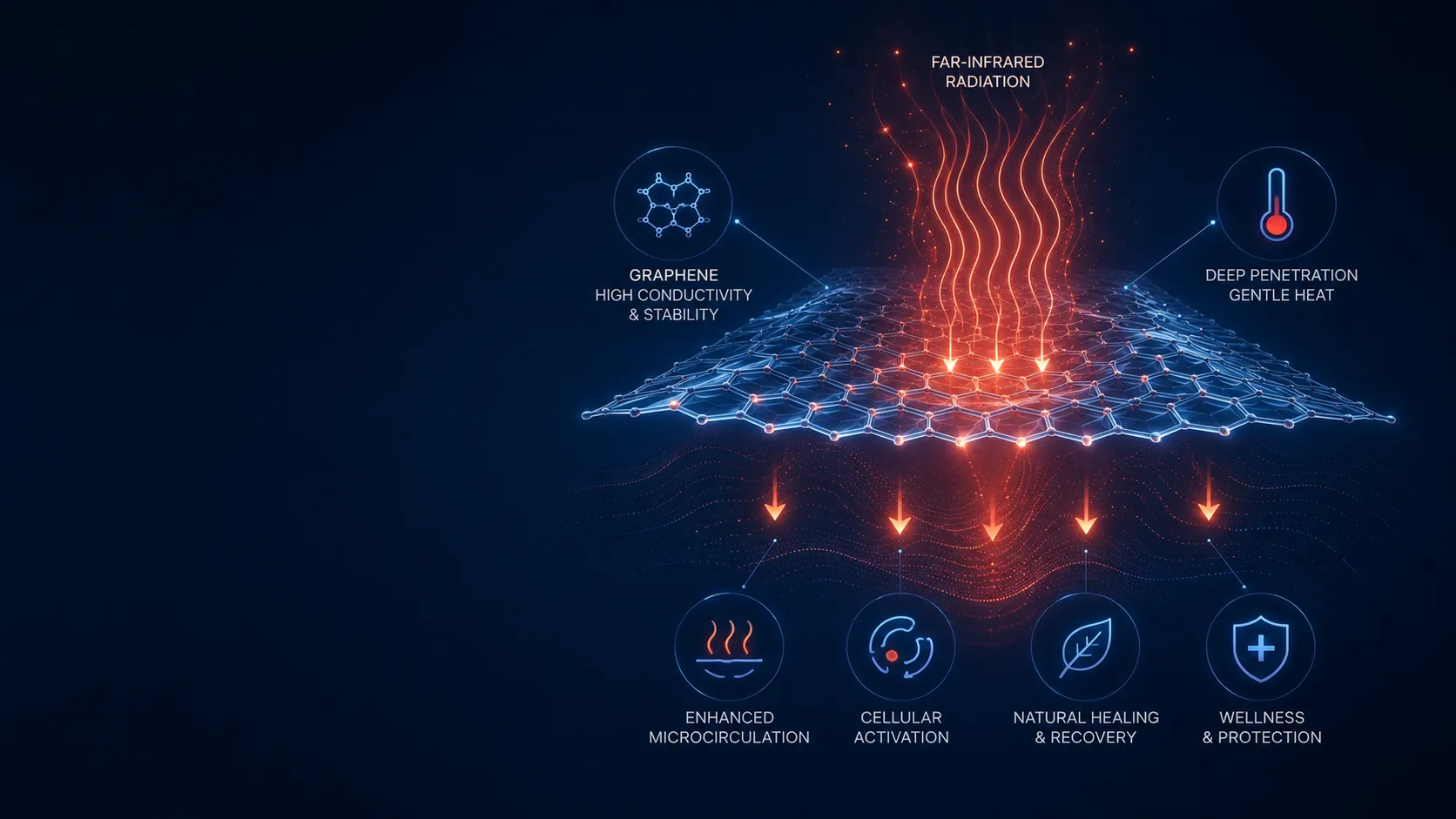
Biological frequency resonance is the principle that water molecules in the body naturally vibrate at specific frequencies. Graphene far-infrared at 9.4μm matches the hydrogen-bond vibration frequency of water — enabling energy transfer that is not thermal (heating) but resonant (frequency-matching). This is the same principle that makes a tuning fork vibrate when exposed to its matching pitch. At the cellular level, this resonance supports microcirculation, mitochondrial efficiency, and neural regulation.
Why This Matters
Most heating technologies deliver indiscriminate thermal energy. Graphene FIR delivers energy at a specific biological frequency — where the body already knows how to receive it. This is the difference between heating and signaling.
Why 9.4 micrometers matters: the intersection of physics, biology, and resonance. How nature chose this frequency — and how graphene reproduces it.
Effortless action at the molecular level: a philosophical exploration of biological harmony — resonance as the body's natural operating principle.
EEG-confirmed: graphene far-infrared increased Alpha waves 2.3–2.9x and Theta waves 3.0–4.1x in human subjects. Published in Small Science.
Frequency & Resonance is the conceptual core of graphene far-infrared science. It explores the biophysical principle that makes graphene different from conventional heating: precision frequency matching. This is where brand philosophy ("We do not manufacture heat. We calibrate frequency.") meets published research.