It's Not Just the Band.
It's the Resonance.
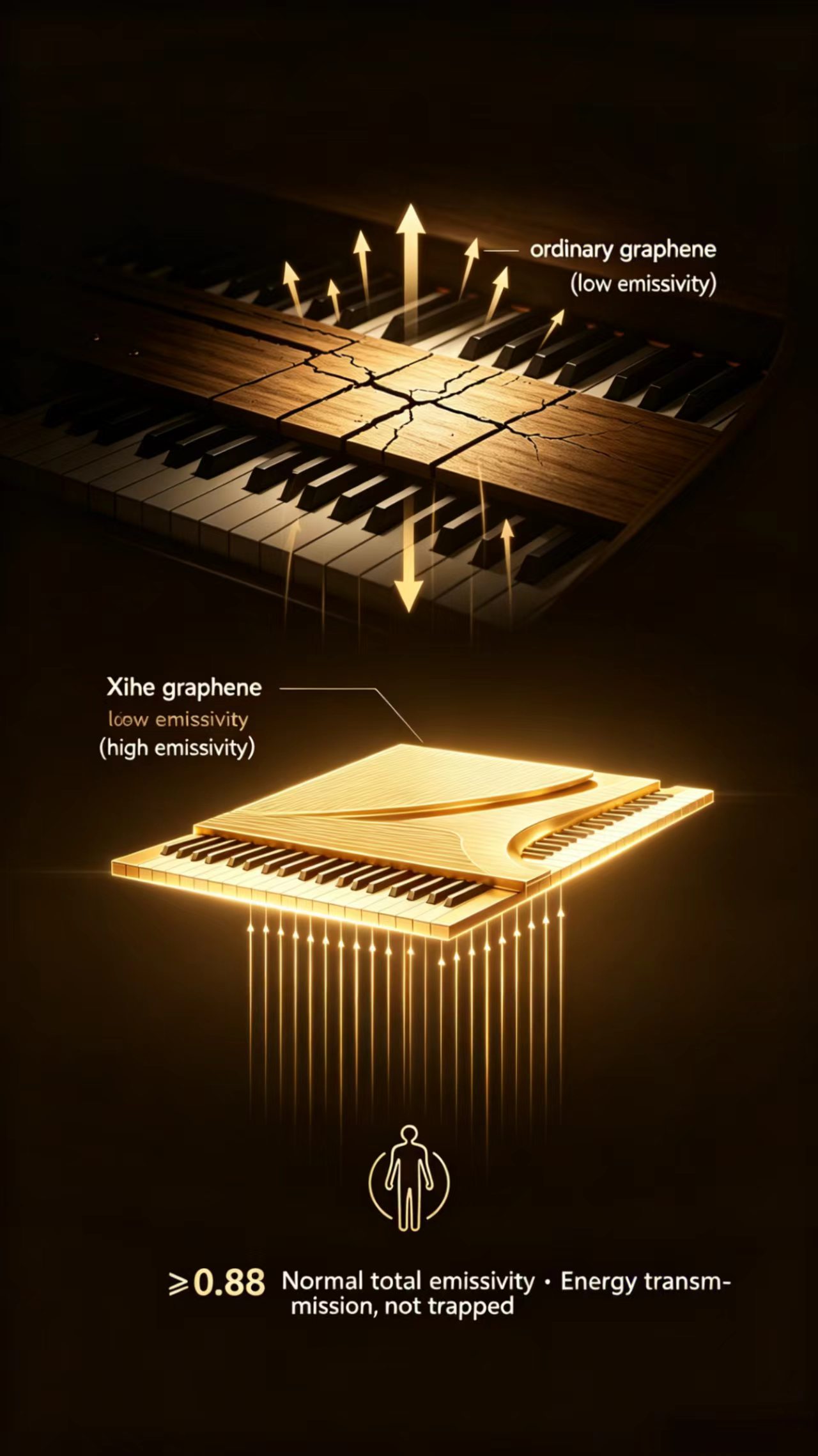
Every graphene product claims the 5–15μm far-infrared band. That's like saying a piano has 88 keys — it's not a differentiator. It's a baseline.
The real question is: how good is the soundboard?
Most graphene heating films have low spectral emissivity — like a cracked soundboard. You strike the key, but the energy stays trapped as surface heat. XIHE's proprietary integrated matrix engineering achieves ≥0.88 emissivity (peak 0.95) — we strike the same 9.4μm note, but our energy is transmitted, not trapped.
"It's the difference between a piano that plays to itself, and a piano that plays to you."
Precise Thermal Stability
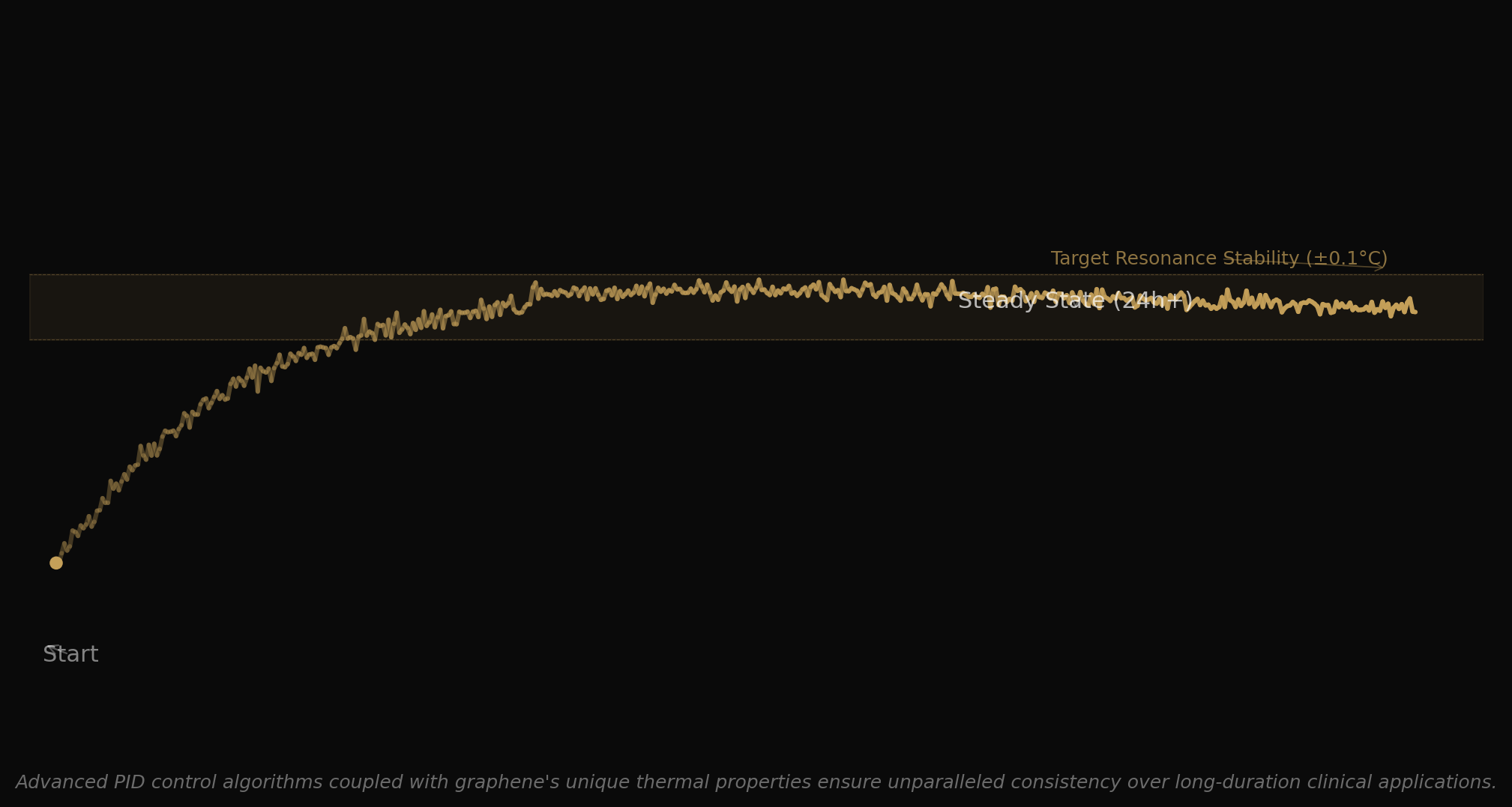
Advanced PID control algorithms coupled with graphene's unique thermal properties ensure unparalleled consistency over long-duration professional applications.
Safety & Trust
The Science of Safety
Why XIHE Is Engineered to a Medical Standard
At XIHE, safety is not an afterthought. It is a design principle. Every graphene far-infrared module is engineered to a medical standard of spectral precision, thermal stability, electromagnetic safety, and manufacturing consistency. Our approach is guided by measurable performance, independent testing, and scientific validation — not marketing claims.
Non-Ionizing Far-Infrared
XIHE emits non-ionizing far-infrared radiation within the 5–15 μm spectral window, including a peak near 9.4 μm. Unlike ionizing radiation such as X-rays or ultraviolet light, far-infrared radiation does not carry sufficient energy to damage DNA or cellular structures. This wavelength range has been widely studied for its interaction with biological tissues and is associated with the body's natural thermal emission spectrum.
Certified by the National Infrared Center.
Near-Zero Electromagnetic Exposure
Safety extends beyond wavelength. Independent testing demonstrates electromagnetic field levels as low as 0.08 μT during operation — significantly lower than many common household appliances.
| XIHE Graphene Module | 0.08 μT |
| Hair Dryer | ~10 μT |
| Induction Cooker | ~20 μT |
No ultraviolet radiation. No microwave radiation. No combustion by-products.
40+ Core Patents
XIHE's technology platform is supported by more than 40 core patents covering graphene electrothermal films, far-infrared emission systems, and spectral engineering technologies. The company also serves as a Lead Drafting Unit for China's graphene electrothermal industry standard, reflecting active participation in establishing technical benchmarks for the industry. This is not a marketing designation — it is a recognized technical role within the standards-development process.
Independently Tested and Certified
Every XIHE module undergoes independent performance evaluation by the National Infrared and Industrial Electric Heating Product Quality Inspection and Testing Center. Testing includes far-infrared emission performance, spectral characteristics, electrical safety, electromagnetic compatibility, and product reliability and quality compliance. Because meaningful innovation requires independent verification.
What We Mean by "Engineered to a Medical Standard"
At XIHE, this phrase describes how the technology is designed — not a regulatory product classification.
It reflects our commitment to:
- Spectral precision
- High-emissivity far-infrared engineering
- Thermal consistency and stability
- Evidence-based product development
- Rigorous quality control
Every design decision begins with the same question: How can energy be delivered more precisely, more efficiently, and more safely?
Because trust should be measured, not claimed.
The Difference
Graphene vs. Conventional Heating:
Quantifying the Difference — 7 Parameters Compared
Electrothermal Conversion Efficiency
Data: National Infrared and Industrial Electro-thermal Product Quality Inspection and Testing Center (Wuhan)
Mechanism of Action — Penetration Depth
Conventional Thermal Conduction
Surface-level heating only. Energy dissipates as superficial warmth — no cellular engagement.
XIHE Molecular Resonance
Deep-tissue far-infrared resonance penetrates 3–5cm — activating cellular ATP synthesis and microcirculation.
Mechanism
Efficiency
Emissivity
Penetration
Stability
EMF Safety
Data sourced from National Infrared Center test reports and independent third-party validation.
See How XIHE Resonance
Is Applied Across Products
From full-body photon chambers to portable wearables — explore the complete range of XIHE graphene resonance devices engineered for professional and wellness applications.
Browse XIHE Product Line →Why We Answer Directly
XIHE's technology is built on verified science, not marketing claims. Every question below is answered with data from our National Infrared Center certifications, 18 SCI-indexed publications, and 40+ core patents. No ambiguity — only evidence.
◆Is graphene heating safe? Does it emit harmful radiation?
XIHE technology emits non-ionizing far-infrared radiation within a wavelength range associated with natural human thermal emission. Unlike ionizing radiation such as X-rays or gamma rays, far-infrared radiation does not have sufficient energy to damage DNA or cellular structures. Independent testing confirms extremely low electromagnetic field levels (0.08 μT), with no ultraviolet or microwave radiation generated during operation. XIHE modules are certified by the National Infrared Center.
◆Is graphene heating just a marketing buzzword?
Graphene heating is not a marketing buzzword when engineered properly. Unlike conventional metal-wire heaters that produce uneven hot spots and inefficient far-infrared output, XIHE's graphene heating module achieves 99.8% electrothermal conversion efficiency with uniform heat distribution across the entire surface. The key difference: conventional heaters primarily warm the air (convection), while XIHE's graphene is designed to deliver far-infrared energy that interacts with biological tissues through radiative transfer and thermal-biological mechanisms — validated by 40+ patents and national industry standards.
◆What are the documented physiological effects of 9.4μm far-infrared resonance?
Published research on XIHE's 9.4μm far-infrared platform has observed: α-wave amplification ×2.3 (relaxation support), deep sleep increase of 27% (research conducted with Xiamen Mental Health Institute), studies suggest modulation of mitochondrial activity and ATP-related metabolic pathways, microcirculation improvement, and measurable comfort improvement in rehabilitation settings — supported by 18 SCI-indexed publications.
◆What do we mean by medical-standard graphene engineering?
At XIHE, medical-standard graphene engineering refers to a design philosophy focused on spectral precision, energy efficiency, thermal stability, and manufacturing consistency. Key parameters include: Spectral emissivity ≥0.88, Electrothermal conversion efficiency ≥99%, and controlled FIR emission profile in the 5–15μm band. This is a framework defined by XIHE's engineering standards and third-party certifications — not a universal regulatory classification.
◆How does XIHE's technology differ from standard graphene heating films?
Standard graphene heating films suffer from low emissivity (0.75-0.85), behaving like an instrument with a poor soundboard: energy is generated, but much of it never reaches the intended destination. XIHE's Integrated Matrix Engineering achieves ≥0.88 normal spectral emissivity (peak 0.95), enabling more energy to be emitted as useful far-infrared radiation rather than retained within the material itself — a fundamentally different physical outcome.
◆What is 9.4μm biological resonance?
9.4μm lies within a far-infrared region that has been widely studied for its interaction with water-rich biological tissues. Research suggests that wavelengths within this range may support efficient energy transfer at the tissue level and contribute to measurable physiological responses. XIHE materials are engineered to maximize emission efficiency within this spectral window.
◆Why doesn't XIHE focus on temperature alone?
Temperature tells you how hot a surface becomes. Emissivity tells you how effectively energy is emitted. Two materials may operate at the same temperature while delivering very different far-infrared performance. For this reason, XIHE focuses not only on heat generation, but on spectral emissivity, wavelength control, and energy transmission efficiency. In far-infrared engineering, the quality of the energy matters as much as the quantity.