Recovery Science

Beyond Thermal Comfort

Macrophage polarization, inflammation signaling, and what biological recovery actually means

Quick Answer

Recovery is not about warmth. It is about what happens at the cellular level when inflammation resolves. Writing in the International Journal of Molecular Sciences (March 2026), researchers at Xiamen University's Jiageng Innovation Laboratory (IKKEM) reported that graphene-based far-infrared application shifts macrophages from the M1 state — which drives inflammation — toward the M2 state — which coordinates tissue repair. This is a mechanism-level finding, not a clinical claim. But it reframes the entire conversation: from "does it feel warm?" to "does it support the biological conditions that enable recovery?"

Source: Graphene Far-Infrared Therapy Enhances Diabetic Wound Healing — IJMS, March 2026. DOI: 10.3390/ijms27073101. Preclinical animal model. Findings not validated in human trials.

When we started XIHE, one question kept coming back:

How do we move beyond "thermal comfort" and think more seriously about the biological recovery environment?

Most recovery technologies — heating pads, saunas, hot packs — produce warmth. They dilate blood vessels near the skin. You feel warmer. Circulation improves temporarily. These are thermal effects. They are real. They are also, in a fundamental sense, superficial.

The question we kept asking was different. Could certain wavelengths of energy — specifically, far-infrared in the 9.4 μm range — do something at the cellular level that warmth alone cannot? Could they engage biological signaling pathways that influence how inflammation resolves, how tissues repair, and how recovery actually works?

What Makes This Study Meaningful

Writing in the International Journal of Molecular Sciences (IJMS, March 2026), researchers at Xiamen University's Jiageng Innovation Laboratory — the research institution behind XIHE's technology platform — published a preclinical investigation into how graphene-based far-infrared application influences the wound-healing microenvironment.

What makes this study meaningful to us is that it helps clarify a possible mechanism behind that founding question — especially around inflammation signaling and the transition from M1 to M2 macrophage activity in the recovery window.

2026 · Preclinical Animal Model

International Journal of Molecular Sciences · DOI: 10.3390/ijms27073101 · Xiamen University (IKKEM)

Using an STZ-induced diabetic rat model — a compromised metabolic system where wound healing is impaired — the research team applied graphene-based far-infrared and measured multiple cellular and molecular parameters over 14 days.

83.9% Wound Closure (14-Day, FIR Group)
66.8% Wound Closure (14-Day, Control)
M1 → M2 Macrophage Polarization Shift

These are preclinical findings from an animal model. They describe cellular and molecular observations, not clinical outcomes in humans.

Three Biological Pathways — Not One Thermal Effect

The study identified three interconnected mechanisms through which far-infrared appears to influence the recovery environment. None of them are about heat. All of them are about biology.

1. Macrophage Polarization: M1 → M2 Shift

Macrophages are the immune system's site managers. In the early phase of injury or tissue stress, they adopt an M1 phenotype — pro-inflammatory, aggressive, clearing debris and fighting potential pathogens. This is necessary. Recovery cannot begin without it.

But recovery also requires a transition. Macrophages must shift to an M2 phenotype — anti-inflammatory, pro-repair, coordinating the rebuilding of tissue. When this transition happens efficiently, inflammation resolves and healing proceeds. When it stalls, the system remains in a chronic inflammatory state.

Writing in IJMS, the IKKEM team reported that graphene far-infrared application was associated with a measurable shift from M1 toward M2 macrophage activity in the wound microenvironment. This is not thermal. It is immunological.
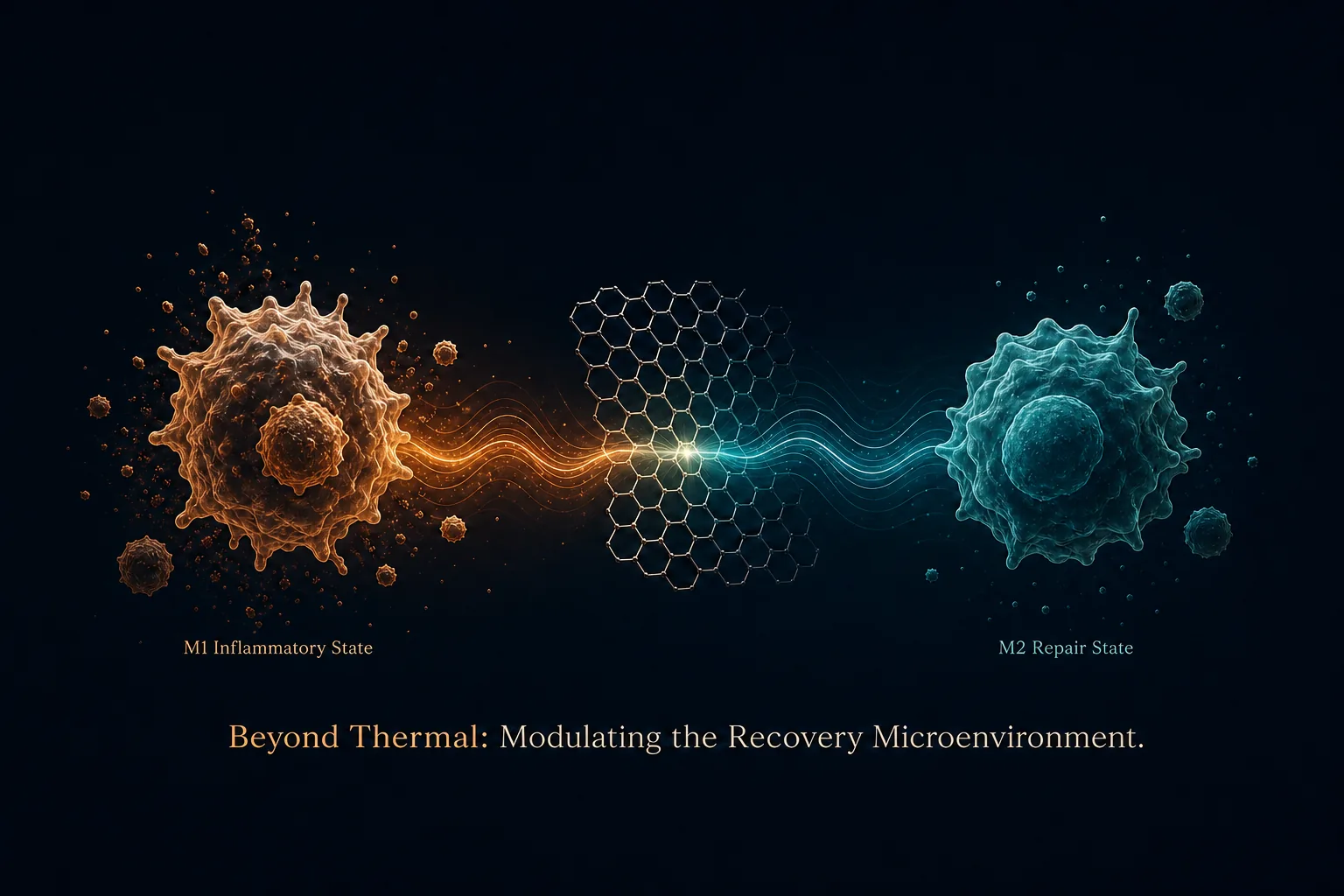
M1 to M2 macrophage polarization under graphene far-infrared: pro-inflammatory M1 macrophages shift toward pro-repair M2 macrophages, supported by 9.4μm FIR in the recovery microenvironment
M1 (pro-inflammatory) → M2 (pro-repair) macrophage polarization in the recovery microenvironment. Source: Adapted from IJMS 2026 research data. XIHE Technology.
M1 Macrophages Inflammatory, debris-clearing, release TNF-α and IL-1β
M2 Macrophages Anti-inflammatory, pro-repair, coordinate tissue remodeling
FIR Effect (Preclinical) Shift from M1 toward M2 activity in the wound microenvironment

2. Cytokine and Chemokine Suppression

The study reported reduced expression of TNF-α and IL-1β — two of the most well-characterized pro-inflammatory cytokines. It also documented suppression of Cxcl2 and Cxcl3 chemokines, which typically recruit inflammatory cells to the site of injury.

The functional meaning: in the preclinical model, FIR application was associated with reduced pro-inflammatory signaling at the tissue level. This is the molecular equivalent of "cooling the inflammatory response" — not with ice, but by modulating the signaling molecules that sustain it.

3. Oxidative Stress Reduction

The study reported decreased levels of reactive oxygen species (ROS) in the FIR-treated group, along with suppression of NF-κB — a transcription factor that acts as a master switch for inflammatory gene expression.

ROS are not inherently harmful — they serve signaling functions — but when they accumulate due to metabolic stress, they contribute to a cycle of oxidative damage and persistent inflammation. The observation that FIR reduced both ROS levels and NF-κB activation suggests a mechanism that addresses inflammation at its signaling source, not just its surface symptoms.

What This Tells Us — and What It Doesn't

This is a preclinical study in an animal model. It does not prove that far-infrared accelerates wound healing in humans. It does not guarantee any clinical outcome. It does not replace human randomized controlled trials.

What it does provide is a mechanism-level rationale. It identifies specific biological pathways — macrophage polarization, cytokine suppression, oxidative stress reduction — that far-infrared appears to engage. It gives us a scientific vocabulary for describing why recovery might be supported, not just that it "feels good."

This distinction matters. Thermal comfort is subjective. Biological mechanism is testable. One belongs in a spa brochure. The other belongs in a research conversation.

Where Recovery Becomes a Systems Question

The traditional recovery narrative goes like this: apply heat, blood vessels open, things feel better. This is not wrong. But it is incomplete.

The research emerging from IKKEM and published in IJMS points toward a more nuanced picture. Recovery is not a single event. It is a sequence of biological processes — inflammatory initiation, macrophage transition, cytokine regulation, tissue remodeling — each with its own timing, its own molecular signals, and its own energy requirements.

When you view recovery through this lens, the question changes. It is no longer "does this feel warm?" It becomes "does this create the biological conditions in which recovery processes can proceed efficiently?"

That is where recovery becomes more than warmth.
It becomes a systems question.

We do not manufacture heat. We calibrate frequency. And the evidence emerging from our research collaborators suggests that this distinction — between thermal sensation and biological signaling — may be the difference between a recovery technology that simply warms tissue and one that supports the cellular conditions for repair.

Questions About Macrophage Polarization & Recovery

What is the M1-to-M2 macrophage transition?

Macrophages adopt different functional states. M1 macrophages drive early inflammation — fighting pathogens and clearing debris by releasing TNF-α and IL-1β. M2 macrophages coordinate resolution and tissue repair. Successful recovery depends on the shift from M1 to M2 activity. When this transition stalls, as observed in chronic inflammatory conditions, macrophages remain in a pro-inflammatory state, continuously releasing cytokines that perpetuate the inflammatory environment.

Does far-infrared influence macrophage polarization?

Writing in the International Journal of Molecular Sciences (March 2026), researchers at Xiamen University's IKKEM laboratory reported that graphene-based far-infrared application shifted macrophages from M1 (pro-inflammatory) toward M2 (pro-repair) in a preclinical diabetic wound model. The study also documented reduced TNF-α and IL-1β expression, decreased oxidative stress markers, and suppression of NF-κB signaling. These are preclinical findings and do not constitute clinical proof in humans.

Why does recovery science look beyond thermal comfort?

Traditional thermal therapies produce localized vasodilation through surface heating — temporary warmth. The emerging question is whether specific wavelengths can engage cellular signaling pathways. Research published in IJMS suggests that graphene far-infrared at 9.4μm may influence macrophage polarization, cytokine regulation, and oxidative stress — mechanisms that operate at the cellular level, not the sensory level. This shifts the conversation from "does it feel warm?" to "does it support the biological conditions for recovery?"

Related Reading

Inflammation and Recovery Biology: Acute Response vs Chronic Dysfunction Nociceptive vs Neuropathic Pain Mechanisms Cellular Energy: ATP and the Foundation of Recovery Science Mitochondrial Function and Far-Infrared — Two Preclinical Studies Mitochondrial Function and Recovery Graphene FIR and Microcirculation How Far-Infrared Works: The Physics of Light and Skin Recovery Hub: Recovery Science Resources
Organizations exploring recovery environment technologies: Technology Platform · Clinical Evidence · OEM / ODM Partnership

First published on xgraphene.tech. This article discusses a preclinical study published in the International Journal of Molecular Sciences (March 2026, DOI: 10.3390/ijms27073101). The study was conducted in an animal model (STZ-induced diabetic rats). Findings have not been validated in human clinical trials. This article does not claim that far-infrared treats, cures, or heals any disease or condition. It describes mechanism-level observations for educational and scientific discussion purposes. XIHE products are wellness devices, not medical devices.