Case Studies / Engineering case study · livestock heating
Large-Area Graphene Heating Panel for Piglet Creep Heating
Engineering validation of temperature distribution across a 2.4 m² heating area.
Case Studies / Engineering case study · livestock heating
Engineering validation of temperature distribution across a 2.4 m² heating area.
Engineering case study / Overview
For livestock equipment manufacturers, a large heating surface presents an important engineering challenge: delivering adequate heat across the intended area while controlling temperature variation and total power input. This case study documents XIHE’s panel-level thermal assessment of a graphene heating panel designed for a piglet creep heating application. The evaluation covered a 2.4 m² test area, with temperature measurements taken at 240 points across the surface. The customer is not named in this record.
Panel-level thermal validation. Results do not establish finished-product certification, animal outcomes, or long-term field performance.
01 / Engineering challenge
In livestock heating applications, the total heating area is only one part of the engineering requirement. The distribution of temperature across that area also matters.
A temperature reading from a single point cannot show whether the rest of the surface reaches the intended temperature range. Localized hot spots, cooler edges, and uneven heat distribution may remain undetected without a defined measurement method.
For equipment manufacturers developing piglet creep heating systems, the heating panel must therefore be evaluated as a surface rather than as an isolated heating element.
The engineering questions
XIHE’s assessment focused on the measured thermal distribution across the test area, providing engineering evidence for evaluating a large-area heating panel.
02 / Test configuration
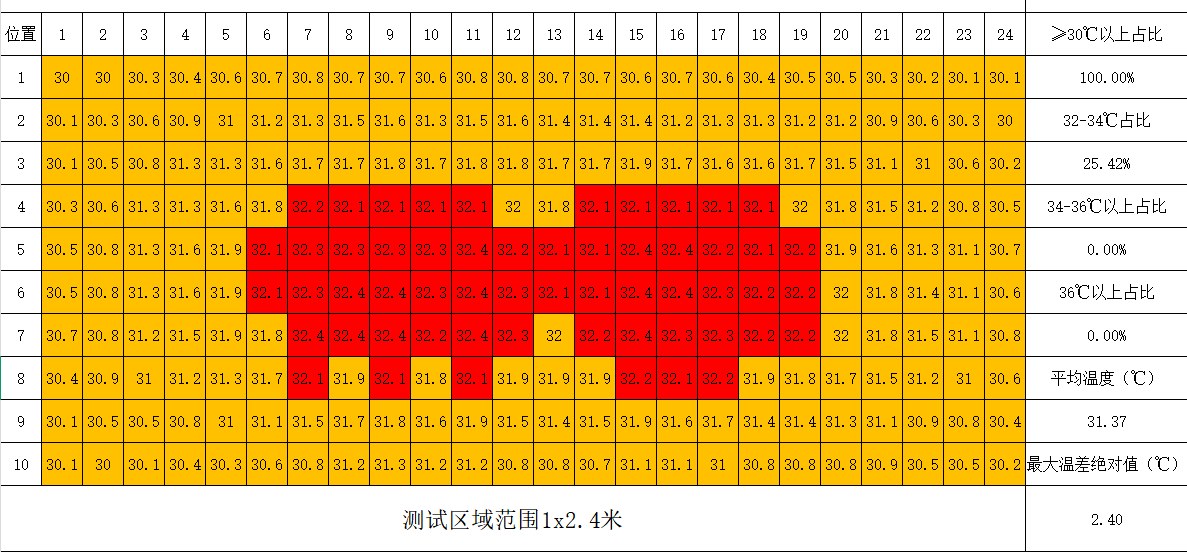
The reported test used a heating area measuring approximately 1.0 × 2.4 m, with 240 temperature measurement points distributed across the area.
The measurements were used to evaluate the temperature distribution across the tested surface rather than relying on a single central reading.
Reported test parameters
| Parameter | Reported value |
|---|---|
| Application | Piglet creep heating |
| Heating technology | Graphene heating panel |
| Test area | 1.0 × 2.4 m |
| Total measured area | 2.4 m² |
| Temperature measurement points | 240 |
| Total input power | 210 W |
| Average measured temperature | 31.37°C |
| Minimum measured temperature | At least 30°C at every reported measurement point |
| Maximum temperature spread | 2.40°C |
The available record does not specify all environmental conditions, stabilization time, sensor accuracy, or the exact measurement interval. These details should be added to the published test record if documented.
03 / Measured results
The reported measurements indicate that all 240 measurement points reached at least 30°C. The average measured temperature was 31.37°C, with a maximum temperature spread of 2.40°C across the tested area.
These figures provide a quantitative view of the panel’s temperature distribution under the reported test conditions.
All 240 reported measurement points reached at least 30°C. This provides evidence of temperature coverage across the defined measurement grid, rather than at a single selected location.
The reported average temperature was 31.37°C. The average helps characterize the overall thermal condition of the measured surface, but it should be considered alongside individual readings and the temperature spread.
The maximum measured temperature spread was 2.40°C. A small temperature spread can be a useful indicator of spatial uniformity within a defined test. The result should not, by itself, be interpreted as proof of temporal stability, finished-product safety, or performance under different environmental conditions.
The reported total input power was 210 W across the 2.4 m² test area, corresponding to a nominal input power density of approximately 87.5 W/m², calculated from the reported total power and test area. Actual power consumption and thermal performance may vary with the final panel design, electrical configuration, installation, control system, and operating environment.
04 / Engineering approach
For a large-area heating panel, engineering evaluation needs to account for the relationship between the heating circuit, panel geometry, measurement locations, and intended operating range. XIHE’s assessment illustrates three useful principles for OEM heating development.
Principle 01
The tested area and measurement grid should be established before interpreting the results. This makes it possible to identify what the reported figures represent and which areas have actually been evaluated.
Principle 02
Average temperature alone can conceal local differences. A defined measurement grid helps reveal the spread between warmer and cooler locations across the surface.
Principle 03
A heating panel is one component within a finished product. Installation, insulation, mounting, airflow, power supply, temperature controls, and protective devices can all affect the final thermal behavior. Panel-level validation is one stage in the engineering process — not a substitute for finished-system verification.
05 / Related engineering record
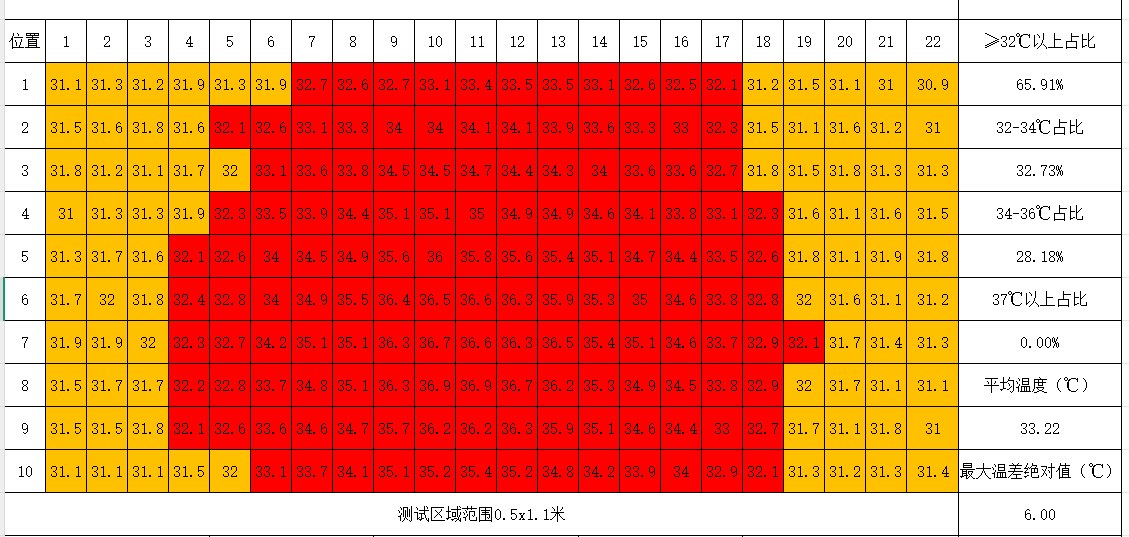
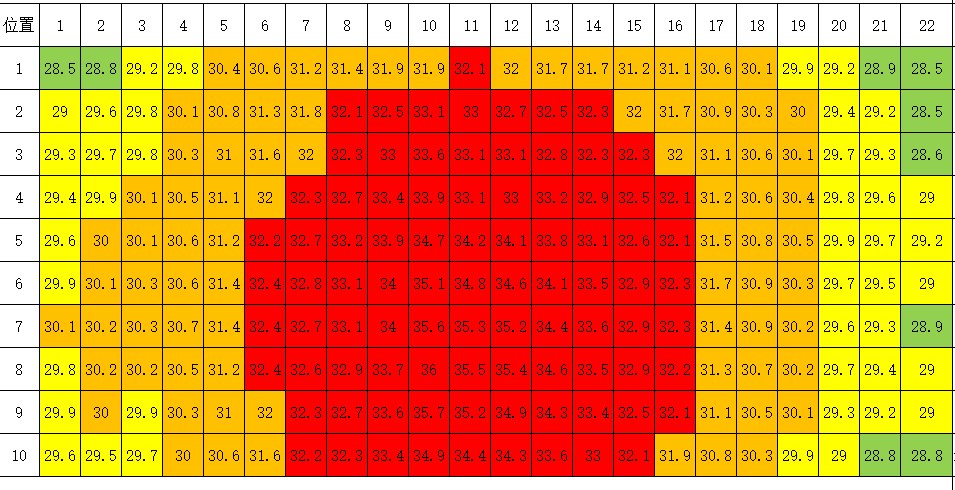
In a separate, smaller-panel development record, XIHE compared two circuit-pattern versions while keeping the graphene heating material unchanged.
The circuit pattern was redesigned between Version 1 and Version 2. The reported results showed a change in the measured peak temperature and in the proportion of the surface above 37°C.
Reported comparison
| Metric | Version 1 | Version 2 |
|---|---|---|
| Peak temperature | 38.1°C | 36.9°C |
| Surface area above 37°C | 4.55% | 0% |
| Input power | Baseline | Approximately 12% higher |
The comparison suggests that circuit geometry can influence the thermal distribution of a flexible heating panel. In this particular test, the redesigned pattern reduced the reported peak temperature even though input power increased by approximately 12%. This result should be understood as a specific engineering comparison — not as evidence that every circuit redesign will produce the same outcome.
This is a separate smaller-panel test record. Its measurements are not part of the 2.4 m² assessment described above and should not be combined with the large-area test results. The basis for the approximately 12% power increase should be stated with the test conditions in the published record.
06 / Engineering implications
A custom heating panel needs to be evaluated against the requirements of the intended equipment, not simply against a generic temperature target. For OEM projects involving piglet creep heating or other livestock heating applications, the development process should establish the following before finalizing a design.
Define the required coverage area, panel dimensions, mounting arrangement, and any areas where heating must be limited or avoided.
Specify the intended operating range, allowable spatial temperature variation, and relevant measurement conditions.
Confirm the supply voltage, total power, power density, wiring arrangement, and compatibility with the intended controller and protective devices.
Define the measurement grid, stabilization period, test environment, sensor accuracy requirements, and acceptance rules before testing.
Assess the assembled system — including its mounting, insulation, controls, electrical protection, and operating environment — against the applicable product requirements.
The appropriate design and verification plan depends on the specific equipment and the customer’s intended use.
07 / Validation scope and limitations
This case study presents reported thermal measurements from a graphene heating panel test and a separate circuit-pattern comparison.
Supported by the reported records
Outside the scope of these records
The development stage of the overall customer project has not been established by the available assessment record. These boundaries are important when using panel-level results to inform product development and procurement decisions.
08 / From test data to OEM development
XIHE works with product developers and equipment manufacturers to evaluate custom-shaped flexible heating films and heating panels for integration into their products.
A typical engineering discussion begins by defining the application and the requirements that the heating component must meet.
Share the equipment type, intended heating area, installation method, target temperature range, and operating environment.
Confirm voltage, power, temperature sensing, control strategy, and the required protective functions.
Evaluate panel geometry, circuit-pattern requirements, material structure, and integration constraints.
Agree on the measurement grid, test conditions, acceptance limits, and required engineering records.
Use the results to inform the next development stage, including any required prototype testing and finished-product verification.
09 / Related solutions
Flexible heating film designed around product geometry and OEM integration requirements.
Learn how heating performance, temperature distribution, and other engineering characteristics can be evaluated through defined tests.
Discuss your application, electrical requirements, heating area, and validation needs with XIHE.
Whether you are developing livestock equipment, heated furniture, technical textiles, or another product requiring a customized heating component, the first step is to define the application\u2019s requirements.
Share your target heating area, operating temperature, power supply, installation constraints, and intended production volume. XIHE can review the requirements and discuss the appropriate heating-film or panel development approach.
XIHE provides OEM-oriented heating-film and integration support. Final product performance, safety, and compliance must be verified for the intended finished system.