Far Infrared Graphene Recovery Capsule — Full-Body Wellness Pod
A commercial far infrared graphene recovery capsule built on upper and lower graphene energy layers for flagship wellness rooms, recovery centers, and premium recovery pod programs that need a stronger procurement story than generic pod catalogs.
XIHE cites NIQS-tested graphene-film material figures — 0.88 normal spectral emissivity, 68% infrared radiant output efficiency, 5-15 um emission band with 9.4 um characteristic peak — and a full-body graphene architecture that can integrate terahertz and rotating-magnetic-field modules as supporting layers.
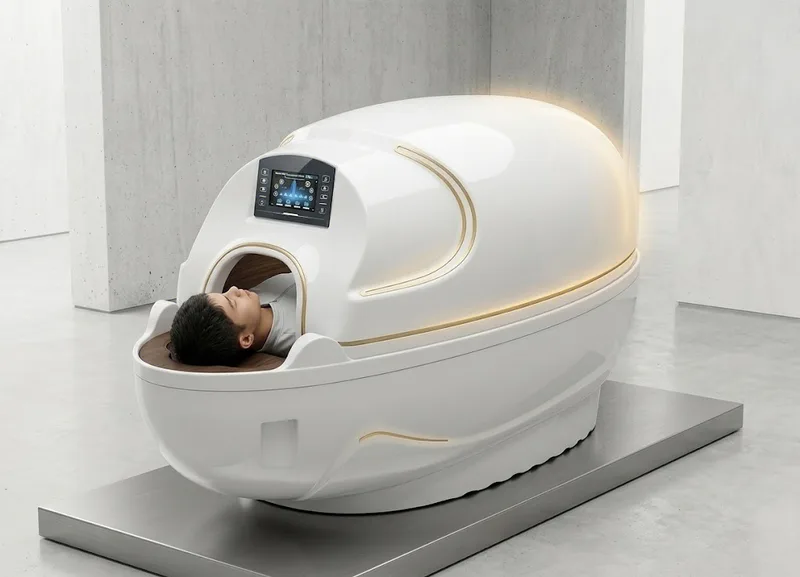
Heat is cheap. Precision resonance is not.
The Standard Approach
The recovery-pod market is crowded with generic sauna language and feature-stacking. That makes it hard for buyers to tell which systems are built on a measurable platform and which ones are only repackaged amenities.
The Hidden Cost
XIHE organizes the CAPSULE around a documented graphene far-infrared core and a layered commercial architecture. That lets buyers separate the main technical story from secondary supporting modules and evaluate the system more rationally.
XIHE's commercial far infrared graphene recovery capsule is positioned as a layered recovery environment rather than a generic sauna pod. The primary commercial story is a full-body graphene far-infrared platform built across both the upper cabin and lower mattress layers; terahertz, rotating magnetic field, environmental controls, and interface modules act as supporting differentiators inside the same room-format system. Before purchase, serious buyers should review footprint, utilities, sanitation workflow, OEM scope, lead-time ownership, and deployment responsibilities instead of comparing only feature counts.
Engineered on the Far Infrared Graphene Science Platform.
Commercial Far Infrared Graphene Recovery Capsule for Premium Recovery Rooms
This page is written for buyers who need a stronger system story than generic infrared-pod language.

Why this page starts with architecture instead of amenities
Most wellness pods are sold like upgraded sauna furniture. That creates a weak buying frame for professional operators because it hides the questions that actually matter: emitter platform, room workflow, supplier documentation, maintenance logic, and what makes the product defensible at premium price points.
XIHE positions the CAPSULE as a commercial recovery environment. Both the upper cabin and lower mattress are treated as graphene far-infrared energy layers. Terahertz, rotating magnetic field, environmental, and interface modules are supporting layers that help a facility build a differentiated service instead of a heat-only room.
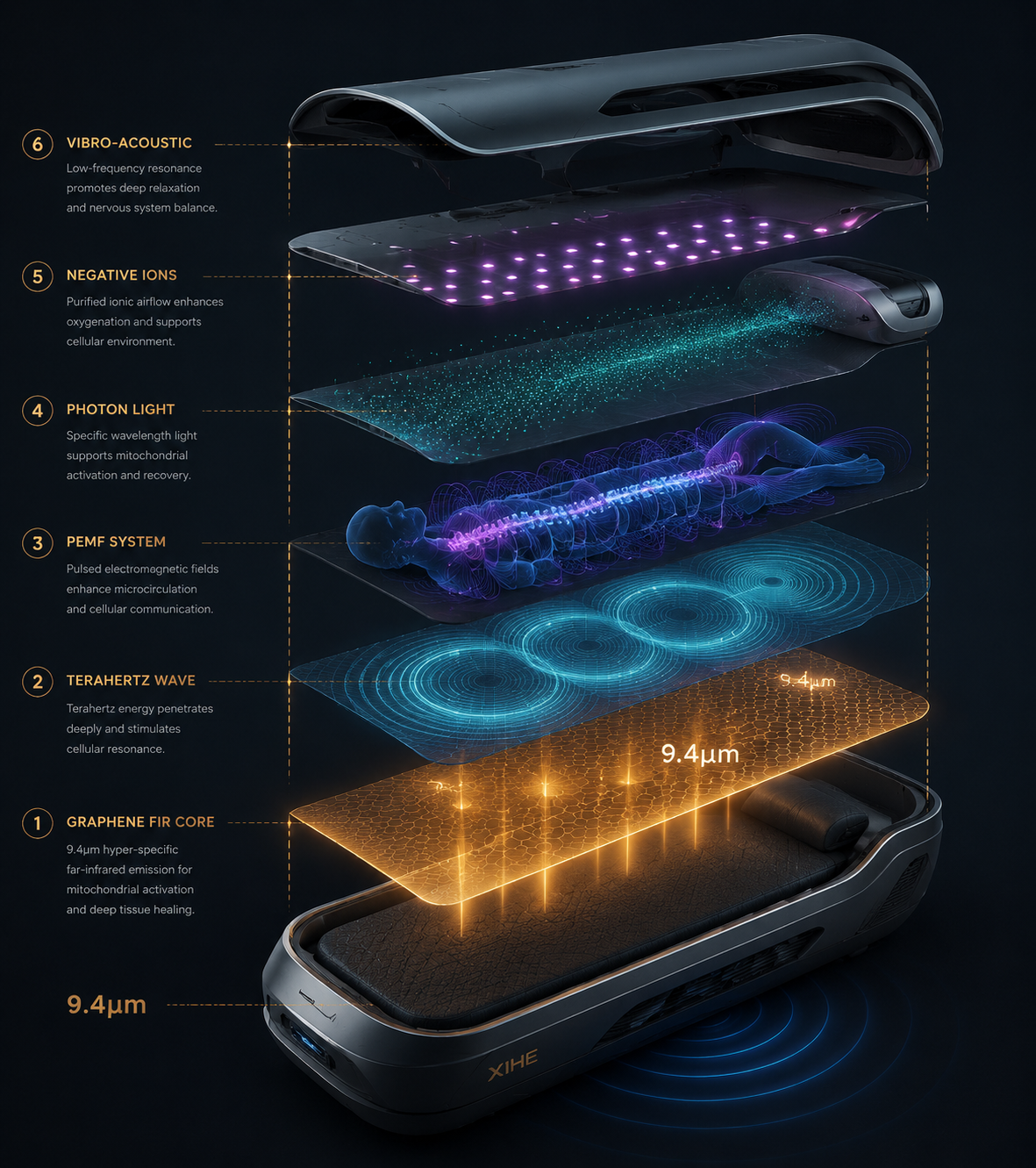
Upper graphene layer. Lower graphene layer. Supporting modules second.
The trust story begins with the same graphene platform references used across XIHE's product line: NIQS-tested 0.88 normal spectral emissivity, NIQS-tested 68% infrared radiant output efficiency, a 5-15 um emission band, and a characteristic peak near 9.4 um.
For the CAPSULE, that platform is not limited to one panel or one insert. The product is framed as a full-body graphene system in which both the upper cabin and lower mattress participate in the core far-infrared environment.
From there, buyers can review the broader evidence package: NMPA Class II certified core-film context, IKKEM laboratory collaboration, reported PKU Third Hospital clinical-evaluation outcomes used elsewhere on the platform, and XIHE's role as lead drafting unit for Standard 2024-0923T-YB.
That ordering matters. It keeps the CAPSULE anchored to documentable source physics instead of asking the market to trust a multi-function room with no measurable center.
Commercial Recovery Pod vs Sauna Pod: How This Graphene Recovery Capsule Compares
This section is designed for procurement logic, not lifestyle copy.
| Parameter | Generic infrared pod | XIHE CAPSULE |
|---|---|---|
| Primary story | Heat and comfort | Documented graphene platform plus room-format system design |
| Commercial value | Amenity purchase | Flagship recovery-room infrastructure |
| Technology logic | Feature list | Layered platform narrative |
| Best fit | Basic spa or home-style offer | Premium wellness and recovery operators |
One product. Four layers of value.
This is the cleaner way to explain a multi-function room without turning it into brochure clutter.
Upper Graphene Layer
Upper cabin graphene energy layer
The upper cabin is part of the documented graphene emitter platform: 5-15 um emission, a 9.4 um characteristic peak, NIQS-tested emissivity, and NIQS-tested radiative conversion. This is part of the main XIHE platform, not a decorative add-on.
Lower Graphene Layer
Lower mattress graphene energy layer
The lower mattress is also part of the graphene far-infrared system. This matters commercially because the CAPSULE is better understood as a full-body graphene environment rather than a single graphene panel with unrelated extras attached to it.
Supporting Physics
Terahertz and rotating magnetic field support
The CAPSULE can integrate terahertz and rotating-magnetic-field modules as supporting physical inputs. On this page, they are framed as differentiators inside a broader graphene system, not as stand-alone miracle claims.
Environmental + Control
Sanitation, airflow, and operator workflow
Negative-ion airflow, ozone sanitation, touchscreen control, audio, and room-management logic matter because premium rooms are judged by reset speed, cleanliness, and repeatable session control as much as by heat delivery.


The anchors buyers can actually use
These metrics and trust signals are more useful than a vague promise of "more modalities."
0.88
Normal Spectral Emissivity
NIQS WT-HW-00529
68%
Radiation Conversion
NIQS evidence chain
5-15 um
Emission Band
Graphene platform range
9.4 um
Characteristic Peak
Spectral anchor
NMPA II
Core Film Context
Certification applies to the core film
YB 2024
Industry Standard
2024-0923T-YB drafting role
35 min
Default Session
Operator workflow baseline
0-15
Upper / Lower Levels
Independent energy control
The questions to answer before you compare price
This is the faster procurement screen for a room-format recovery product.
Best Fit
Best fit for flagship session operators
Best aligned with wellness clubs, recovery centers, hospitality programs, and premium operators who need a room-format paid session rather than a low-cost heat amenity.
Not Ideal
Not ideal for commodity pod buying
If the project only needs the lowest-cost pod or a home-style appliance, the CAPSULE may be the wrong buying frame. This page assumes a documented supplier review, not a catalog impulse purchase.
Deployment Review
Confirm footprint, clearance, and utilities early
Before commercial approval, request the installed dimensions, service clearance, door-path requirement, power specification, airflow logic, sanitation workflow, and who owns site preparation.
Lead Time + OEM
Separate standard lead time from customization lead time
Ask whether the quote is based on a standard configuration or an OEM/JDM program, what the design-freeze date is, which modules affect production timing, and what documents arrive before shipment.
Documented signals the market understands
Keep these signals visible. They reduce buyer uncertainty without slipping into over-claiming.
NMPA Class II Certified Core Film
Obtained
IKKEM Laboratory Collaboration
Obtained
PKU Third Hospital Published Outcomes
Obtained
NIQS Emitter Test Report
Obtained
CE Certified (Whole Machine)
Obtained
Standard 2024-0923T-YB Drafting Unit
Obtained
OEM / JDM Program Review
In Progress — Q3 2026
Documentation available on request
Serious buyers review documents before committing. Request any of the following through the commercial review.
NIQS
NIQS Test Report WT-HW-00529
Graphene film material: 0.88 normal spectral emissivity, 68% infrared radiant output efficiency. Material-level test data.
CE
CE Certificate (Whole Machine)
EMC 2014/30/EU + LVD 2014/35/EU, issued 2023. Available for buyer technical review.
NMPA
NMPA Class II (Core Film Context)
Certification applies to the core graphene film, not the finished capsule. Scope clarified in the commercial review.
Commercial Far Infrared Graphene Recovery Capsule FAQ
These answers are written for B2B buyers, OEM evaluators, and facility operators.
What is a commercial far infrared graphene recovery capsule?
How is the CAPSULE different from a sauna pod?
Why mention terahertz and rotating magnetic field on a graphene page?
Can this capsule be used during fever or when body temperature is above 38 C?
How should ozone sanitation be used?
Who needs extra caution with the rotating magnetic field module?
Does NMPA Class II apply to the whole capsule?
What should a commercial buyer compare first?
How should I evaluate room footprint before ordering?
What should a buyer ask about lead time?
What is the MOQ and sampling policy?
What can be customized in an OEM or JDM program?
Learn more about the difference between the difference between a recovery pod and a sauna pod →
Bring the room plan, utility notes, and target service model.
We will structure the commercial review.
Best fit for wellness operators, recovery centers, hospitality programs, and OEM wellness-pod partners who need a deployment review, not just a brochure.
Use this page to decide whether the CAPSULE belongs in your service model before comparing catalogs on price alone. A strong inquiry includes footprint, access path, utility constraints, customization scope, and launch timing.