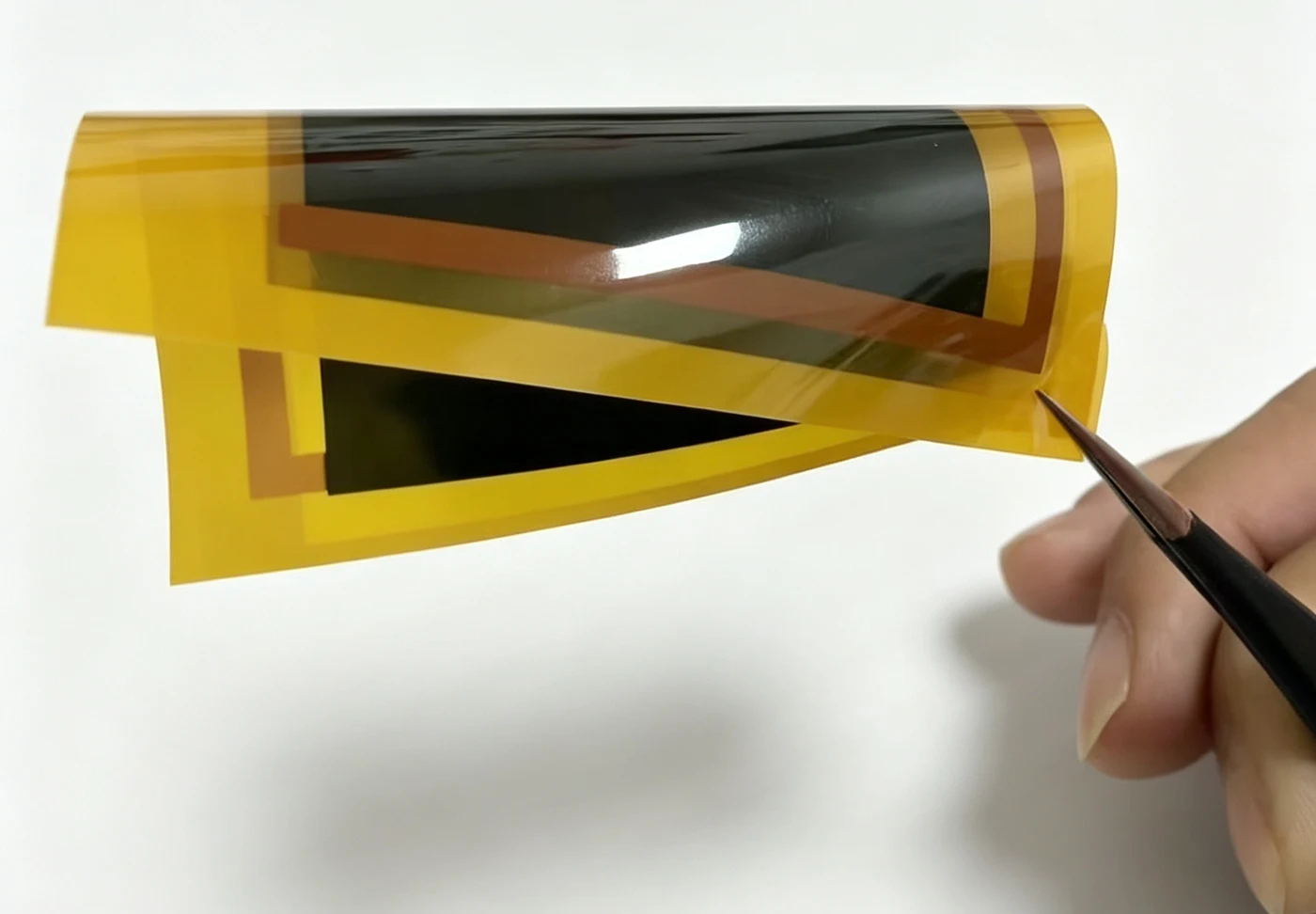
XIHE sample photograph. Bending shows the component form; performance retention requires the measurement records below.
Engineering · Evidence Centre
Heating Film Engineering
Define electrical, thermal and reliability tests around the actual assembly. Connect each measurement to a sample, an operating condition and a design decision.
Plan your validation
Validate the configuration you intend to source.
Use these records to define sample tests. Review component options in Graphene Heating Film and production controls in Manufacturing.
Evidence sequence
Sample → Method → Conditions → Result → Procurement implication
Biological or clinical research does not qualify a component or finished product for sourcing.
Evidence modules
Testing & Standards
Which methods and standards define the comparison language, and what a named test report does and does not establish.
Thermal Performance
Heating rate, operating temperature, thermal stability and heat distribution.
Temperature Uniformity
How surface uniformity is defined, measured and reported — including the point grid and conditions.
Far-Infrared Emission
Spectral characteristics, emissivity and radiative conversion — as engineering properties, with their test conditions.
Reliability & Durability
Continuous operation, thermal cycling, repeated deformation and long-duration stability.
01 · Testing & Standards
Testing & Standards
Start with the decision the test must support: material screening, component selection, assembly qualification or production acceptance. These need different samples and different evidence.
| Review item | What to establish |
|---|---|
| Identify the sample | Record the drawing revision, material stack, active area, electrodes and sample or batch identifier. |
| Define the method | Agree the measured quantity, instruments, calibration, conditioning and acceptance rule before testing. |
| Preserve the scope | Keep the report number, date, sample and conditions attached to every result used for sourcing. |
02 · Electrical Performance
Electrical Performance
Electrical measurements establish the input delivered to the heater and how that input changes with temperature, connection losses and operating time.
| Review item | What to establish |
|---|---|
| Resistance | State sample temperature and contact method. Use an appropriate four-wire method where lead and contact resistance would materially affect the result. |
| Voltage and current | Measure at the heater terminals under load. Separate supply output from voltage lost in leads, switches and connectors. |
| Power and control | Record applied voltage, current and control duty cycle together. A nominal supply rating is not the measured heater input. |
| Stability | Compare resistance under matched reference conditions before and after the defined test exposure. |
03 · Thermal Performance
Thermal Performance
Temperature is a system response. The same electrical input can produce different temperatures when mounting, airflow, facing material or contact load changes.
| Review item | What to establish |
|---|---|
| Warm-up | Define the starting condition, measurement location and target criterion. Record the full time trace, including overshoot. |
| Steady operation | Agree a settling criterion and record ambient conditions, orientation, supply and control behaviour. |
| Surface measurement | Use reference sensors or a validated infrared method. Document emissivity settings, reflections and the measured surface. |
| Assembly comparison | Compare the bare heater and finished stack under defined conditions; identify the temperatures relevant to the product. |
04 · Temperature Uniformity
Temperature Uniformity
A uniformity claim needs a region, a time and a statistic. An attractive thermal image by itself cannot establish a reproducible specification.
| Review item | What to establish |
|---|---|
| Region of interest | Mark active area, exclusions, edges, seams and electrode regions before looking at the result. |
| Spatial spread | Report the maximum and minimum across the same region at the same time, along with the mean where useful. |
| Temporal variation | Report temperature drift or cycling separately from spatial spread. A stable sensor reading does not prove a uniform surface. |
| Contact conditions | State mounting, applied load, insulation, ambient temperature and airflow. Repeat the conditions for comparisons. |
05 · Far-Infrared Emission
Far-Infrared Emission
Infrared characterisation describes emitted radiation under a stated method. It complements electrical and surface-temperature measurements; it does not replace them.
A documented infrared film measurement.
Report (2022) WT-HW-00529, issued on 29 July 2022 by Wuhan Product Quality Supervision & Inspection Institute / National Infrared and Industrial Electrothermal Product Quality Inspection and Testing Center, tested one delivered Sample 3: far-infrared film FIHF-7.9V-6.7W. Jiageng Innovation Laboratory is named as the sample supplier and producer.
Normal total emissivity describes the tested surface emission property. The separate radiation-conversion result uses a double-sided measurement. These quantities help an OEM specify the infrared measurements needed for its selected assembly.
| Review item | What to establish |
|---|---|
| Quantity and method | Distinguish spectral emissivity, total emissivity and radiative conversion efficiency. They are not interchangeable metrics. |
| Sample and temperature | Identify the tested assembly, emitting surface and operating condition. Do not transfer a result between different film constructions. |
| Report interpretation | Read the method, sample identity, date, uncertainty and laboratory scope before extracting a number or curve. |
| Sample | Method | Conditions | Result | Procurement implication |
|---|---|---|---|---|
| Historical delivered laboratory sample FIHF-7.9V-6.7W only. | GB/T 7287-2008, Chapter 18, Method B. | One delivered Sample 3, far-infrared film, model FIHF-7.9V-6.7W; supplied and produced by Jiageng Innovation Laboratory. | 0.88 | Use the result to specify comparable emission testing; do not generalise it to every current film. EV-ENG-FIR-EMISSIVITYSource and permitted scope
|
| Historical delivered laboratory sample FIHF-7.9V-6.7W only. | JG/T 286-2010, clause 6.2.1; double-sided measurement. | One delivered Sample 3, far-infrared film, model FIHF-7.9V-6.7W; supplied and produced by Jiageng Innovation Laboratory. | 68% (double-sided measurement) | Use the result to specify comparable emission testing; do not generalise it to every current film. EV-ENG-FIR-CONVERSIONSource and permitted scope
|
These results describe the historical delivered sample identified in report (2022) WT-HW-00529. Radiative conversion is distinct from total electrical-to-heat efficiency; the report does not establish a rating for every current XIHE module.
06 · Reliability & Durability
Reliability & Durability
Reliability work asks whether the electrical, thermal and insulation functions remain acceptable after the product-relevant exposure. A test duration alone is not a service-life prediction.
| Review item | What to establish |
|---|---|
| Repeated bending | Define radius, axis, direction, rate, powered state and cycle count. Inspect the leads and electrodes as well as the active region. |
| Thermal cycling | Define temperature limits, dwell, transition and operating state. Record functional measurements before and after exposure. |
| Moisture and cleaning | Use the expected environment and care method to select conditioning. Include terminals, edges and seals. |
| Degradation | Compare like-for-like resistance, temperature distribution and insulation measurements against pre-agreed acceptance limits. |
| Sample | Method | Conditions | Result | Procurement implication |
|---|---|---|---|---|
| Representative tested heating-film configuration — not every XIHE product. | 10 mm bend radius, 100 mm/s, 10,000 cycles; resistance measured after 1 h rest. | Sample 1-1: 33.7 to 33.4 ohm; reported resistance change -0.9%. | 10,000 cycles / −0.9% resistance change | Use the result to frame a project-specific durability test for a comparable configuration. EV-ENG-REL-BENDSource and permitted scope
|
| Representative tested heating-film configuration — not every XIHE product. | Continuous energisation for 600 h; power deviation recorded after the defined exposure. | 600 h table: initial power 45.4 W, measured power 43.2 W; reported change magnitude 4.80%, a decrease. Preserve the source rounding. | 600 h / 4.80% power change | Use the result to frame a project-specific durability test for a comparable configuration. EV-ENG-REL-CONTINUOUSSource and permitted scope
|
| Representative tested heating-film configuration — not every XIHE product. | 10 thermal cycles; 13 m/s airflow, 180 s test time, 32.4 V test voltage on a 24 V rated sample. | Sample 1-2: initial resistance 84.40 ohm, after 10 cycles 82.52 ohm; reported change -2.2%. | 10 cycles / −2.2% resistance change | Use the result to frame a project-specific durability test for a comparable configuration. EV-ENG-REL-CYCLINGSource and permitted scope
|
| Representative tested heating-film configuration — not every XIHE product. | Humidity ageing, reported exposure 500 h+ and resistance change +1.8%. | Company-confirmed result. Do not attach the drafting comparison 60°C/90% RH conditions, which describe separate 48 h and 96 h tests. | 500 h+ / +1.8% resistance change | Use the result to frame a project-specific durability test for a comparable configuration. EV-ENG-REL-HUMIDITYSource and permitted scope
|
| Drafting comparison sample 4-6; not identified as an XIHE product. | Flat-plate press at 0.8 MPa for 30 min; measured after 1 h rest at room temperature. | Sample 4-6, room temperature: 8.98 ohm initially, 9.08 ohm at test end, 9.02 ohm after 1 h rest; reported change 0.4%. | 0.8 MPa / 30 min / 0.4% resistance change | Use the result to frame a project-specific durability test for a comparable configuration. EV-ENG-REL-PRESSURESource and permitted scope
|
Each row identifies its own sample and test basis. The drafting comparison and collected self-test results come from the YB/T 6493-2026 drafting records; the long-duration humidity result is separately confirmed by XIHE. The pressure comparison sample is not identified as an XIHE sample. Apply each result to its stated configuration and conditions.
07 · Compliance
Compliance
Start with the finished product category and intended market. A component test report may support a technical file, but does not by itself approve a complete device.
| Review item | What to establish |
|---|---|
| Product scope | Identify intended use, supply type, accessible surfaces and the responsible finished-product manufacturer. |
| Required documents | Agree applicable electrical, material, environmental and other product requirements with the relevant assessment body. |
| Configuration control | Tie documentation to the actual bill of materials, assembly and model. Review changes for their effect on existing evidence. |
Compliance statements are made only for a defined product, market and scope. A component-level observation is never presented as a finished-product approval.
Traceability matrix
From Standard to Test to Result
Standards establish the comparison language. A named test report establishes a result for a defined sample and condition. Neither is a universal finished-product guarantee.
| Record | Required context |
|---|---|
| Method | Named procedure, measured quantity, instrument and calibration. |
| Sample | Model or drawing revision, material stack, batch and preparation. |
| Conditions | Input, mounting, ambient environment, duty cycle and measurement region. |
| Result | Reported quantity, units, variation and the acceptance decision. |
| Applicability | The configuration and decision the result supports. |
| Sample | Method | Conditions | Result | Procurement implication |
|---|---|---|---|---|
| Historical delivered laboratory sample FIHF-7.9V-6.7W only. | GB/T 7287-2008, Chapter 18, Method B. | One delivered Sample 3, far-infrared film, model FIHF-7.9V-6.7W; supplied and produced by Jiageng Innovation Laboratory. | 0.88 | Use the result to specify comparable emission testing; do not generalise it to every current film. EV-ENG-FIR-EMISSIVITYSource and permitted scope
|
| Representative tested heating-film configuration — not every XIHE product. | 10 mm bend radius, 100 mm/s, 10,000 cycles; resistance measured after 1 h rest. | Sample 1-1: 33.7 to 33.4 ohm; reported resistance change -0.9%. | 10,000 cycles / −0.9% resistance change | Use the result to frame a project-specific durability test for a comparable configuration. EV-ENG-REL-BENDSource and permitted scope
|
| Representative tested heating-film configuration — not every XIHE product. | Continuous energisation for 600 h; power deviation recorded after the defined exposure. | 600 h table: initial power 45.4 W, measured power 43.2 W; reported change magnitude 4.80%, a decrease. Preserve the source rounding. | 600 h / 4.80% power change | Use the result to frame a project-specific durability test for a comparable configuration. EV-ENG-REL-CONTINUOUSSource and permitted scope
|
| Representative tested heating-film configuration — not every XIHE product. | 10 thermal cycles; 13 m/s airflow, 180 s test time, 32.4 V test voltage on a 24 V rated sample. | Sample 1-2: initial resistance 84.40 ohm, after 10 cycles 82.52 ohm; reported change -2.2%. | 10 cycles / −2.2% resistance change | Use the result to frame a project-specific durability test for a comparable configuration. EV-ENG-REL-CYCLINGSource and permitted scope
|
| Representative tested heating-film configuration — not every XIHE product. | Humidity ageing, reported exposure 500 h+ and resistance change +1.8%. | Company-confirmed result. Do not attach the drafting comparison 60°C/90% RH conditions, which describe separate 48 h and 96 h tests. | 500 h+ / +1.8% resistance change | Use the result to frame a project-specific durability test for a comparable configuration. EV-ENG-REL-HUMIDITYSource and permitted scope
|
| Drafting comparison sample 4-6; not identified as an XIHE product. | Flat-plate press at 0.8 MPa for 30 min; measured after 1 h rest at room temperature. | Sample 4-6, room temperature: 8.98 ohm initially, 9.08 ohm at test end, 9.02 ohm after 1 h rest; reported change 0.4%. | 0.8 MPa / 30 min / 0.4% resistance change | Use the result to frame a project-specific durability test for a comparable configuration. EV-ENG-REL-PRESSURESource and permitted scope
|
Request the sample identity and test conditions with any result used in a sourcing decision. A component report and a finished-product assessment serve different purposes.
Where the evidence applies
From a measured result to a product decision.
Evidence supports a decision only inside the boundary of its own test. These are the layers it connects to.
Products this evidence applies to
Case studies built on this evidence
Where the results are made repeatable
Need a specific validation answered?
Tell us the property, the sample and the conditions you need measured. We will scope the test with you.
Start Technical Review