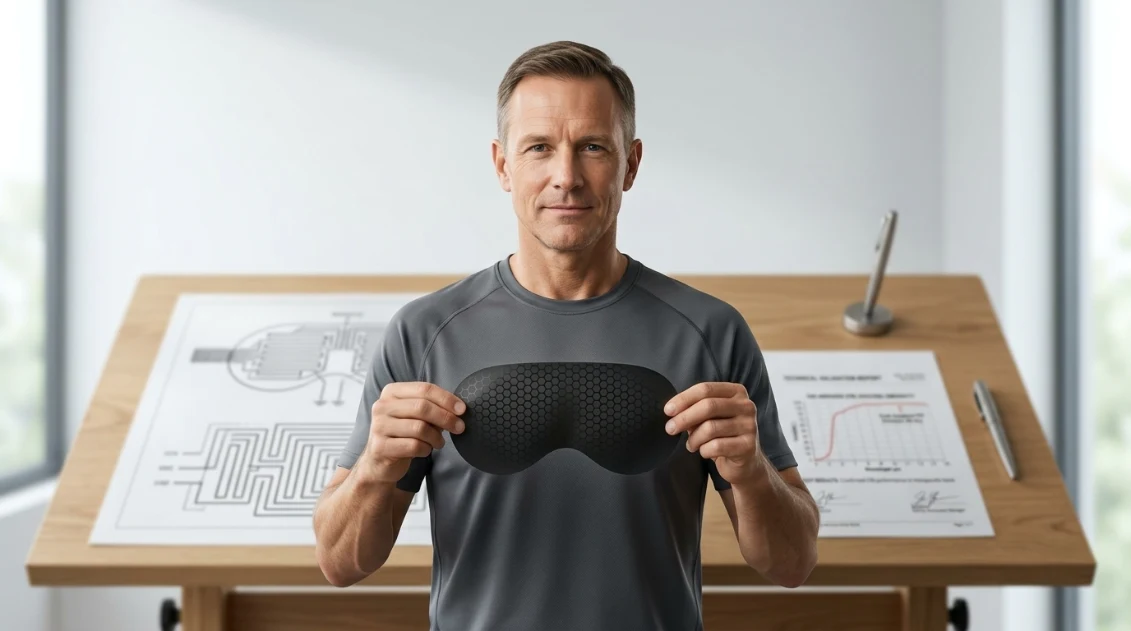
Custom Graphene Heating Film — Flexible Heating Elements for OEM/ODM Integration
Configured for OEM/ODM product integration.
(Multi-Layer | Precision Traced | Integrated Sensing)

Heat is cheap. Precision resonance is not.
The Standard Approach
Many flexible heaters can reach target temperature, but OEM/ODM teams still have to balance thickness, uniformity, integration effort, and the quality of supplier documentation.
The Hidden Cost
A better buying question is not simply 'Which heater gets hot?' but 'Which component gives us documented radiative performance, thin integration, and a supplier that understands validation and scale-up?'
XIHE graphene heating film is a flexible far-infrared heating component for OEM/ODM integration. On this site, the strongest documented anchors are NIQS-tested 0.88 emissivity, stable 5-15μm emission, 68% infrared radiant output efficiency, and XIHE's lead drafting role in Standard 2024-0923T-YB.
Engineered on the Far Infrared Graphene Science Platform.
A Flexible Far-Infrared Heating Component
A flexible electrothermal component engineered with graphene-based conductive materials for integration into wearable products, home textiles, wellness equipment, and thermal devices.
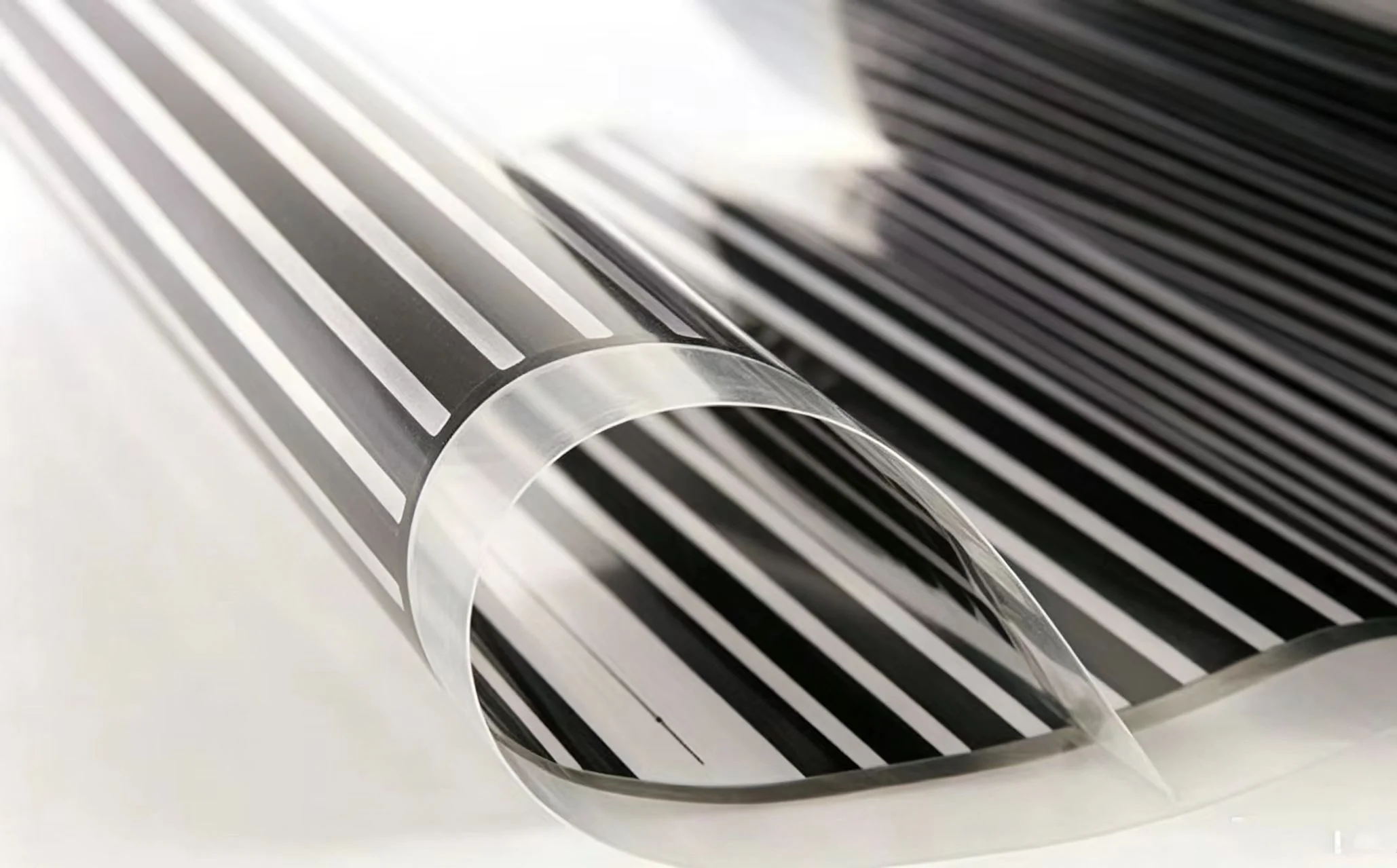
Selected configurations have demonstrated far-infrared emission in the 5–15 μm range
Selected configurations have demonstrated far-infrared emission in the 5–15 μm range, with a reported characteristic peak near 9.4 μm under specified test conditions. Performance depends on film construction, operating conditions, encapsulation, and final-product assembly.
Suitable for heated apparel, eye masks, heating pads, mattress systems, wellness equipment, thermal devices, and OEM/ODM product development.
Technical Specifications for OEM/ODM Buyers
Standard and available configurations. Final values are project-specific and must be confirmed for each application.
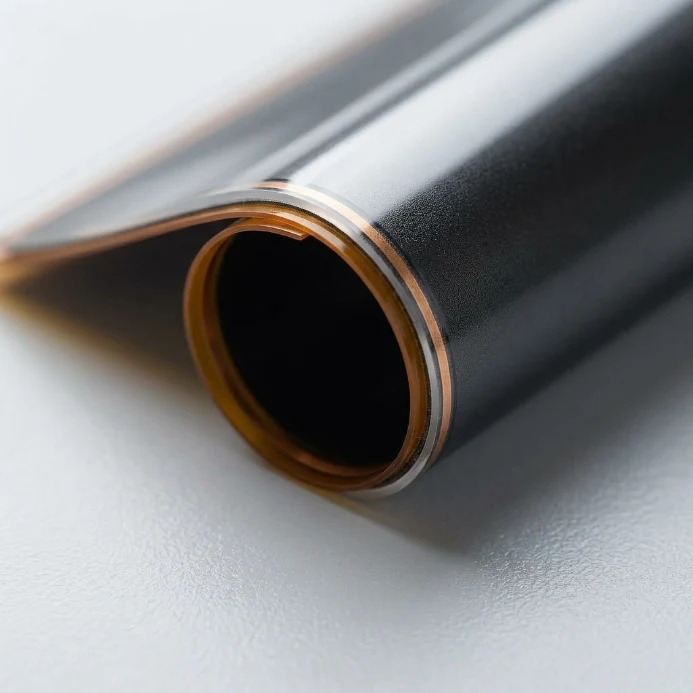
Project-specific construction
Film structure, thickness, operating voltage, power density, and temperature range are all defined by the end product requirements. XIHE works with your team to select the substrate, electrode layout, encapsulation, and sensor configuration that match the application.
Parameter / Configuration / Evidence Note
| Parameter | Typical / Available Configuration | Evidence or Note |
|---|---|---|
| Film Structure | Graphene conductive layer + flexible substrate + encapsulation | Final stack-up defined by application |
| Thickness · Voltage · Power · Temperature | Project-specific | Defined by product requirements, controller and thermal design |
| Temperature Uniformity | Configurable based on application; ΔT = 5.4°C demonstrated on a representative baseline configuration | Tighter uniformity available for specific geometries and power-density targets; consult engineering for feasibility |
| Applicable Evaluation Limit | ≤6.4°C at 64°C average temperature | Where the stated test method and conditions apply |
| FIR Emission | 5–15 μm reported on selected configurations | NIQS report (2022)WT-HW-00529; verify sample and method |
| Normal Emissivity | ≥0.88 reported on tested sample | NIQS report (2022)WT-HW-00529; verify sample and method |
| Heating Area · Geometry | Customizable | Pattern, edge margin and connection layout configurable |
| FPC Integration · NTC Sensor | Available | Subject to electrical, assembly and control strategy |
Customization Around Your Product Requirements
XIHE customizes film geometry, electrical characteristics, and integration features to match your device program.
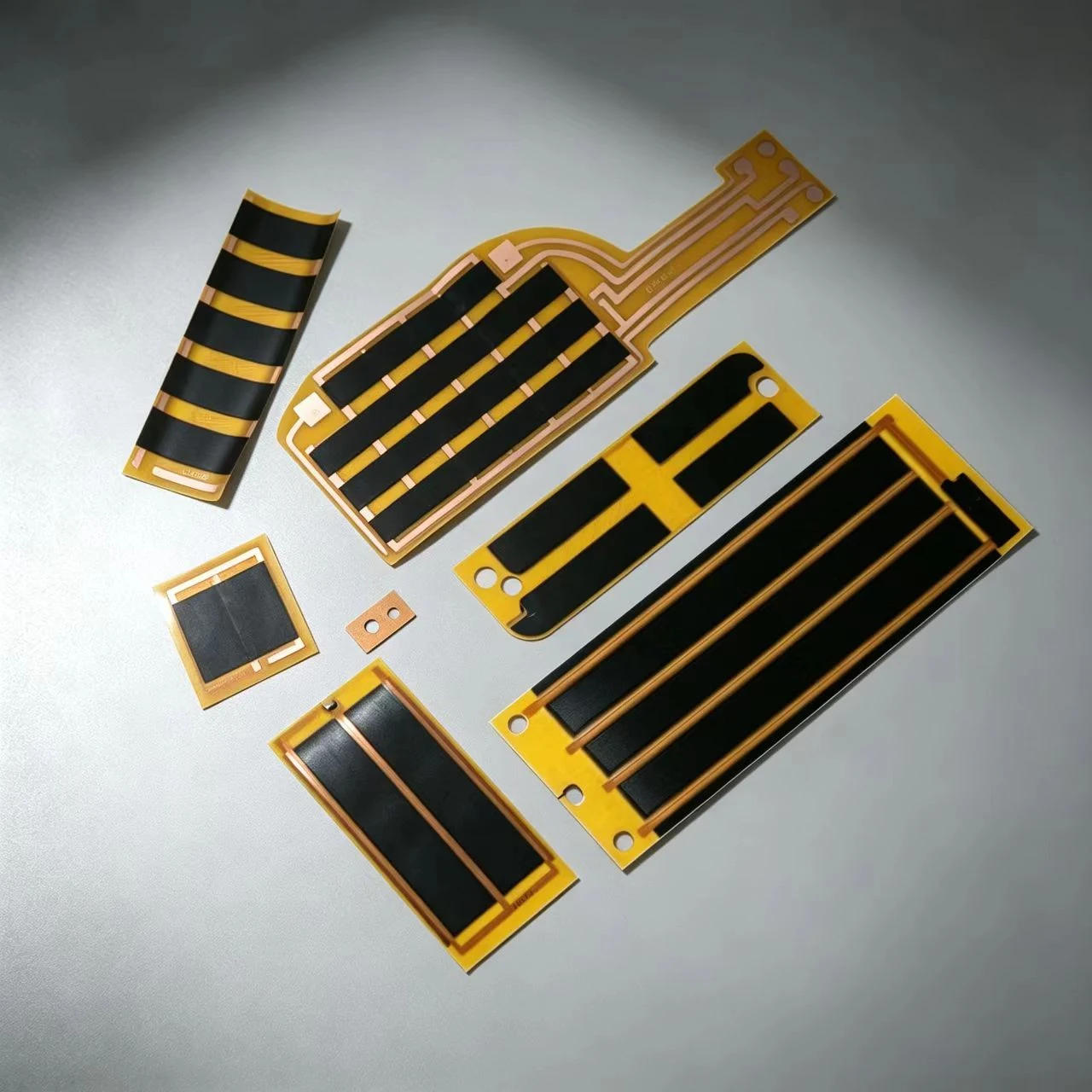
Custom-Shaped Flexible Heating Films
We specialize in developing flexible heating films for complex product geometries, including customized shapes, dimensions and heating patterns.
Standard geometry → Custom geometry → Integrated heating insert.
Dimensions, voltage, power density, heating area, temperature range, resistance, substrate, FPC integration, NTC sensor, connector type, and encapsulation can all be tailored to the product.
Provide your target product type, heating area, voltage, and temperature needs — XIHE will respond with a film configuration matched to your application.
Customization Parameter / Options
| Customization Parameter | Options |
|---|---|
| Dimensions | Length, width, shape tailored to your product |
| Voltage | Custom operating voltage |
| Power Density | Adjusted to your heating requirements |
| Heating Area | Pattern and coverage defined by your design |
| Temperature Range | Optimized for your application |
| Temperature Uniformity | Tighter ΔT available for applications requiring more even surface heating; subject to geometry, power density and substrate selection |
| Resistance | Customized to match your control system |
| Substrate | Flexible cloth / PI / PET |
| FPC Integration | With or without flexible circuit board |
| NTC Sensor | Integrated temperature sensing |
| Connector | Custom connector type and position |
| Encapsulation | Waterproof / washable / breathable options |
How the Film Becomes Part of Your Product
A graphene heating film is not a standalone product — it is a component that must be integrated into your system.
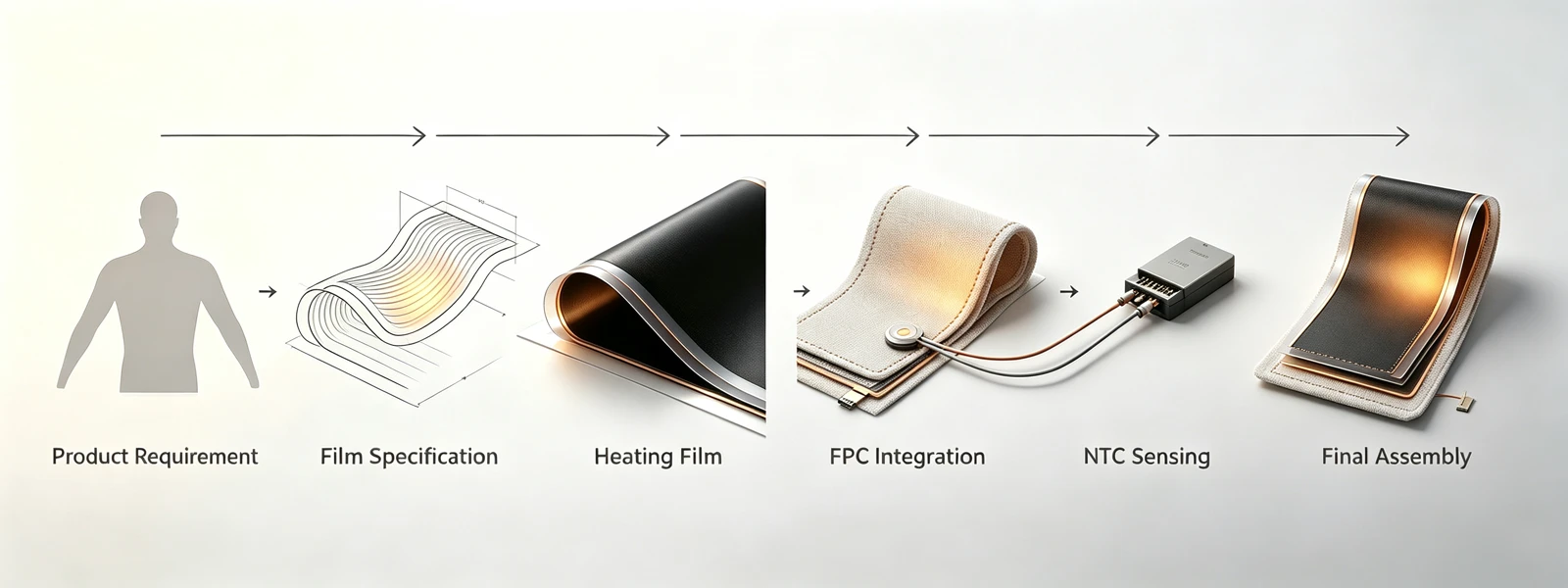
XIHE supports integration across the full stack
Integration support includes electrode design and placement, FPC (flexible printed circuit) integration, NTC sensor configuration, controller compatibility, encapsulation and sealing, and thermal interface design.
The typical integration path flows from your product requirement to film specification and customization, graphene heating film fabrication, electrode and FPC integration, NTC temperature sensing, controller interface, and final product assembly.
From Heating Component to Integrated Solution
XIHE graphene heating film is engineered for OEM/ODM integration across multiple product categories.
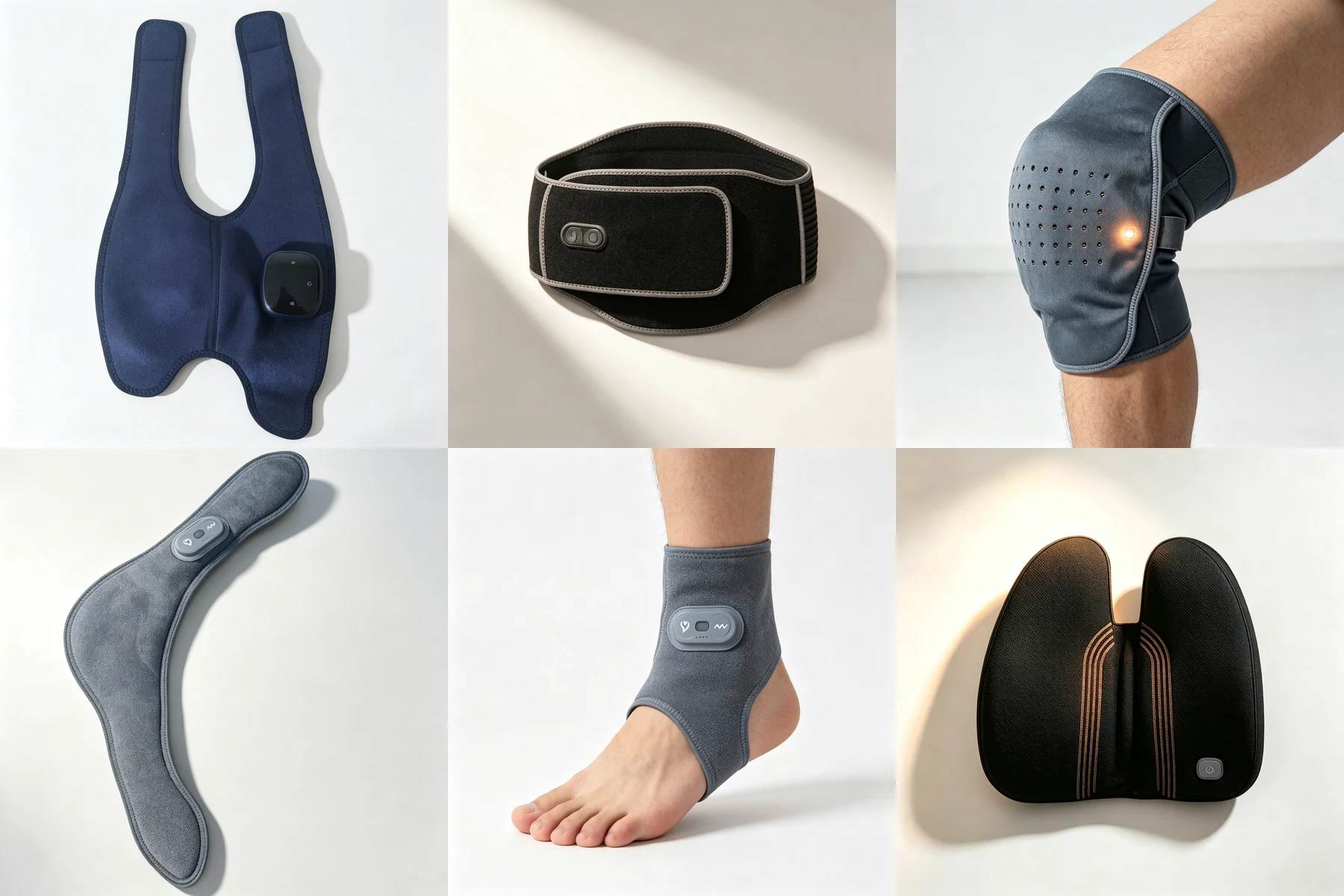
Real product applications across body zones
Applications include heated apparel, wearable devices, home textiles, wellness equipment, automotive thermal components, and professional thermal equipment.
Application / What We Support
| Application | What We Support |
|---|---|
| Heated Apparel | Jackets, vests, gloves, scarves — film integration with fabric layering |
| Wearable Devices | Eye masks and compact warming accessories — low-voltage, temperature-controlled configurations |
| Home Textiles | Mattress heating layers, blankets, cushions — large-area uniform heating |
| Wellness Equipment | Heating mats, controlled-warming equipment, and recovery-oriented product concepts |
| Automotive | Seat heating, steering wheel warmth, interior thermal components |
| Thermal Equipment / Professional Devices | Industrial heating modules, professional thermal management systems |
From Requirement to Production — One Engineering Path
XIHE supports OEM/ODM projects from initial concept through to production ramp. Our engineering team works alongside yours at every stage.
- 01
Requirement Definition
Your product spec → heating requirement → target
- 02
Engineering Review
Feasibility assessment → material selection → design
- 03
Prototype Development
Film fabrication → electrode integration → testing
- 04
Performance Validation
Temperature uniformity · FIR emission · durability
- 05
Pilot Production
Process validation · batch consistency · QC setup
- 06
Mass Production
Scale-up · quality control · delivery
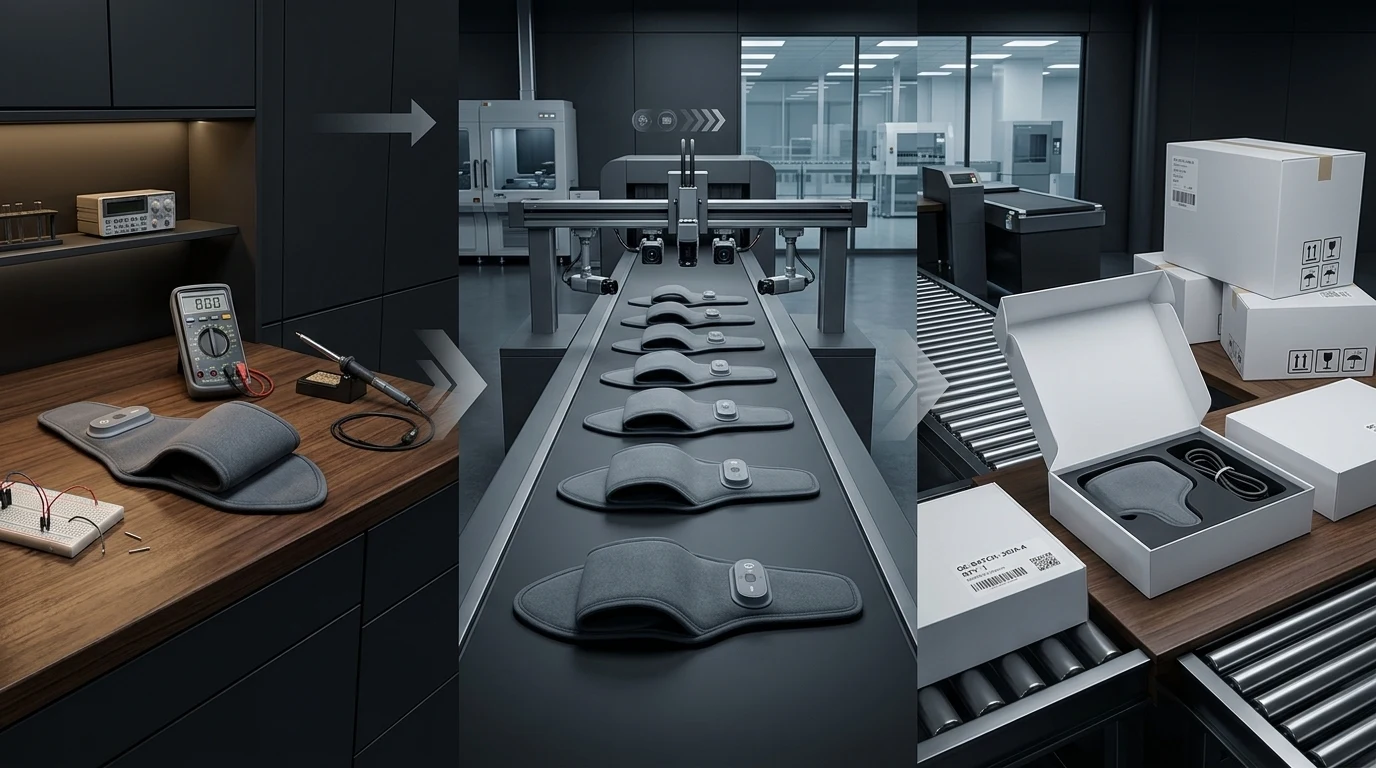 Engineering + Factory
 Verified Performance. Documented Evidence.
Measured values refer to representative tested samples. Final performance varies with film geometry, power density, voltage, substrate, encapsulation, controller logic, ambient conditions, and final-product assembly.
- Industry Standard
XIHE is the lead drafter of China's graphene flexible electrothermal heating film industry standard (2024-0923T-YB)
Confirm standard number and status
- ≥0.88
Normal Emissivity
NIQS-tested
- ΔT < 5.4°C
Temperature Uniformity
Representative tested configuration
- 10,000
Dynamic Bending Cycles
Result in applicable validation report
- 600h
Accelerated Aging
Result in applicable validation report
- IKKEM
Research Backing
Jiageng Innovation Laboratory
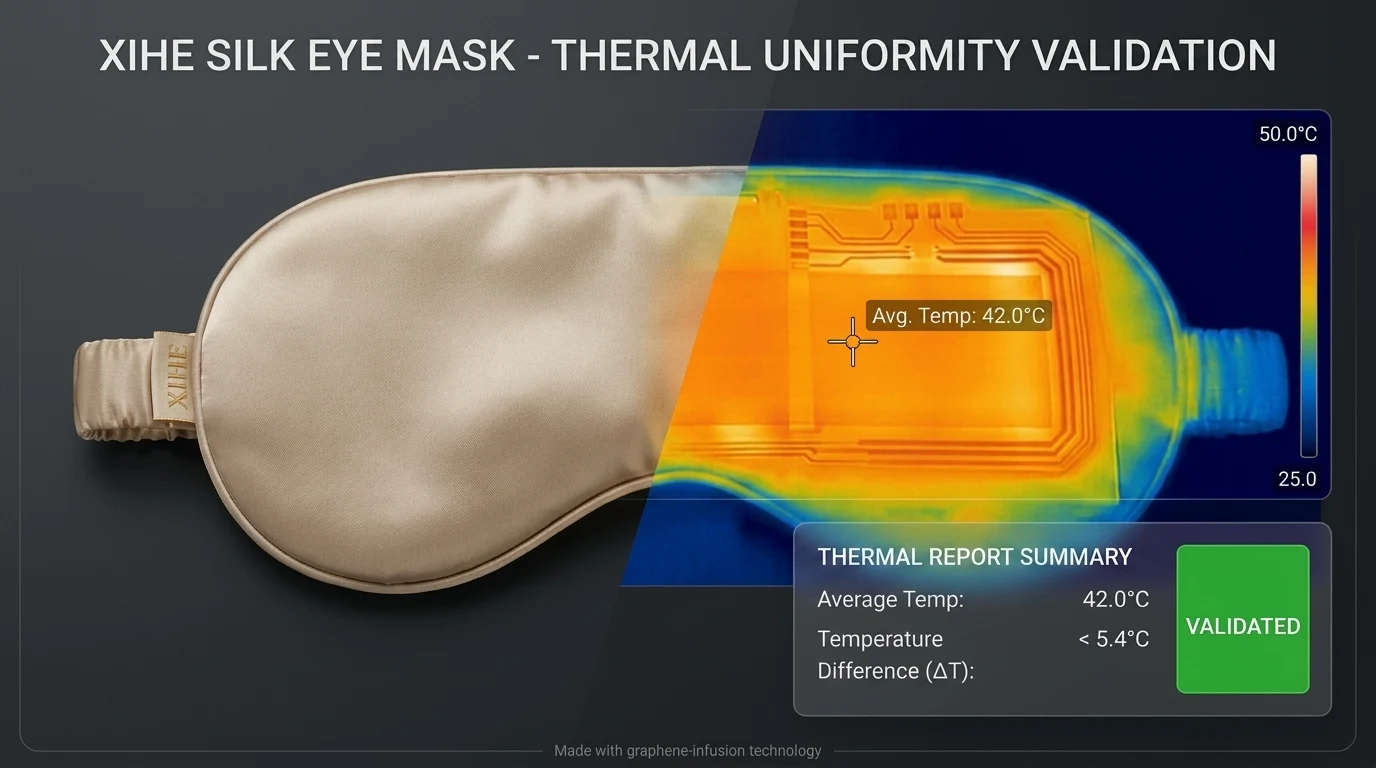 Thermal Uniformity Validation — Silk Eye Mask (Avg. 42.0°C, ΔT < 5.4°C)
 How our numbers are earned
Every headline figure traces to a stated method and report. The boundary conditions are part of the claim.
| Figure | Method / report | Condition boundary |
|---|---|---|
| 0.88 normal emissivity | NIQS test report (2022)WT-HW-00529 | Film-material level; tested sample configuration only |
| 68% infrared radiant output efficiency | NIQS test report (2022)WT-HW-00529 | Film-material level; varies with construction and operating conditions |
| 5–15 μm emission band, ~9.4 μm peak | NIQS test report (2022)WT-HW-00529 | Reported on selected configurations under specified test conditions |
| ΔT < 5.4°C temperature uniformity | Representative baseline configuration validation | Component-level result, not a finished-product guarantee |
What to send for a usable quotation
Send these items and XIHE engineering will reply with a feasibility assessment and film configuration.
01
Application and product type
What product the heater goes into and how it is used.
02
Heating area and dimensions
Length × width of the heating zone and available installation space.
03
Operating voltage
e.g. 12V DC, 110V AC, 220V AC — supported range 5–240V, AC/DC.
04
Target temperature
Operating temperature and maximum required (up to 350°C).
05
Substrate preference
PI, mica, or PET — or let engineering recommend.
06
Expected volume
Annual quantity and first-order size. MOQ 10 pcs; sampling from 1 pc.
07
Timeline
Sampling needs 10 days; confirm your project milestones.
Engineering envelope at a glance
Representative ranges for XIHE graphene heating film. Final feasibility confirmed in engineering review.
Electrical
5–240V, AC/DC
US / EU standards compatible.
Thermal
Up to 350°C
Maximum operating temperature.
Substrates
PI / Mica / PET
Substrate options for different applications.
Sampling
From 1 pc, 10 days
Custom sampling accepted; premium single-piece pricing.
Volume MOQ
10 pcs
Minimum order quantity for volume production.
Customization
Geometry and power
Film size, shape, and power density per project.
Prototyping and validation questions
What to specify, how uniformity is validated, and how a project moves from prototype to mass production.
What should I specify when requesting a custom heating film prototype?
How do you validate temperature uniformity in prototypes?
How long does it take to move from prototype to mass production?
Need a heating film for your product?
Share your product type, target heating area, operating voltage, temperature range, and expected annual volume. XIHE will review feasibility and recommend a film configuration for your project.
Temperature uniformity specifications are configurable. Tighter ΔT may be achievable for specific geometries, power densities and substrate selections. Consult XIHE engineering for application-specific feasibility.