Far Infrared Graphene Technology: 9.4 μm Resonance Engineering Platform
Precision Engineering at the Molecular Scale
Far Infrared Graphene Technology is an engineering discipline focused on designing multilayer graphene lattice systems that convert electrical energy into precisely controlled far infrared radiant energy, with spectral emissivity 0.88 NIQS-certified, 99.8% electrical-to-thermal conversion efficiency, and peak emission at 9.4 μm within the 5–15 μm therapeutic wavelength window.
Not Just Heat.
Far Infrared Graphene Resonance.
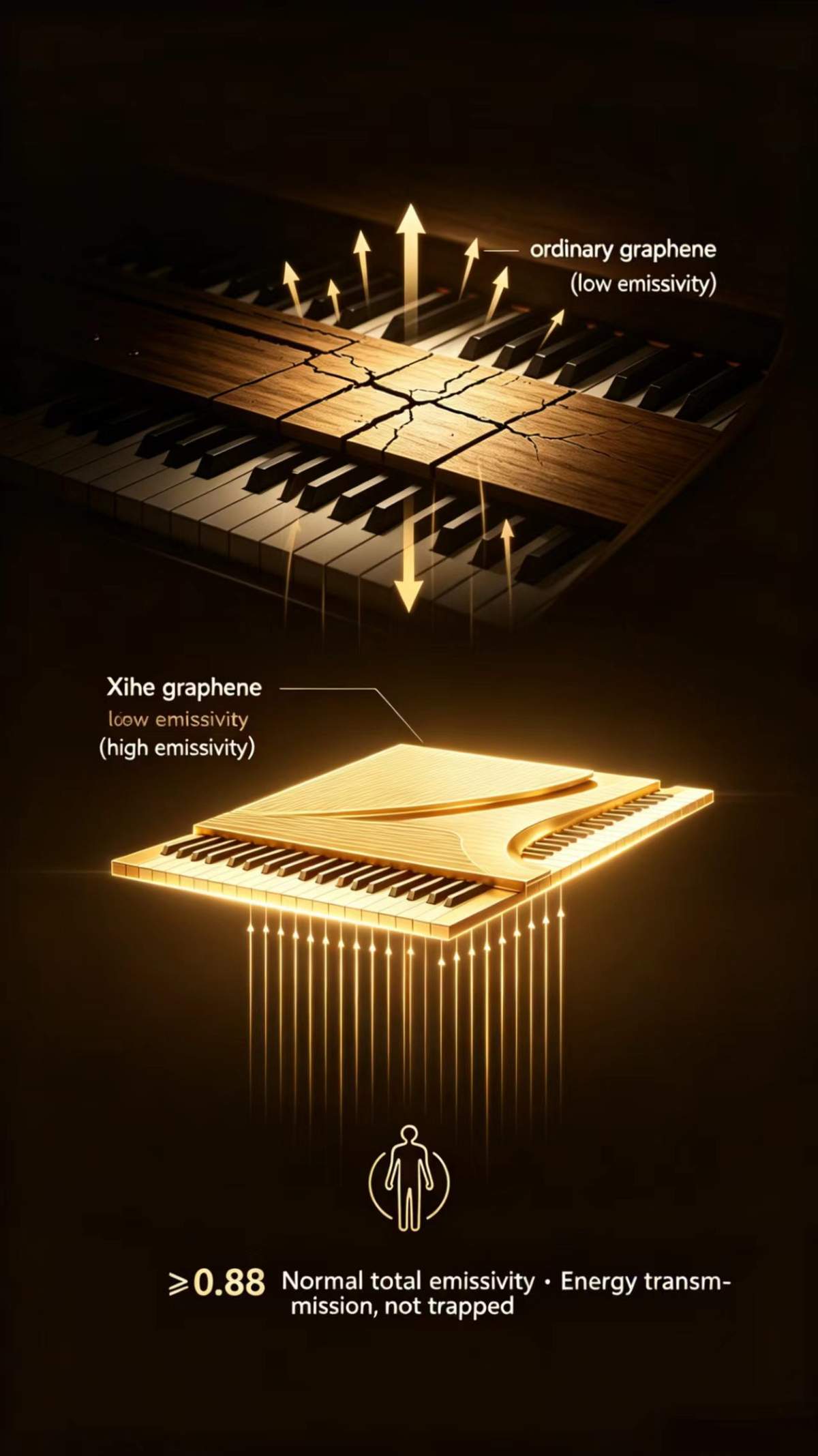
Standard graphene heating films suffer from low emissivity (0.75-0.85). XIHE's Integrated Matrix Engineering achieves 0.88 normal spectral emissivity, enabling more energy to be emitted as useful far infrared radiation rather than trapped as surface heat.
Standard Graphene Film
- Emissivity: 0.75-0.85
- Efficiency: 60-75%
- Stability: +/-2-3C drifts
- Surface heating only
- Random wavelength emission
XIHE Integrated Matrix
- Emissivity: 0.88 NIQS-certified
- Efficiency: 99.8%
- Stability: +/-0.1C, 10,000+ hrs
- 5-15um resonance delivery
- Peak emission 9.4um
XIHE 5–15 μm Far Infrared Wavelength Range
5-15um is not arbitrary. It is the precise wavelength range where water molecules in human tissue absorb far infrared photons most efficiently. Peak emission at 9.4um aligns with the body's natural thermal emission spectrum.
Molecular Resonance, Not Surface Heat
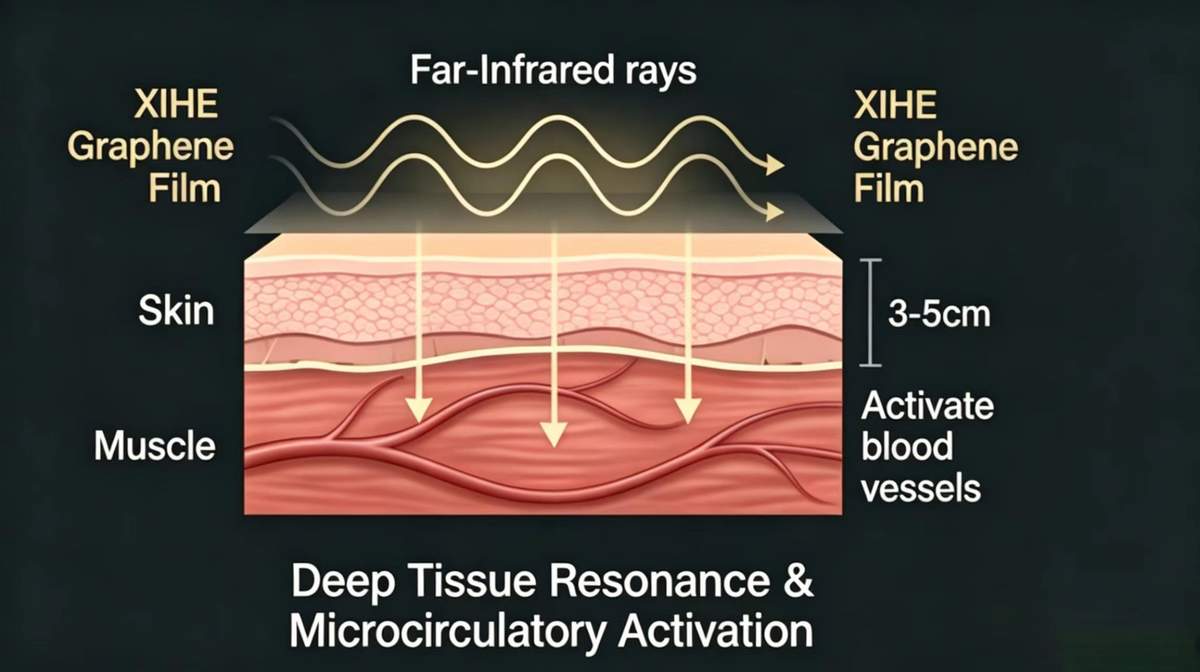
Far infrared photons at 5-15um wavelength are absorbed by water molecules in tissue, triggering molecular resonance and gentle thermal activation —not surface burning.
This is the fundamental difference between XIHE's engineered far infrared and conventional heating. The energy penetrates tissue and activates cells from within, rather than merely warming the skin.
XIHE Graphene Far Infrared 4-Layer Architecture
XIHE's graphene electrothermal film is engineered with a precise 4-layer structure. Each layer is optimized for specific performance parameters.
Integrated Matrix Engineering
Unlike standard graphene films that suffer from random wavelength emission and low efficiency, XIHE's 4-layer architecture achieves 0.88 normal spectral emissivity with 99.8% electrical-to-thermal conversion efficiency.
Each layer is precision-engineered: the graphene heating layer provides controlled electron mobility, the PET insulation ensures electrical safety, the copper electrode network delivers uniform energy distribution, and the reflective layer directs far-infrared energy toward the target surface.

01
Graphene Heating Layer
Monolayer graphene lattice with controlled electron mobility for precise far-infrared emission
02
PET Insulation Layer
Medical-grade PET film providing electrical insulation and thermal stability
03
Copper Electrode Layer
High-conductivity copper network for efficient energy transfer
04
Reflective Layer
far-infrared-reflective coating directing radiant energy toward the target surface
XIHE Far Infrared Performance: Verified Parameters
All performance parameters are validated by NIQS - National Infrared and Industrial Electric Heating Product Quality Inspection and Testing Center. Report: (2022)WT-HW-00529.
Thermal Stability Under Control
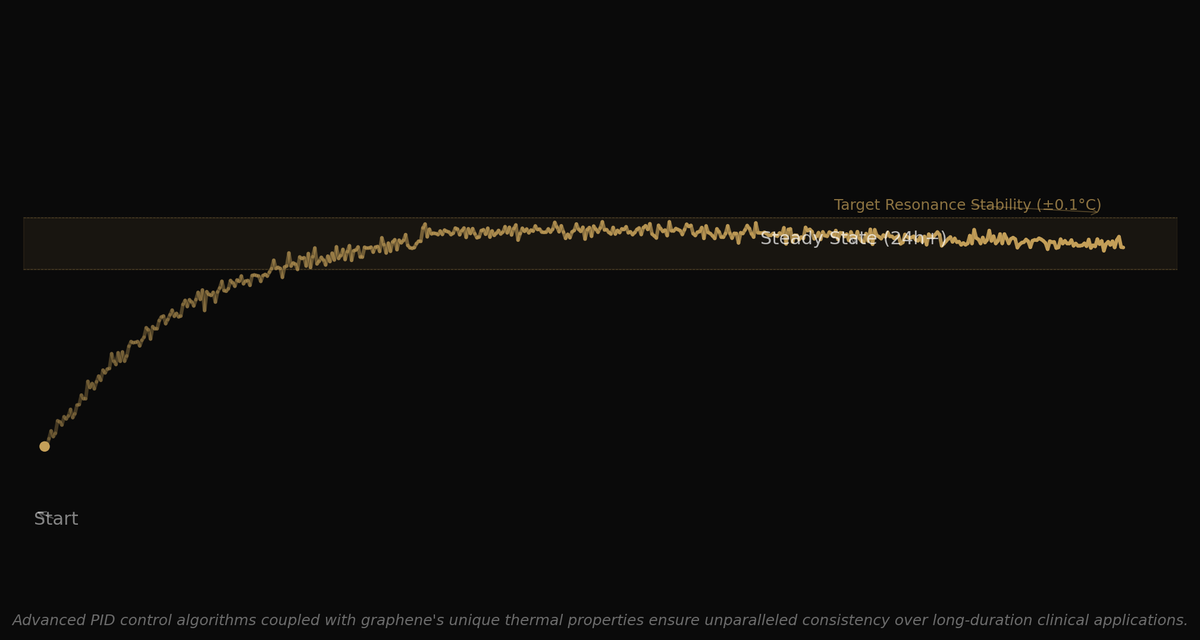
XIHE graphene film maintains +/-0.1C thermal stability over 10,000+ hours of continuous operation. This is not a laboratory curiosity —it is a production specification validated by independent testing.
Every parameter is controlled, measured, and verified. Not estimated. Not marketed. Engineered.
0.88
Emissivity (NIQS)
99.8%
Electrical-to-Thermal Conversion
±0.1°C
Thermal Stability
68%
Radiant Efficiency
5–15
FIR Band (μm)
9.4
Peak Emission (μm)
NIQS Certification
(2022)WT-HW-00529 · Verified 2026
- Emissivity: 0.88
- Radiant Efficiency: 68%
- Electrical-to-Thermal: 99.8%
NMPA Class II
Medical Device Registration · NMPA Class II
- Arthritis adjunctive treatment
- Soft tissue recovery
- Safe for clinical use
MIIT Industry Standard
Lead Drafter - 2024-0923T-YB · MIIT 2024
- Graphene Electrothermal Film
- National Standard
- Category Definition
XIHE Far Infrared Safety and Medical-Grade Standards
Safety is not an afterthought. It is a design principle. Every XIHE module is engineered to measurable performance - not marketing claims.
Non-Ionizing Far Infrared
XIHE emits non-ionizing far infrared radiation within 5-15um. Unlike X-rays or UV, far infrared does not carry sufficient energy to damage DNA or cellular structures. Safe for long-term exposure.
Near-Zero EMF Exposure
Independent testing confirms EMF levels as low as 0.08 uT - significantly lower than common household appliances. XIHE: 0.08 uT | Hair Dryer: ~10 uT | Induction Cooker: ~20 uT
40+ Core Patents
XIHE's technology platform is supported by 40+ core patents covering graphene electrothermal films, far-infrared emission systems, and spectral engineering. Intellectual property protection across China and international markets.
Independently Tested
Every module undergoes independent evaluation by the National Infrared Center. Testing includes far-infrared emission, spectral characteristics, electrical safety, and long-term stability.
XIHE vs. Conventional Heating
The Emissivity Gap
Emissivity determines how efficiently a material converts energy into useful far infrared radiation. Higher emissivity means more therapeutic output and less wasted surface heat.
XIHE's 0.88 emissivity represents a fundamental engineering advantage over conventional heating materials that operate at 0.40-0.70.
Mechanism
Efficiency
Emissivity
Stability
EMF
Wavelength
Output Uniformity
Engineering Parameters
| Parameter | XIHE Graphene FIR |
|---|---|
| Peak wavelength | 9.4 μm |
| Spectral emissivity | ≥0.88 (NIQS certified) |
| Thermal stability | ±0.1°C / 10,000+ hours |
| Electrical-to-thermal conversion | 99.8% |
| EMF level | 0.08 μT |
| Operating wavelength band | 5–15 μm |
| Custom voltage range | 3–240V |
| Output uniformity | Surface-uniform (±2% variation) |
Comparison of Infrared Heating Architectures
| Dimension | XIHE Graphene FIR | Conventional Heating |
|---|---|---|
| Energy mechanism | Far infrared resonance engineering | Surface thermal conduction |
| Wavelength control | Engineered 5–15 μm band, 9.4 μm peak | Not controlled |
| Emissivity verification | ≥0.88, NIQS certified | Usually unspecified |
| Thermal stability | ±0.1°C / 10,000+ hours | Variable |
| EMF architecture | Low-EMF source design | Depends on wiring architecture |
| Primary design target | Radiant energy delivery | Temperature rise |
| Output uniformity | Surface-uniform (±2% variation) | Hot-spot prone |
| Voltage compatibility | 3–240V custom range | Fixed voltage only |
Frequently Asked Questions About Far Infrared Graphene Technology
What is far infrared graphene technology?
How does XIHE graphene technology generate far infrared energy?
Why is wavelength important in far infrared technology?
What is the emissivity of XIHE graphene technology?
How is XIHE different from conventional graphene heating films?
Is far infrared graphene technology safe?
What certifications support XIHE technology?
How stable is XIHE graphene infrared performance over time?
Scientific References for Far Infrared Graphene Technology
- Non-Thermal Biological Effect of Graphene Far Infrared Radiation
DOI: 10.3390/ijms27073101 — IJMS 2026 discusses TNF-alpha and IL-1beta downregulation with M1-to-M2 macrophage polarization in graphene far infrared research. - Structure of graphene and its disorders: a review
PMCID: PMC6116708 - Graphene Properties, Synthesis and Applications: A Review
PMCID: PMC9568937
Continue Exploring
Technology is only the foundation. Understand how engineered far infrared energy interacts with biological systems, and explore the scientific evidence behind XIHE.
Continue Your Exploration
far-infrared Mechanism —Photon to Biology
How 9.4um far infrared photons interact with water molecules and cellular structures to trigger biological responses.
Scientific Evidence —Peer-Reviewed Research
IJMS 2026: TNF-alpha and IL-1beta downregulation, with M1-to-M2 macrophage polarization discussed in graphene far infrared research.
Cellular Energy —The Real Currency of Life
Why mitochondrial ATP production is the foundation of recovery, performance, and healthy aging.
How Mitochondria Produce ATP
The electron transport chain, cytochrome c oxidase, and the cellular engine behind far infrared biology.
Cellular Energy and ATP —A Primer
Understanding the molecule that powers every function in the human body.
Deep Recovery —From Science to Application
How XIHE translates far infrared graphene engineering into non-invasive recovery devices.
Current: Technology - Far Infrared Graphene Engineering Precision
Upstream: Far Infrared Technology & Engineering Platform
Downstream: Mechanism - Photon to Biology
Terminal: Partnership - Collaborate with Far Infrared Graphene Standard-Setter