QUICK TAKE
Production-scale proof that graphene heating technology can be manufactured and commercialized at volume: 560,000 heated garments in a single season, 0.95 emissivity, +2.3C temperature rise, 5B wash adhesion, printed on standard textile lines.
Quick Answer
Yes. Graphene heating technology has already scaled to industrial volume. XIHE deployed Far Infrared Graphene Conductive Ink across 560,000 heated garments in a single production season with Anta Sports, using standard screen-printing and gravure processes with no new production equipment. The same material platform is available for OEM textile integration today.
Key Takeaways
- 560,000 units of graphene heated apparel were produced in a single season with Anta Sports, making this one of the larger commercial applications of Far Infrared Graphene Conductive Ink in the global textile industry.
- XIHE’s ink delivered a measured 0.95 far-infrared emissivity in the Anta project context, alongside a core industrial reference point of NIQS-tested 0.88 normal spectral emissivity, a +2.3C temperature-rise result, and a 5B ISO wash-adhesion grade.
- The technology replaces traditional carbon-fiber heating wires with a flexible printed graphene layer, reducing bulk and helping avoid wire-path hot spots in the garment architecture.
- Demonstrated at ton-scale manufacturing, the ink is compatible with standard screen printing and gravure processes, without requiring new production equipment for many graphene textile OEM partners.
The Technology Behind the Milestone
At the core of the 560,000-unit production run is XIHE’s in-house Far Infrared Graphene Conductive Ink, a printable solution that applies directly to fabric using conventional textile-printing processes.
Unlike traditional resistive heating wires embedded in typical heated apparel, XIHE’s ink does not function as a bulky mechanical heating element. Instead, it absorbs body heat and re-emits it as far-infrared radiation in the 5-15 um wavelength range, with a characteristic peak near 9.4 um. This creates a reflective thermal barrier that helps keep the wearer warm without added weight or stiffness. The printed graphene layer is designed to remain flexible with the fabric and to support repeated washing within the intended product architecture.
This is the structural reason the Anta project could scale to 560,000 units while maintaining consistent production logic: the heating element is not a wire, but a material-level coating integrated into the fabric itself.
Hard Facts Table
| Performance Metric | XIHE Measured (Anta Project) | Industry Standard |
|---|---|---|
| Far-Infrared Emissivity | 0.95 (textile tested) | >=0.88 (NIQS-tested core-film reference) |
| Peak Far-Infrared Wavelength | 9.4 um | 5-15 um range |
| Far-Infrared-Induced Temperature Rise | +2.3C | >=1.4C |
| Surface Resistivity | 1.2 Ohm/sq | — |
| Wash Resistance Grade | 5B ISO Maximum Grade | — |
| Production Volume | 560,000 units (single season) | — |
| EMF Emission | Near-Zero EMF (passive radiation) | — |
Why Graphene Replaces Mechanical Heating Wires
Most heated apparel on the market today still relies on traditional carbon fiber or metal wire heating elements, a technology that introduces persistent problems for brands.
Carbon fiber wires add bulk and stiffness, create uneven heating paths, and carry durability risk when repeated bending and washing degrade the wire structure. XIHE’s Far Infrared Graphene Conductive Ink addresses those issues at the material level.
Instead of embedding rigid wires into fabric, the ink is printed directly onto the textile substrate. The mechanism is different: rather than generating heat through electrical resistance, the graphene layer absorbs body heat and re-emits it as far-infrared radiation. This creates a more uniform thermal envelope around the wearer, without bulky wires and with Near-Zero EMF positioning at the source.
For OEM partners, the implication is straightforward: this is not only an incremental improvement on older wire-based heating apparel. It is a different technology path that can improve the balance between performance, comfort, and durability.
From Winter Olympics to Mass Production
The technology first gained international visibility at the 2018 PyeongChang Winter Olympics closing ceremony, and one year later it reached 560,000 consumers through Anta Sports.
At the 2018 PyeongChang Winter Olympics closing ceremony, 72 performers wore lightweight graphene-heated costumes engineered to maintain comfort at -3C without restricting movement. The public saw graphene apparel on stage, but the deeper story was the manufacturing readiness behind it.
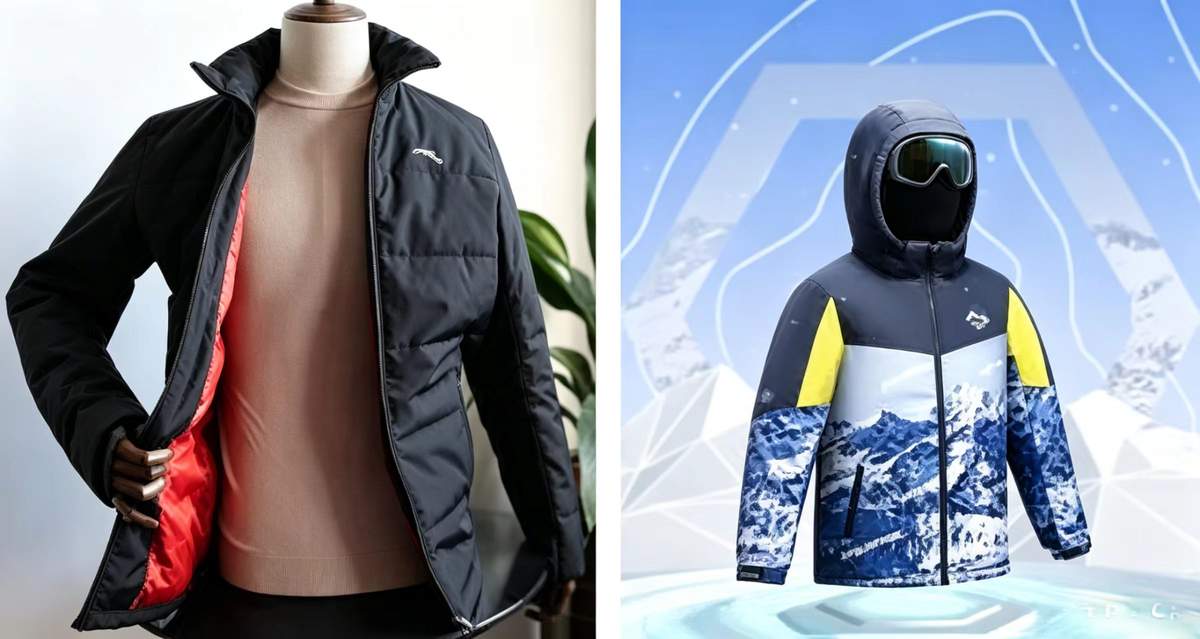
One year later, XIHE partnered with Anta Sports to bring the same core technology to the consumer market. The “Scorching Heat” and “Hurricane Warm” jacket series launched in winter 2019 across adult, children’s, and e-commerce product lines. The Anta graphene project demonstrates that XIHE’s Far Infrared Graphene Conductive Ink is not limited to laboratory-scale discussion; it is an industrial-grade material already used in a large commercial apparel program.
OEM Integration: How It Works
For graphene textile OEM partners, integrating XIHE’s ink into existing production lines does not require expensive equipment upgrades. The process follows familiar textile-printing workflows.
- STEP 01 — Ink Supply: XIHE delivers Far Infrared Graphene Conductive Ink in ton-scale batches, ready for production use.
- STEP 02 — Printing: Apply to fabric using conventional screen-printing or gravure processes already in the factory.
- STEP 03 — Curing: Standard thermal curing, with no specialized equipment required.
- STEP 04 — Quality Control: Every batch is checked against target specifications for emissivity and adhesion consistency.
This plug-and-play model allows brands to launch their own graphene heated apparel lines without building new manufacturing capacity.
Where This Fits in XIHE’s Platform
For XIHE, this Anta milestone is not only an apparel story. It is also a proof-of-manufacturing story for a far infrared graphene material system that can move from source-layer engineering into finished textile formats at commercial scale.
Readers who want the source definition behind that category can continue to the Far Infrared Graphene hub. Readers evaluating apparel-OEM relevance can continue to Graphene Clothing and Graphene Heating Film.