QUICK TAKE
There is no single best far infrared material for every application. Ceramic often wins on static high emissivity, metals remain durable and mature, carbon fiber improves flexibility, and graphene stands out when the design brief requires high emissivity, thin-film surface heating, and flexible integration.
Introduction: Far-Infrared Performance Is More Than Heat Generation
Far-infrared technology is often associated with warmth.
If you need the short answer first, graphene is usually the most engineerable option when the product brief requires thin integration, flexible form factor, and broader surface-led heat delivery. Ceramic remains strong for rigid high-emissivity emitters, while metals and carbon fiber remain relevant when durability, cost structure, or simpler heater logic matters more.
However, generating heat is only the beginning.
Every object with a temperature above absolute zero (-273.15°C) naturally emits infrared radiation. The human body, the Earth, metals, ceramics, and engineered materials all continuously exchange infrared energy with their surroundings.
Therefore, the important question is not:
Can a material emit infrared radiation?
Almost every material can.
The more important questions are:
- How efficiently does the material emit infrared energy?
- Which wavelength range does it produce?
- How uniformly is the energy distributed?
- How precisely can the emission characteristics be engineered?
These factors determine the practical performance of a far-infrared material.
For a form-factor follow-up, continue to Graphene Forms: How Material Architecture Shapes Energy Delivery or review the Graphene Heated Film product layer.
1. What Determines Far-Infrared Material Performance?
Far-infrared emission performance is commonly evaluated through several parameters:
Spectral Emissivity
Spectral emissivity describes how efficiently a material emits thermal radiation at specific wavelengths.
A higher emissivity means the material can convert thermal energy into infrared radiation more effectively.
Emission Spectrum
Different materials produce different infrared wavelength distributions.
Some materials generate broad-spectrum infrared radiation, while others can be engineered to concentrate emission within specific wavelength regions.
Energy Conversion Efficiency
For electrically powered heating systems, another important factor is how efficiently electrical energy is converted into useful thermal radiation.
Thermal Uniformity
For applications involving direct contact with the human body, such as wearable devices, uniform heat distribution becomes critical.
A material is not only defined by how much heat it produces. It is also defined by how precisely it delivers energy.
2. Four Common Far-Infrared Emission Materials
In practical far-infrared applications, four material categories are commonly used:
- Metals
- Ceramics
- Carbon fiber
- Graphene-based materials
Each represents a different approach to infrared energy generation and control.
2.1 Metals: Traditional Resistive Heating Materials
Metals are among the earliest materials used for electrical heating applications.
Common examples include:
- nickel-chromium alloys
- iron-chromium-aluminum alloys
- stainless steel heating elements
Their operating principle is based on resistive heating.
When electrical current passes through the material, resistance generates heat, and the heated surface emits infrared radiation.
However, metals generally have relatively low infrared emissivity.
Typical emissivity ranges:
| Material | Approximate emissivity |
|---|---|
| Polished aluminum | 0.03–0.09 |
| Stainless steel | 0.07–0.30 |
| Oxidized metal surfaces | 0.30–0.70 |
The advantage of metals is reliability and durability.
The limitation is that much of the energy remains as conductive or convective heat rather than optimized infrared emission.
2.2 Ceramics: High-Emissivity Infrared Emitters
Ceramic materials improved infrared performance through their molecular vibration characteristics.
Many ceramic infrared emitters use metal oxides or specially formulated compounds to enhance radiation efficiency.
Typical far-infrared emissivity:
| Material | Approximate emissivity |
|---|---|
| Infrared ceramic materials | 0.78–0.95 |
Ceramics are widely used in:
- industrial infrared heaters
- stationary heating systems
- thermal processing equipment
Their advantages include:
- good thermal stability
- high infrared emissivity
- long operating life
However, ceramics typically have limitations in:
- flexibility
- lightweight integration
- wearable applications
2.3 Carbon Fiber: Flexible Heating Technology
Carbon fiber introduced greater flexibility into heating applications.
Unlike metal wires, carbon fiber structures can create lightweight heating elements suitable for fabrics and flexible products.
The working principle remains resistive heating:
Electrical energy → heat generation → infrared emission
Typical characteristics:
| Parameter | Carbon Fiber |
|---|---|
| Infrared emissivity | approximately 0.75–0.88 |
| Structure | fiber-based heating element |
| Heating pattern | depends on fiber arrangement |
| Flexibility | high |
Carbon fiber is a mature and practical technology.
However, because heating depends on fiber distribution, performance can be influenced by:
- fiber density
- weaving structure
- contact uniformity
The engineering challenge is achieving a consistent surface energy distribution.
2.4 Graphene: A New Generation of Thin-Film Energy Materials
Graphene represents a different material architecture.
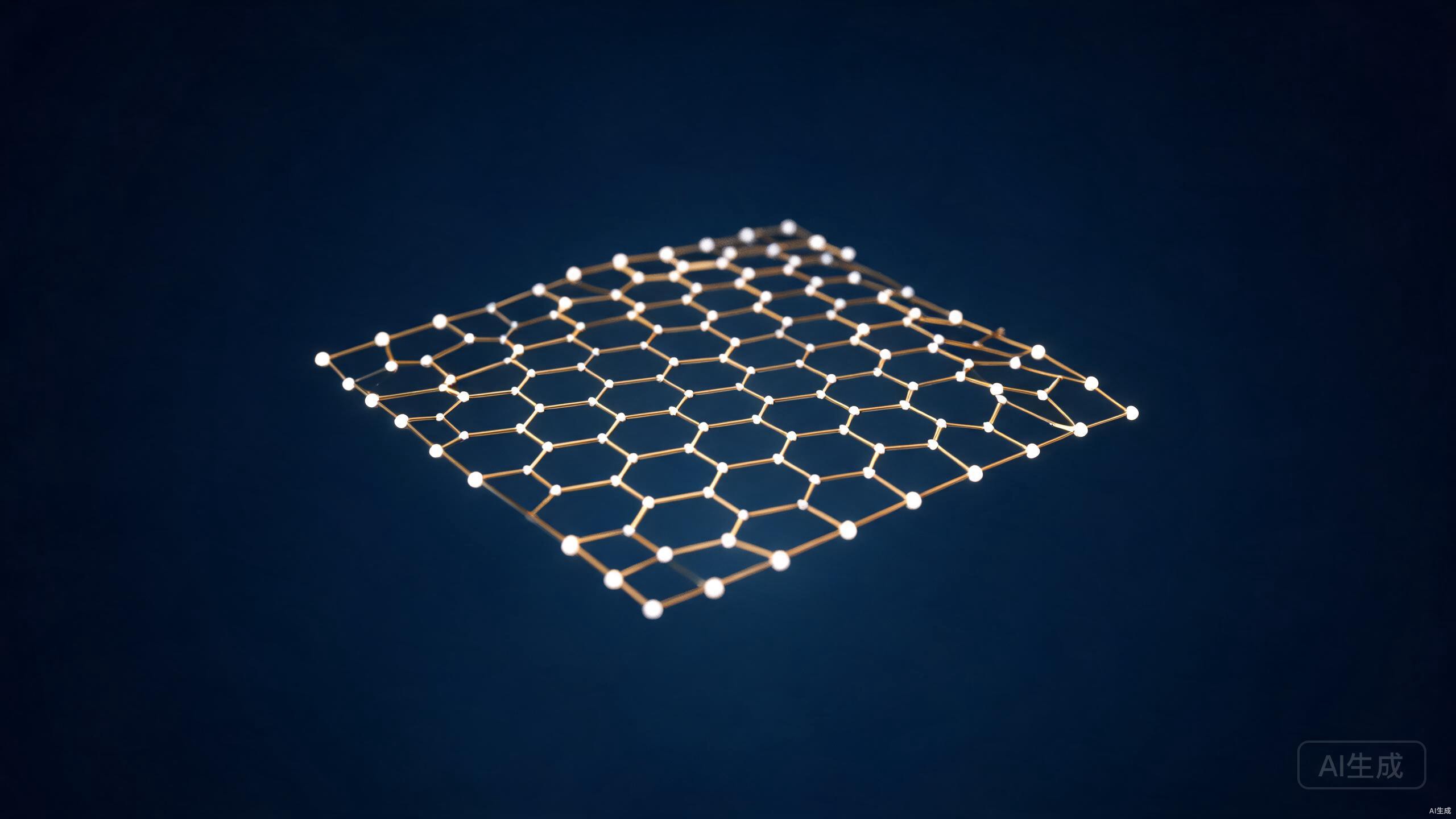
Unlike conventional fiber or wire-based heating systems, graphene can be engineered into ultra-thin conductive films.
This enables a surface-based heating approach.
Typical characteristics of graphene-based far-infrared films:
| Parameter | Graphene Film |
|---|---|
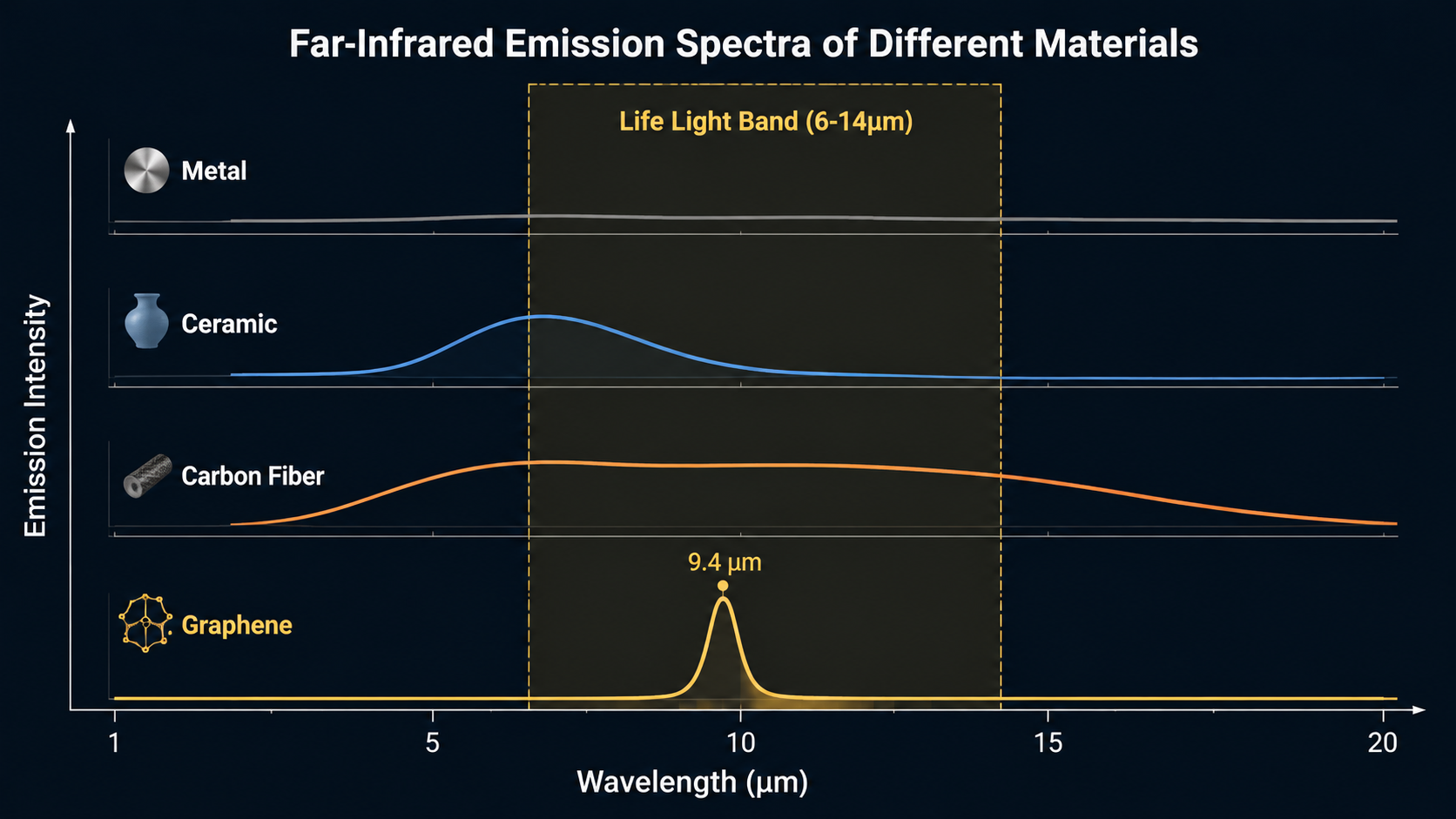
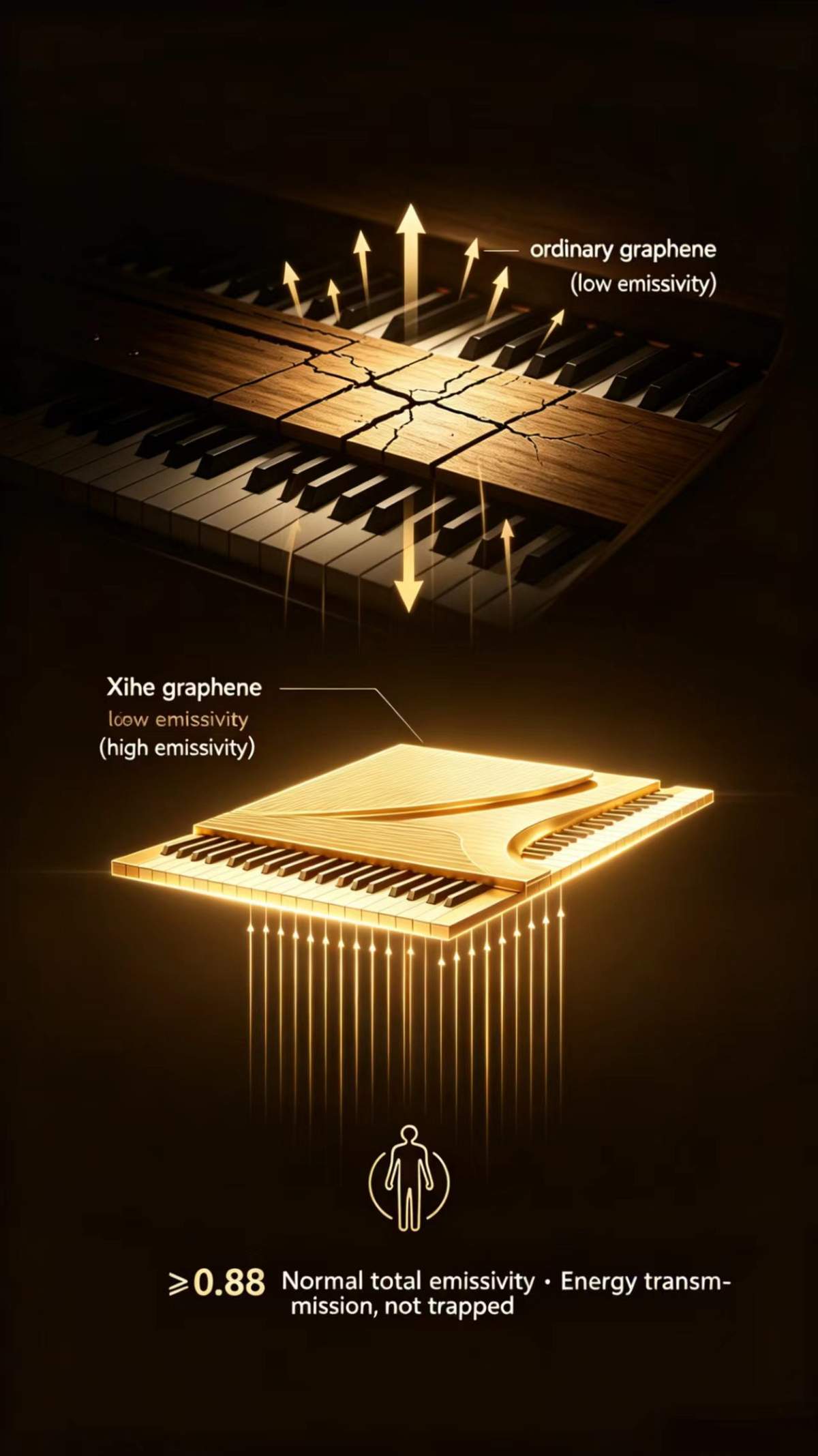
| Spectral emissivity | ≥0.88 (tested value, depending on structure) |
| Heating architecture | thin-film surface heating |
| Temperature distribution | highly uniform |
| Flexibility | excellent |
| Integration capability | high |
The significance of graphene is not only its ability to generate heat.
Its advantage lies in combining:
- high infrared emissivity
- uniform surface energy distribution
- flexible material integration
Graphene shifts far-infrared technology from simply creating heat toward engineering energy delivery.
3. Comparison of Far-Infrared Material Architectures
| Feature | Metal | Ceramic | Carbon Fiber | Graphene |
|---|---|---|---|---|
| Primary function | heat generation | infrared emission | flexible heating | energy delivery engineering |
| Structure | wire / surface | ceramic body | carbon fibers | carbon lattice thin film |
| Emissivity | low–medium | high | medium–high | high |
| Flexibility | low | low | medium | high |
| Surface uniformity | limited | good | depends on structure | excellent |
| Wearable integration | limited | limited | common | advanced |
The evolution of far-infrared materials is not simply a competition of temperature.
It is a progression from:
generating heat → improving emission → controlling energy distribution
4. Case Study: Graphene Heating Eye Mask
A wearable eye mask demonstrates why material architecture matters.
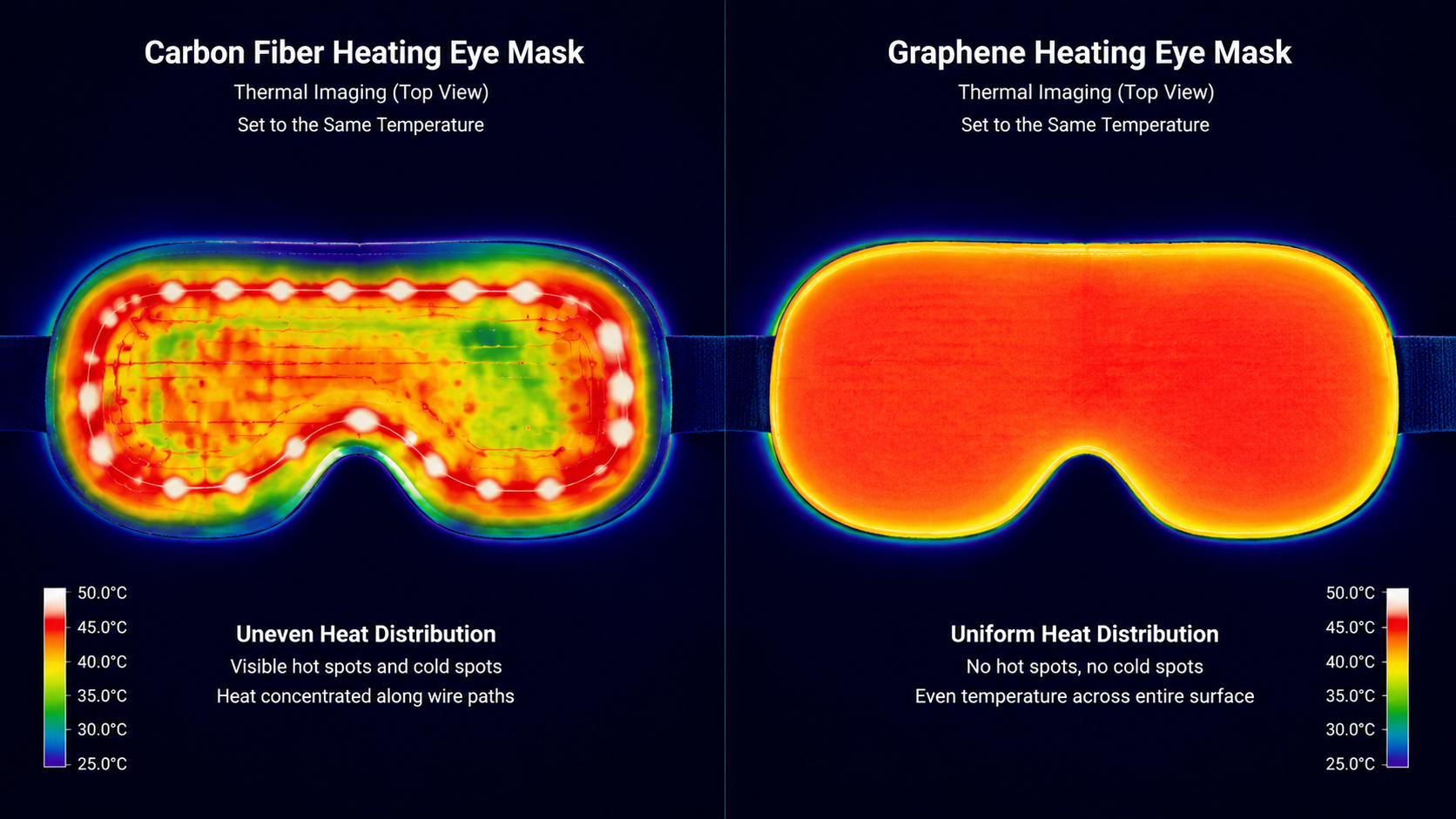
Traditional carbon fiber heating masks use fiber-based heating elements.
Because heat originates from individual fibers, the final experience depends on:
- fiber arrangement
- spacing
- manufacturing precision
Users may perceive differences between warmer and cooler areas.
Graphene thin-film heating structures work differently.
Instead of relying on separate heating lines, the material forms a continuous heating surface.
This creates:
- more uniform temperature distribution
- thinner product design
- improved flexibility
- closer surface conformity
The difference is not simply:
“hotter versus cooler.”
It is:
localized heating versus engineered surface energy distribution.

5. Beyond Emissivity: Why Material Architecture Matters
Emissivity is an important measurement.
But it is not the only factor determining real-world performance.
A complete far-infrared system depends on:
- material structure
- electrical design
- thermal management
- surface engineering
- application form
The same graphene material can be engineered into different architectures:
Graphene Film
Designed for large-area energy distribution.
Applications:
- far-infrared cabins
- environmental heating systems
Graphene Modules
Designed for integrated environments.
Applications:
- mattresses
- cushions
- heating surfaces
Wearable Graphene Devices
Designed for localized applications.
Applications:
- eye masks
- supports
- flexible wearable products
Different forms create different energy delivery pathways.
6. Evidence & Testing: How XIHE Verifies Material Performance
Material claims are only useful when they are tied to documented test methods.
XIHE graphene far-infrared materials are characterized through:
| Test Item | Reported Value | Test Context |
|---|---|---|
| Normal spectral emissivity | ≥0.88 | NIQS test report WT-HW-00529 |
| Operating wavelength band | 5–15 μm | Stable far-infrared emission band |
| Peak emission wavelength | 9.4 μm | Engineered characteristic peak |
| Electrical-to-thermal conversion | 99.8% | Energy conversion at film level |
| Infrared radiant output efficiency | 68% | Heat-to-radiant conversion under test conditions |
These values are reported under controlled test conditions. They provide a common reference for buyers, engineers, and partners evaluating material options.
7. Why Graphene Represents the Future of Far-Infrared Materials
The development of far-infrared materials reflects a broader evolution in material engineering.
- Metal focused on: producing heat.
- Ceramic improved: infrared emission efficiency.
- Carbon fiber introduced: flexible heating structures.
- Graphene enables: precise energy delivery architectures.
The future of far-infrared technology is not only about increasing temperature.
It is about controlling:
- where energy is delivered
- how uniformly it is distributed
- how efficiently it interacts with an environment
Graphene is not simply another heating material.
It represents a new approach:
engineering the pathway between energy generation and energy delivery.
About XIHE Graphene Platform
XIHE develops graphene-based far-infrared material technologies focused on thin-film energy systems and flexible applications.
Through graphene material engineering, infrared emission testing, and application-specific design, XIHE explores how advanced carbon materials can create more precise and efficient energy delivery solutions.
Last verified: . Test values are reported under specific conditions; actual performance depends on integration design and operating environment.