Graphene Heating Film OEM vs. ODM: What Buyers Need to Know
Understand the difference between OEM, ODM, and white-label graphene heating solutions. Find the right partnership model for your product with XIHE's engineering support.
QUICK ANSWER
Choosing the right manufacturing partnership model — OEM, ODM, or white label — is one of the earliest and most consequential decisions in bringing a heating product to market. This guide breaks down what each model means for graphene heating film, how to decide which fits your situation, what engineering and manufacturing capabilities to evaluate in a partner, the structured cooperation process, IP and commercial terms, and common mistakes to avoid.
Reference Signals
Choosing the right manufacturing partnership model is one of the earliest and most consequential decisions in bringing a heating product to market. Pick the wrong model, and you may end up paying for design work you do not need, losing control of intellectual property you thought you owned, or waiting months for a “white label” product that does not actually exist off the shelf.
XIHE works with brands, equipment manufacturers, and product teams across three cooperation models — OEM, ODM, and white label — each suited to different stages of product maturity and internal capability. This guide breaks down what each model means for graphene heating film, how to decide which one fits your situation, and what to look for in a partner.
Primary CTA — Start a Technical Review
Secondary CTA — Discuss Your Project Requirements
1. Why Choosing the Right Partnership Model Matters
Buyers who select a cooperation model without matching it to their internal capabilities typically encounter one of four problems downstream:
You chose OEM but have no design capability. You send a rough sketch and ask for an “OEM quote,” assuming the supplier will fill in the engineering gaps. What you get is a quote that keeps changing as the supplier discovers missing parameters, and the project loses weeks in clarification cycles.
You chose ODM but want to retain design control. You engage an ODM to design the product, then realize you want to approve every circuit detail, select every material, and own every revision. The ODM’s standard process cannot accommodate this level of involvement without effectively becoming an OEM relationship — and the pricing and timeline were never set up for that.
You assumed white label means off-the-shelf availability. You see “white label service” on a supplier’s website and expect 500 branded units next week. What you discover is that white label means the product carries your brand — but the product itself may still need design, tooling, or certification for your market. The timeline is months, not weeks.
You found a prototype shop that cannot scale to production. The first samples look great, the test data checks out, and you place a production order. Then quality drops, lead times stretch, and the supplier explains that “production is handled by a partner factory.” The engineering team that made your prototype is not the same team running your production.
For graphene heating film, where thermal performance depends on substrate selection, circuit pattern design, encapsulation, and control integration — all interacting — these mismatches are expensive to correct. The right model at the start saves iterations, protects IP, and ensures the supplier’s capabilities match what you actually need.
Who this guide is for — This article is for procurement managers, product managers, and founding teams evaluating graphene heating film suppliers. It helps you determine which cooperation model — OEM, ODM, or white label — fits your situation, and what engineering capabilities to assess in a partner.
2. OEM vs ODM vs White Label: What’s the Difference?
The three most common cooperation models each define a different division of responsibility between customer and supplier.
Comparison at a glance
| Dimension | OEM | ODM | White Label |
|---|---|---|---|
| Core definition | Customer provides design/spec; supplier manufactures to spec | Supplier handles design + manufacturing; customer brands the product | Supplier provides a standard/semi-standard product under customer’s brand |
| Design responsibility | Customer | Supplier | Product already exists (or is a minor variant) |
| Brand | Customer’s brand | Customer’s brand | Customer’s brand |
| Typical customer | Companies with in-house engineering or existing design | Brands/startups with a product concept but no thermal design team | Resellers, e-commerce brands, fast market entry |
| Upfront investment | Lower — design already exists | Higher — includes engineering effort | Varies by product availability |
| IP arrangement | Customer owns app-specific design; supplier owns base heating tech | Customer owns finished product design; supplier owns underlying platform | Supplier owns base design; customer owns brand |
| XIHE availability | Available | Available | Standard service (feasibility per project) |
OEM: Build to your drawing
OEM is the right model when you have a clear specification — dimensions, voltage, power, substrate, temperature target — and need a supplier who can manufacture it consistently.
Real-world scenario: A seat cushion manufacturer has a complete product design including the heating element specification (12V DC, specific shape, target surface temperature). They need a supplier who can produce the graphene heating film to their drawing, integrate NTC sensors, and deliver consistent quality from prototype through mass production. The customer keeps full design control; the supplier’s role is manufacturing excellence and process consistency.
XIHE’s OEM work ranges from low-voltage DC wearables to line-voltage AC industrial heating panels, where the customer provides the specification and XIHE handles fabrication, testing, and production ramp. See a commercial swine equipment case study for an industrial panel example.
ODM: Design + build for your brand
ODM is the right model when you have a product concept and target market, but no in-house thermal engineering team. The supplier takes your product requirements and delivers a complete heating solution — designed, prototyped, and manufactured — that you sell under your own brand.
Real-world scenario: A wellness brand wants to launch a far-infrared recovery pod. They know the market and user experience, but they do not have engineers who can design the graphene heating system or optimize thermal uniformity. They partner with an ODM who handles the complete heating system design — element layout, control integration, safety features — and delivers a finished sub-assembly ready for the brand’s enclosure.
XIHE’s ODM projects cover product categories including recovery pods, eye masks, neck protectors, and hair care caps.
White label: Brand it and sell it
White label is a specific type of ODM where the product already exists in a standard or near-standard form, and the customer simply applies their own brand. The key distinction from full ODM is minimal custom design work — the product is essentially ready, and you are branding it rather than co-developing it.
White label feasibility note — White label service is available as a standard offering, but feasibility depends on the specific product concept. Not every product form is available as a finished assembly off the shelf. The fastest way to assess feasibility is to send your product concept — target application, form factor, expected volume — for a review.
3. How to Choose the Right Model
Selecting the right cooperation model starts with an honest assessment of what you have, what you need, and what you want to own.
Start with: Do you have a complete heating element design?
- Yes → You have CAD drawings, a full spec, and engineering capability to review changes. OEM is likely the right model. You bring the design; the supplier brings manufacturing.
- No, but we have a clear product concept → You know what the product should do, but no thermal engineer on staff. ODM is likely the right model. You bring the vision; the supplier brings engineering and manufacturing.
- No, and we want to sell an existing product under our brand → You’ve identified a market opportunity for a product that already exists. White label may be right, if the product is available. Send your concept to confirm feasibility.
Then ask: Where do you want to add value?
- If your strength is engineering and product design → OEM lets you control design while outsourcing manufacturing
- If your strength is brand, marketing, and distribution → ODM or white label lets you focus on go-to-market
- If your strength is channels and retail → White label gives the fastest path to market
The XIHE Inside model
For customers who already have a finished product and want to add graphene heating as a feature — rather than sourcing a standalone component — XIHE offers the XIHE Inside model. This is a deeper integration partnership where XIHE works with your engineering team to embed graphene heating technology into your existing product architecture. This model is common in outdoor equipment, automotive interiors, and battery thermal management — where heating is a feature of a larger product, not the product itself.
Not sure which model fits? — You do not need to know the exact model before reaching out. Share what you have — a sketch, a product description, a reference photo — and the engineering team can help you assess which model makes the most sense.
4. What to Look for in an OEM/ODM Partner
Regardless of which model you choose, the quality of your product depends on your partner’s engineering and manufacturing capabilities. Here is what to evaluate.
Engineering capability
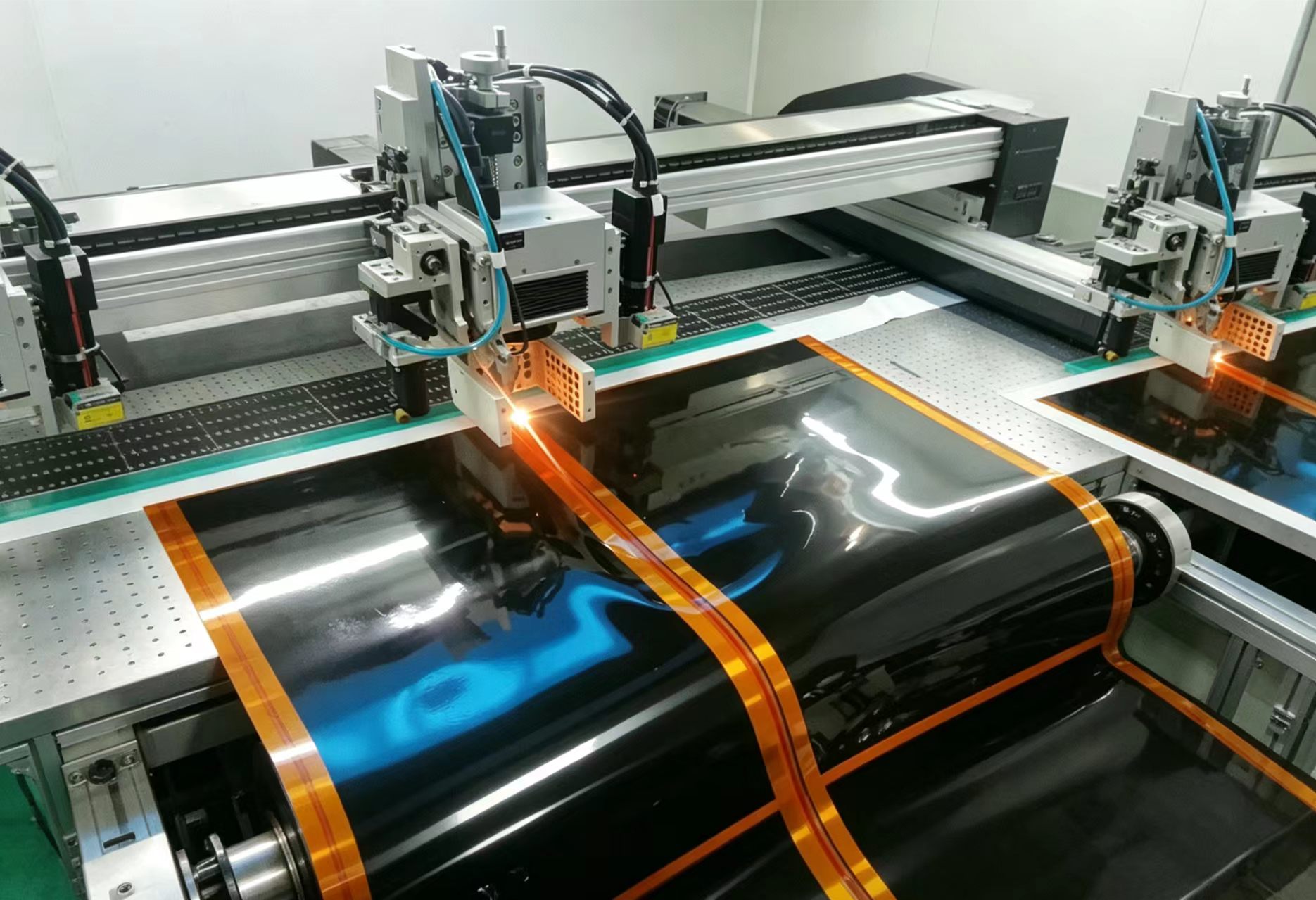
Graphene heating film’s key advantage over wire or etched-foil heaters is that the heating pattern is printed — not wound or etched through a mask. This means the circuit layout can be optimized for your specific shape and uniformity requirements without new tooling.
The practical value shows up in design iteration speed and uniformity improvement. In a commercial swine equipment OEM project — a graphene-on-mica heating panel — two design iterations were compared under identical test conditions (case study):
Edge Compensation — Design Optimization Case Study
Test conditions (identical for both versions): 220-point receiving-plane temperature grid, 500 mm vertical distance from the panel surface, graphene-on-mica substrate. Only variable: printed circuit pattern and resulting input power.
Metric V1 Prototype V2 Accepted Change Max ΔT 8.20°C 6.00°C −26.8% Points above 37°C 4.55% (10 pts) 0 Eliminated Coldest point 29.9°C (corners) 30.9°C +1.0°C The improvement came from only modifying the printed circuit pattern — redistributing current paths from the overheating center toward cooler edges. This edge compensation design offsets boundary heat losses, a capability uniquely practical with printed graphene films.
Note: Results from a specific project under defined test conditions (receiving-plane temperature at 500 mm vertical distance from the panel, 220-point grid). Not a universal specification. Performance varies by heater size, shape, power density, substrate, and measurement method.
When evaluating partners, ask to see before/after optimization data from a real project. It demonstrates both engineering methodology and transparent performance data — two signs of a serious partner.
Manufacturing quality
Temperature uniformity at scale. The ultimate test is whether every unit from a production batch has the same thermal profile. Look for suppliers who verify uniformity with thermal imaging rather than spot-checking with thermocouples.
In a commercial swine equipment OEM project — a 2.4 m² livestock heating panel tested with a 240-point grid at 900 mm vertical distance from the panel surface — achieved a maximum temperature difference (ΔT_max) of just 2.4°C (case study).
Important qualification — The 2.4°C figure is from a specific project (2.4 m² livestock heating panel) under specific test conditions (210W input, 900 mm vertical measurement distance from the panel surface, 240-point grid, receiving-plane temperature — not surface temperature). This should not be generalized as a universal uniformity specification.
Material reliability. The base material’s performance sets the ceiling for the finished product. XIHE’s material-level test data includes:
| Parameter | Reference Value | Qualification |
|---|---|---|
| Far-IR emissivity | 0.88; stable across 5–15 μm band, peak at ~9.4 μm | Material-level, NIQS certified (July 2022). Exceeds national standard (≥0.83). |
| Thermal stability | <3.4% resistance change after 240h continuous aging | Material-level indicator. National standard threshold ≤10%. |
| Dynamic bending | −0.9% resistance change after 10,000 cycles @ 10 mm radius | Material-level, bare film. Finished product life depends on encapsulation. |
| Humidity aging | +1.8% resistance change after 500+ hours exposure | Material-level, bare film. Finished product depends on encapsulation quality. |
Evidence discipline — Material-level data describes the base material’s characteristics. Finished product performance depends on encapsulation, construction, and application. A reputable supplier will always distinguish between material-level test results and product-level guarantees.
NTC temperature sensing — standard. NTC thermistors are included as standard on all custom heater prototypes and production units, enabling closed-loop temperature control. Over-temperature protection can be added per project requirements.
Verification capability
A supplier without systematic verification capability is shipping blind. The seven verification domains relevant to heating film:
| Domain | What It Covers |
|---|---|
| Electrical | Resistance, voltage, current, power draw |
| Thermal | Temperature rise, steady-state, stability |
| Uniformity | ΔT across heating area, hot spot detection |
| Mechanical | Bending, flexing, vibration resistance |
| Environmental | Humidity, temperature cycling, dust/water |
| Safety & compliance | Insulation, dielectric strength, over-temp protection |
| Control integration | Sensor accuracy, closed-loop behavior |
Not every test is needed for every project — the scope should match the application. What matters is that the supplier has the capability and methodology.
Production capability
Key indicators of production capability:
- Low MOQ: Standard production MOQ is 10 pieces — made possible by in-house printing and cutting equipment. Prototypes start from 1 piece.
- Batch traceability: Every batch traceable to material lots, process parameters, and inspection records
- Incoming QC: Material quality starts at receiving
- 100% electrical testing: Every unit tested for resistance and continuity
XIHE Quality Control Baseline — Every heating element undergoes 100% electrical testing, batch traceability, and incoming material QC. This baseline applies across OEM, ODM, and white label.
Compliance responsibility
| Responsibility | Supplier (XIHE) | Customer | Joint |
|---|---|---|---|
| Material declarations (RoHS/REACH) | Component-level | — | — |
| Component electrical testing | Per-unit testing | — | — |
| End-product certs (UL/CE/ETL) | — | Full product | Component data provided |
| EMC compliance | — | System-level | Component data provided |
| Production QC | In-process + final | — | — |
Compliance note — Component-level test results do not automatically certify the finished device. The complete product — power supply, controls, enclosure, intended use — must be assessed against applicable market requirements.
5. The XIHE OEM/ODM Process
Whether you choose OEM, ODM, or white label, the cooperation follows a structured workflow.
Phase 1: Requirements & feasibility assessment
Both sides align on product needs, constraints, and feasibility.
- Input: Your product concept, spec, or drawing
- Output: Feasibility assessment, preliminary concept, budgetary quote
- Timeline: 2–3 business days for standard projects
Phase 2: Solution design & formal quotation
Engineering develops the detailed design.
- Input: Confirmed requirements brief
- Output: Detailed design proposal, formal quotation, lead time confirmation
- Timeline: 3–5 business days (varies by complexity)
Phase 3: Prototyping & validation
Design moves from drawing to physical sample.
- Input: Approved design + prototype PO
- Output: Prototype sample(s) with test data
- Timeline: ~10 working days for standard projects
Lead time clarification — The ~10-day figure applies to standard prototypes — single-zone or simple multi-zone film on PI/PET/fiberglass with standard lead wires. Complex projects — high-temperature mica, silicone encapsulation, integrated control modules — may require more time and are evaluated case-by-case.
Phase 4: Design freeze & pilot production
Once the prototype meets acceptance criteria, design is frozen and a pilot run validates the production process.
- Output: Pilot batch (typically 10–100 units), quality baseline, control plan
- Timeline: Case-by-case
The pilot run catches issues that only appear at scale: material batch variation, process yield, and inspection throughput.
Phase 5: Mass production & QC
With the process validated, the product moves to regular volume production.
- Output: Production quantity, batch inspection records, traceability documentation
- Reorder lead time: Confirmed per project
Phase 6: Continuous optimization
As volumes grow, opportunities include cost-down, performance improvement, yield optimization, and new feature addition.
6. IP, Naming and Commercial Terms
IP ownership
Intellectual property ownership is agreed in writing before the project agreement begins.
The standard arrangement:
- Customer-owned: Application-specific design configurations, product-specific shape/dimensions, customer-brand elements, custom features unique to the customer’s product
- XIHE-owned: Underlying graphene heating technology, base material formulations, standard circuit design methodologies, manufacturing process know-how
The key principle: IP is discussed and documented upfront — not negotiated after delivery.
Branding and white label
White label service is available as a standard offering. Customers brand heating products under their own name — XIHE manufactures, customer handles marketing and distribution.
Feasibility depends on the specific product concept. Not every form is available as a finished assembly. Send your concept for a feasibility review.
MOQ and lead time
| Item | Standard Value | Notes |
|---|---|---|
| Prototype MOQ | 1 piece | For initial evaluation |
| Production MOQ | 10 pieces | In-house printing enables low MOQ |
| Standard prototype lead time | ~10 working days | Standard projects only; complex case-by-case |
| Production lead time | Confirmed per project | Depends on quantity, complexity, material availability |
Design change management
- Before design freeze: Changes handled as design iterations
- After design freeze: Changes go through Engineering Change Request (ECR) process — impact on performance, cost, and lead time assessed before implementation
- During production: Changes require additional validation
Every change — even moving a lead wire by 5 mm — can affect uniformity, resistance, and yield.
7. Common Mistakes to Avoid
Mistake 1: Choosing the cheapest supplier and paying more in rework
You select a supplier based on lowest per-unit price, only to discover their engineering capability is limited. Multiple iterations, delay costs, and management time end up costing more than a capable supplier would have.
Better approach: Evaluate on total cost of getting to a production-ready product, not just unit price. Ask about iteration speed, engineering support, verification capability, and prototype-to-production consistency.
Mistake 2: Confusing white label with off-the-shelf availability
“White label” describes the branding arrangement, not the product’s readiness level. A white label product can be anything from truly off-the-shelf to completely custom.
Better approach: Ask specifically about current lead time, existing certifications, and what customization affects timeline. Be upfront about your go-to-market timeline.
Mistake 3: Not discussing IP ownership until after delivery
IP is easy to defer when everyone is focused on the first sample. But it becomes a serious problem when the product succeeds and you want to scale — or when the partnership ends.
Better approach: Raise IP ownership in the first conversation. Ask about their standard IP arrangement, what they own, what you own, and what is negotiable. Get it in writing.
Mistake 4: Underestimating the prototype-to-production gap
A prototype is typically built by senior technicians with hand-selected materials. Mass production is built by production lines with standard materials and repeatable processes. The gap between “one good one” and “a thousand consistent ones” is where quality issues hide.
Better approach: Plan a pilot run (10–100 pieces) between prototype and full production. Ask what changes between prototype and production — different equipment, operators, material sourcing — and what controls maintain consistency.
8. FAQ
What is the difference between OEM and ODM for graphene heating film?
OEM means you provide the design/specification and the supplier manufactures to your drawing. ODM means the supplier both designs and manufactures, and you sell under your own brand. The key difference is who is responsible for the design: you (OEM) or the supplier (ODM).
Do you offer white label service?
Yes, white label service is available as a standard offering. However, feasibility depends on the specific product concept — not every form is available as a finished assembly. Send your product concept for a feasibility review.
What is the minimum order quantity (MOQ)?
The standard MOQ for mass production is 10 pieces, made possible by in-house printing and cutting equipment. Prototype quantities start from 1 piece.
How long does prototyping take?
For standard projects — simple single-zone or multi-zone film on PI/PET/fiberglass with basic lead wires — typically ~10 working days from design approval. Complex projects with custom encapsulation or integrated controls are evaluated case-by-case.
Who owns the design and IP?
IP ownership is agreed in writing before the project begins. For most OEM projects, the customer owns the application-specific design while XIHE retains the underlying heating technology platform. For ODM projects, the arrangement is confirmed during quotation.
Can you customize the size, shape, and power?
Yes. Custom dimensions, shapes, and power ratings can be discussed against your requirements, including edge-compensated layouts for cold corners. Laser-cutting supports a wide range of geometries within the standard width limit (≤500mm). Final configuration depends on feasibility and constraints.
What substrate materials do you offer?
XIHE offers several substrate options: PI (polyimide) for low-to-medium temperature thin profiles, PET for low-temperature cost-effective applications, mica for high-temperature rigid use, fiberglass for medium-to-high temperature with dimensional stability, and silicone encapsulation for waterproof flexible applications. The right substrate depends on your target temperature, environment, and mechanical requirements.
What quality control measures do you have?
Every heating element undergoes 100% electrical testing (resistance, continuity) before shipment. Additional measures include incoming material QC, batch traceability, dimensional inspection, and thermal imaging verification where applicable. The specific QC plan is aligned with customer requirements.
Who is responsible for product certification?
XIHE provides component-level material declarations (RoHS/REACH) and electrical test data. End-product certifications — UL, CE, ETL, EMC — are the customer’s responsibility, as they apply to the complete product including power supply, controls, enclosure, and intended use. XIHE supports customers by providing component-level data for certification submissions.
How do I start a project?
Share what you know: application, dimensions or drawing, operating voltage, target temperature, quantity, and timeline. If you are unsure about some details, that is fine — the engineering review helps fill gaps. You will receive a feasibility assessment, proposed scope, and confirmed timeline — typically within 2–3 business days.
9. Ready to Start Your OEM/ODM Project?
Before you reach out, here is a quick preparation checklist:
- Do you know your target application and end user?
- Do you have dimensions, a drawing, or at least a sketch?
- Do you know your operating voltage (3.7V–48V DC or 110V–240V AC)?
- Do you have a target temperature or power requirement?
- Have you identified your preferred cooperation model (OEM / ODM / white label)?
- Do you know your approximate prototype and production quantities?
- Have you considered compliance requirements for your market?
If you answered “no” to some, that is expected — especially at an early stage. Share what you know and flag what you do not. An experienced partner will help fill the gaps during the engineering review.
Start a Technical Review — Send your project details to our engineering team. We will review your requirements, assess feasibility, and propose the right cooperation model and project scope. Response typically within 2–3 business days.
Not sure which model fits? — Share your situation — what you are building, what you have today, and what you want to achieve. Our team will help you evaluate whether OEM, ODM, white label, or XIHE Inside is the best fit.
XIHE develops graphene-based heating solutions for OEM, ODM, and white-label partnerships across wearables, wellness, industrial, livestock, and outdoor applications. Final specifications, verification scope, production feasibility, IP arrangements, and compliance responsibilities are confirmed project by project.
CONTINUE EXPLORING
Custom Graphene Heating Film | Flexible Heating Elements OEM | XIHE
Custom-shaped flexible graphene heating films for OEM applications. Customize geometry, voltage, power and heating patterns for product integration and mass production.
Partnership
Move from evidence review into OEM, sourcing, and commercial evaluation with XIHE.
Graphene Clothing for OEM Apparel Programs
Evaluate XIHE for graphene clothing OEM programs. This page is built for buyers comparing graphene apparel, heated jackets, textile durability, and supplier documentation rather than generic clothing claims.
XIHE Far Infrared Cabin for Next-Generation Wellness Spaces
Evaluate XIHE's commercial far infrared cabin for wellness centers, recovery facilities, and premium health environments. Combines graphene FIR technology, NIQS-tested graphene-film emissivity (material-level data), low-EMF positioning, and B2B procurement guidance.
XIHE Far Infrared Graphene Abdominal Wearable
Evaluate the XIHE far infrared graphene abdominal wearable for warm comfort, portability, and everyday use. This page focuses on wearable format, documented emitter performance, near-zero EMF positioning, and buyer comparison rather than medical claims.
DEEP RECOVERY
Evaluate XIHE Deep Recovery wearables for knee, neck, and lumbar warm-comfort support. The page focuses on wearable format, far infrared graphene emitter positioning, OEM potential, and buyer comparison rather than treatment claims.