Ask the supplier to define the material. Graphene is used loosely across powders, flakes, coatings, composite fillers, films, inks and finished products. International terminology standards such as ISO/TS 80004-13 exist because graphene needs clear definitions. A supplier should be able to explain which graphene-related material is used, how it is processed, where it exists in the product structure, and whether it is the main functional material or an additive.
Graphene Insights · Engineering notes
How Can Buyers Verify a Graphene Material Claim?
No photograph, microscopy-style image or Raman curve proves a graphene claim by itself. Buyers need a traceable chain from material definition and sample identity to method, conditions and product-level validation.
product-integration 9 min read Updated 2026-09-19
For B2B buyers, “real graphene” is not a yes-or-no conclusion that can be established from one picture or one peak. First define the graphene-related material and identify the tested sample. Then review complementary characterisation, the original method and conditions, and whether the same construction delivers the required function in the finished product.
Explore the component
Graphene Heating Film
Review the component, available supply formats and integration requirements for your product.

Engineering note 1
Start with terminology
Engineering note 2
Do not treat appearance as material identification
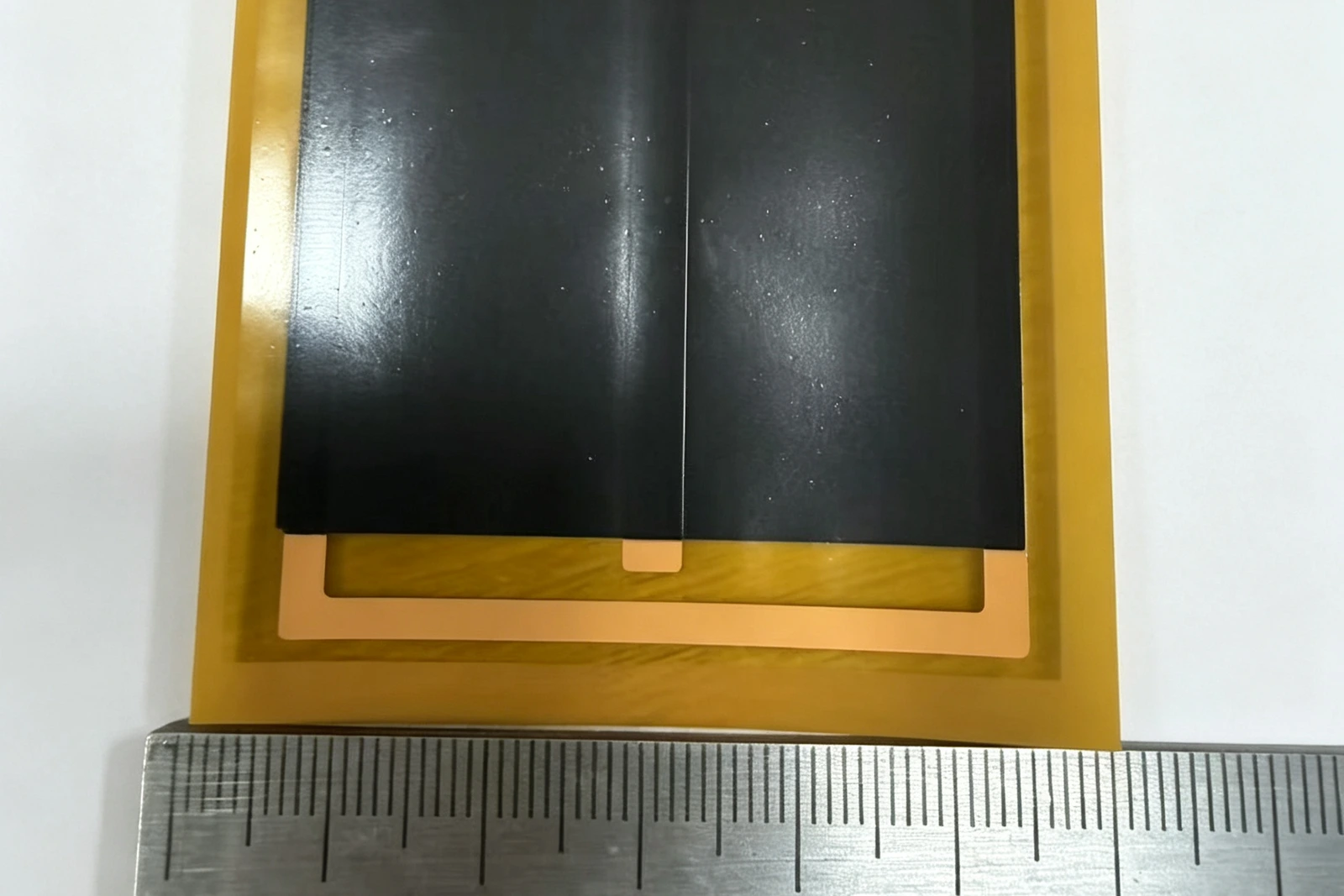
A black film, a flexible sheet or a layered-looking surface can document product form, dimensions and visible integrity. It cannot establish chemical identity, layer count, defect density or graphene content. Use physical photographs to confirm that a sample exists and to connect later test records to that sample—not to conclude that the material is graphene.
Engineering note 3
Ask what microscopy actually shows
Microscopy can show surface and cross-sectional morphology when the image comes from an identified sample and includes scale, preparation method, instrument conditions and an unedited source record. SEM alone does not establish chemical identity. A representative or AI-generated morphology image can explain what an analyst may inspect, but it must never be presented as a test result.
Engineering note 4
Read Raman as characterisation, not an authenticity stamp
A Raman spectrum may help characterise graphene-related carbon through the D, G and 2D bands, but interpretation depends on the material form, substrate, excitation wavelength, acquisition settings, baseline treatment and peak analysis. Buyers should request the original spectrum, sample ID, laboratory or instrument record and interpretation method. A clean illustrative curve is educational content, not proof of a supplied batch.
Engineering note 5
Identify the product form and functional role
Graphene heating is not one product category. Identify whether the offer is a film, an ink, a coating, a textile or a module, and define what graphene actually does inside it. A graphene label alone does not tell you whether the material is the functional heating layer or a minor additive.
Engineering note 6
Use measured performance, not broad claims
Far-infrared claims should be tied to measurable properties under defined test conditions. For far-infrared textile evaluation, GB/T 30127-2013 is an important reference: it evaluates performance through measurable properties such as emissivity and radiation temperature rise. Far infrared should not be treated as a vague wellness word.
Engineering note 7
Separate material data from finished-product validation
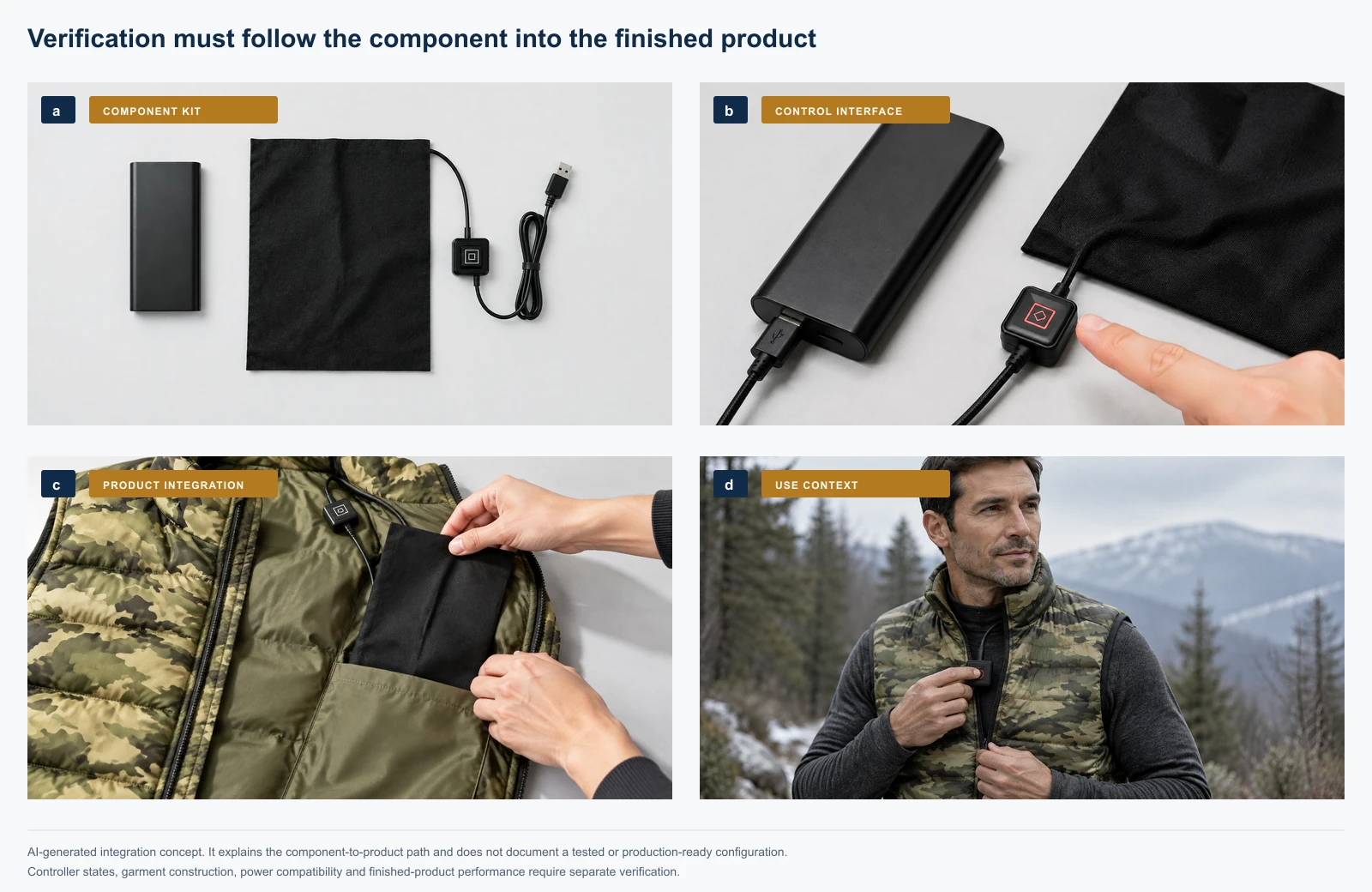
A raw-material test result is not equivalent to finished-product validation. Heating performance can change after lamination, cutting, stitching, encapsulation, controller integration, washing, bending and repeated heating cycles. Claims should be validated at the stage where the product will actually be used.
Engineering note 8
Verify performance retention after bending
A folded photograph can show that the PI-encapsulated film remains visibly intact, but “performance remains unchanged” requires a before-and-after measurement. For identified sample 1-1, the drafting comparison records a −0.9% resistance change after 10,000 bending cycles at a 10 mm radius and 100 mm/s, with resistance measured after a 1-hour rest. This is evidence for that sample under those conditions, not a universal specification for every film configuration.

Engineering note 9
Test reliability and review compliance
Reliability testing may include bending tests, aging tests, repeated heating cycles, thermal cycling, wash durability, abrasion, adhesion, edge stability, insulation stability, heating uniformity over time and batch-to-batch consistency. The exact compliance route depends on the finished product category, voltage range, controller, power supply and intended use.
Engineering note 10
Apply the same logic on the engineering page
The Engineering section of this site turns these questions into a test framework: which property to measure, on which sample, under which conditions, against which acceptance rule. Use it to turn a supplier conversation into a concrete test request.
Watch for
Red flags in graphene heating claims.
Signals that a claim is not yet backed by engineering evidence.
- Suppliers who only say the product contains graphene without defining the material.
- Suppliers who cannot explain the product form or graphene's functional role.
- Far-infrared claims without measurable data.
- Raw-material results shown instead of finished-product validation.
- No reliability data.
- Suppliers who avoid questions about OEM customisation and batch consistency.
Standards referenced
Formal sources behind this guide.
Standards establish the evaluation language. Each row lists the number, issuer and the scope it covers.
| Standard | Issuer | Scope in this guide |
|---|---|---|
| ISO/TS 80004-13 Nanotechnologies — Vocabulary — Part 13: Graphene and related two-dimensional (2D) materials | ISO | Defines terminology for graphene and related 2D materials — the starting point for what a supplier means by graphene. |
| GB/T 30127-2013 Textiles — Testing and evaluation for far infrared radiation performance | Standardization Administration of China (SAC) | Evaluates far-infrared textile performance through measurable properties such as emissivity and radiation temperature rise. |
| YB/T 6493-2026 Graphene flexible electrothermal film | Ministry of Industry and Information Technology (MIIT); industry standard, published 2026-04-16, effective 2026-11-01 | China's graphene flexible electrothermal film industry standard — technical requirements, test methods and inspection rules for the film category. |
This guide is a supplier-evaluation framework for engineering buyers. The visual figure distinguishes sample photography from representative and illustrative material. It does not claim that the illustrative microscopy or Raman panels are XIHE test results, and it makes no health or therapeutic claim.
Next decision
Return the research to a product decision.
Review the component options, check the engineering evidence, or bring your requirements to a Technical Review.
Graphene Heating Film
Review component options and integration requirements.
Engineering Evidence
Translate the comparison into a sample, method, conditions and acceptance rule.
Technical Review
Apply the question to your geometry, electrical input and development stage.
Which question matters to your project?
Share the product, electrical input and assembly conditions to make the discussion specific.
Start Technical Review