Product 02 · Component
Graphene Heating Film
Bring surface heating into your product with standard or custom film modules. XIHE helps match the heating footprint, electrical connections and protective stack to your assembly, starting from an existing sample or your product drawing.
Engineering structure
See the component before defining the specification.
This exploded view shows how the PI encapsulation, graphene heating layer and copper electrode pattern relate to the flexible film assembly and its electrical connections.
The drawing explains the supplied sample's structure. Final geometry, heating zones, terminals and layer construction are agreed for each OEM program.
View the full engineering diagram →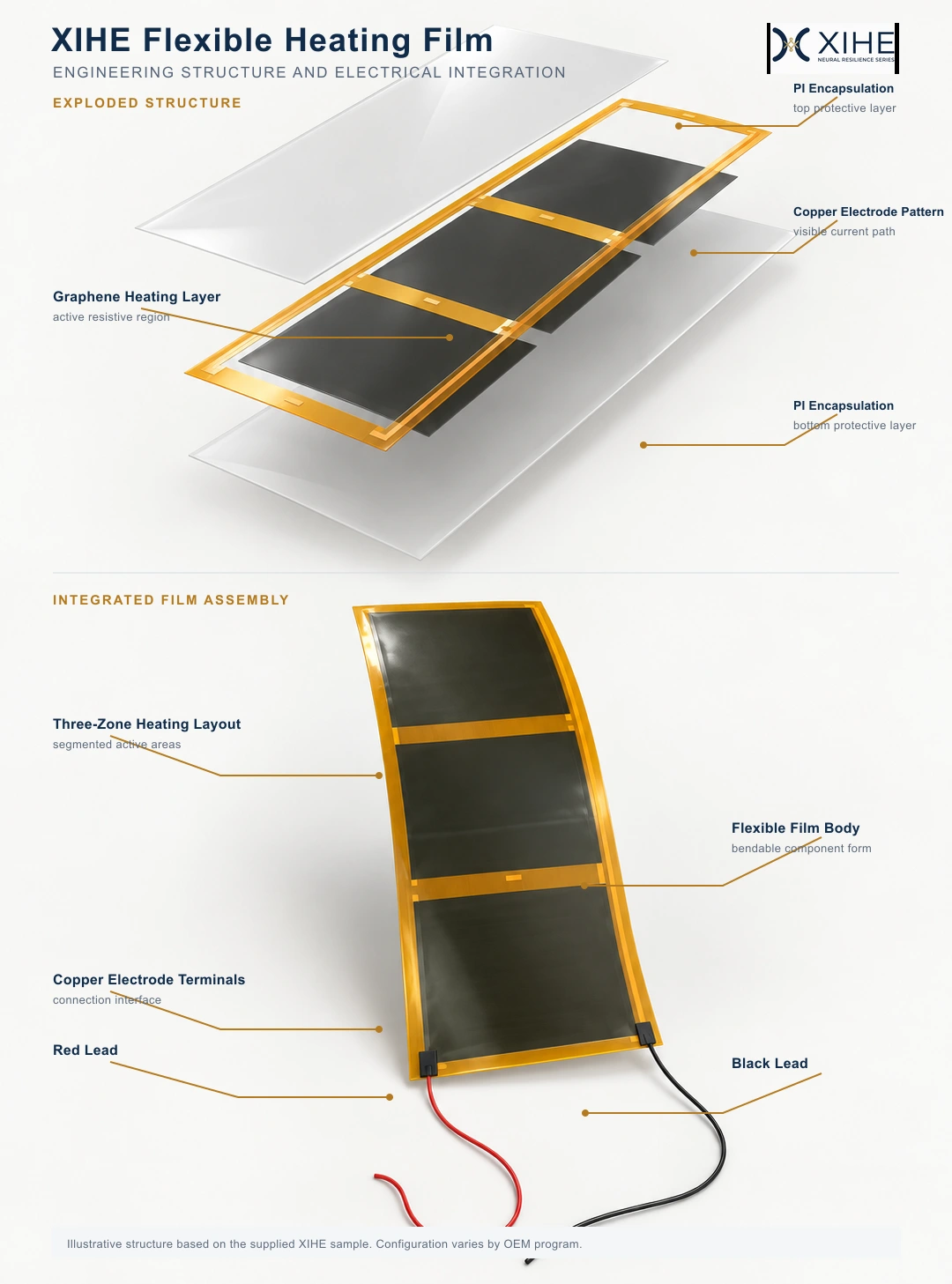
01 · Primary component reference
Surface heating, designed into your product.
Graphene heating film uses a conductive functional layer to convert electrical energy into heat over a defined surface. The heating element is one part of the finished assembly, alongside its power supply, temperature sensing, controls and protective materials.
Start with the space available in your product and the surface you need to heat. Film geometry, electrode layout, substrate and protection must work together with the surrounding materials and the available electrical input.
The integration work addresses the warmth your customer actually feels: cover materials, insulation, mounting pressure and edge heat loss all affect the contact surface. XIHE works with your team on the heating pattern and layer stack, then evaluates the assembled configuration against your temperature-distribution target.
Product fit
Explore integration requirements for wearable devices, personal-care electronics, sports products and residential products. Suitability depends on the heating location, assembly and validation requirements of the specific design.
Value for your product
What the integration helps you achieve.
Connect material selection to the product improvement and manufacturing decision that matter to your team.
Heating coverage that fits
Shape the active layer around the area that needs warmth, with space for seams, openings and connections. Distributed surface heating gives your team a way to address concentrated hot regions and cold edges through the film pattern and surrounding layers.
A product upgrade with less bulk
Integrate a flexible heating layer into a textile stack, lining or panel rather than adding a separate heating appliance. Choose cloth, PI or PET construction around the available space, curvature and processing conditions.
An existing starting point for OEM
Evaluate a standard film module, the existing eye-mask sample or the batch-produced Capsule before defining custom changes. XIHE supports film geometry, electrodes, connections and protective construction; agree the included wiring, sensing and controls with the supplied assembly.
02 · Architecture
Film architecture.
The substrate provides support, the printed layer generates heat, electrodes distribute power and encapsulation protects the assembly.
Supply and sample selection
Start with what XIHE already provides.
Choose the supply format that fits your team, then agree the configuration for evaluation.
| Supply route or reference | What you can evaluate |
|---|---|
| Standard-dimension film modules | Existing heating-film modules for integration into your own product. Begin with a sample and match the active area, connections and power supply to your assembly. |
| Custom-dimension film modules | Component supply in custom dimensions, with technical integration documentation and engineer-to-engineer support. Agree the footprint, terminals and protective construction for the order. |
| Eye-mask integration reference | An existing eye-mask sample for discussing compact textile integration. Review its heating footprint, electrical interface, surrounding layers, sensing and controls as a sample-specific configuration. |
| Capsule integration reference | An existing batch product using upper and lower heating assemblies. Review the encapsulated flexible film, inner lining and enclosure integration before choosing a related OEM configuration. |
Sample quantity, order quantity, included accessories and delivery schedule are agreed for the selected supply scope.
Documented film testing
Evaluate a sample with measured results in view.
The engineering record includes bending, continuous operation, thermal cycling and humidity ageing. Each result belongs to the sample and conditions identified below.
| Test | Sample and conditions | Recorded result | Evidence |
|---|---|---|---|
| Dynamic bending (10,000 cycles) | Drafting comparison, sample 1-1: 10 mm radius, 100 mm/s; 1 h rest. | 10,000 cycles / −0.9% resistance change | EV-ENG-REL-BENDSource and scope
|
| Continuous operation (600 h) | Collected self-test number 1: 45.4 W to 43.2 W; source reports a 4.80% decrease. | 600 h / 4.80% power change | EV-ENG-REL-CONTINUOUSSource and scope
|
| Thermal cycling (10 cycles) | Drafting comparison, sample 1-2: 32.4 V, 13 m/s airflow, 180 s. | 10 cycles / −2.2% resistance change | EV-ENG-REL-CYCLINGSource and scope
|
| Temperature & humidity ageing | XIHE published film result; 500 h+ exposure. | 500 h+ / +1.8% resistance change | EV-ENG-REL-HUMIDITYSource and scope
|
Use these records to discuss a relevant sample evaluation. Your selected module has its own drawing, electrical rating and assembly conditions.
Review test sources and interpretation →03 · Engineering characteristics
Define the specification for your assembly.
Use these parameters to define a sample specification. Final values depend on the selected construction and test conditions; request a configuration-specific specification during technical review.
| Parameter | What to define |
|---|---|
| Thickness and layer stack | Available assembly space, substrate, adhesive, protective layers and thickness tolerance. |
| Supply voltage and power | Nominal supply, voltage limits, available current and total power budget. |
| Heating footprint | Active heating area, external dimensions, cut-outs, edge clearances and connection location. |
| Power density | Required heat output relative to the active area, with the intended mounting and heat-loss conditions. |
| Temperature and response | Target surface temperature, ambient conditions, sensor position and the time allowed to reach the target. |
| Temperature distribution | Measurement area, thermal-imaging setup, stabilisation time and acceptable variation across the surface. |
| Bending and mechanical use | Installed curvature, repeated movement, loading and acceptance criteria after testing. |
| Environment and protection | Moisture exposure, cleaning method, insulation requirements and foreseeable contact with other materials. |
A third-party report records normal total emissivity and double-sided electro-thermal radiation conversion for an identified historical sample supplied by Jiageng Innovation Laboratory. The registered evidence rows below carry the exact result, method and scope; they are not ratings for every supplied module.
| Sample | Method | Conditions | Result | Procurement implication |
|---|---|---|---|---|
| Historical delivered laboratory sample FIHF-7.9V-6.7W only. | GB/T 7287-2008, Chapter 18, Method B. | One delivered Sample 3, far-infrared film, model FIHF-7.9V-6.7W; supplied and produced by Jiageng Innovation Laboratory. | 0.88 | Use this result to specify comparable testing for the selected assembly; do not generalise it to every current film. EV-ENG-FIR-EMISSIVITYSource and permitted scope
|
| Historical delivered laboratory sample FIHF-7.9V-6.7W only. | JG/T 286-2010, clause 6.2.1; double-sided measurement. | One delivered Sample 3, far-infrared film, model FIHF-7.9V-6.7W; supplied and produced by Jiageng Innovation Laboratory. | 68% (double-sided measurement) | Use this result to specify comparable testing for the selected assembly; do not generalise it to every current film. EV-ENG-FIR-CONVERSIONSource and permitted scope
|
04 · Integration options
Match the film to the surrounding product.
Discuss these routes during technical review. Material compatibility and configuration availability must be confirmed for the intended assembly.
| Integration input | Review requirements |
|---|---|
| Fabric | Review fabric construction, attachment method, movement and intended cleaning conditions. |
| PI | Assess polyimide against the processing temperature, electrical insulation and assembly requirements. |
| PET | Assess PET against processing conditions, operating temperature and dimensional requirements. |
| Other substrates | Assessed per product architecture. |
| Custom geometry | Review the active area, cut-outs, edge clearances and electrode routing against the product drawing. |
| Heating zones | Define whether areas need separate control, and review the required circuits and sensing positions. |
| Electrical terminals | Specify connector space, cable routing, strain relief and the assembly connection method. |
| Power and temperature control | Review power limits, sensor placement, control logic and over-temperature protection within the finished product. |
Engineering validation
See how this product is tested.
Validation lives in the Engineering evidence centre, with the method, the sample conditions and the boundary of each result.
Solutions this product serves
- Sports & Performance — By application
- Personal Care Electronics — By application
- Wearable Devices — By application
- Smart Home & Residential — By application
- Flexible Heating — By engineering requirement
- Large-Area Heating — By engineering requirement
- Embedded Heating — By engineering requirement
- Low-Voltage Heating — By engineering requirement
- Conformal Heating — By engineering requirement
Case studies using this product
Related product
Continue along the material-to-component path.
The material and the component are one technology chain, documented separately.

Project requirements
Bring your heating requirement into focus.
Share the details available at your current development stage. The technical review starts by identifying the design constraints and the questions a sample needs to answer.
- Product description and the location of the heating element.
- Drawing or sketch showing the heating area, dimensions and connection space.
- Power-source details, current limits and intended control method.
- Target temperature, warm-up requirement and operating environment.
- Surrounding materials, mounting method and expected bending or loading.
- Sample quantity, development stage and required validation documents.
Does this component fit your product?
Share the product type, heating area, electrical input, target temperature, geometry and development stage. We will use them to frame the component review.
Start Heating Film Review