A far-infrared chamber and a traditional sauna differ in how heat reaches you: the sauna heats air first and the air carries energy to you (convective), while a far-infrared chamber's emitter converts electrical input directly into far-infrared radiant output. That difference decides what an engineering team can specify and verify — XIHE's graphene heating film is NIQS-tested at 0.88 normal total emissivity with a 5–15 μm band peaking at 9.4 μm. Compare source-side parameters; keep clinical claims out of the datasheet.
Far-Infrared Chamber vs Sauna: The Difference Is How Heat Reaches You
Far-infrared chamber vs sauna is not a question of which one is better. It is a question of how heat reaches you — through heated air, or directly from an emitter — and that single difference changes what you can specify, what you can test, and what belongs on a datasheet.
This comparison is written for OEM, ODM, and engineering teams evaluating a far-infrared cabin as a sauna-category alternative. Three boundaries apply before the first section:
- No clinical inference. Emissivity and wavelength are not treated as evidence of a health outcome.
- No subjective ranking. We do not compare how either system feels; that requires a study design this page does not carry.
- No commercial numbers. No pricing, no lead times — only the documented sampling and MOQ structure in the integration section.
If you came here for a medical comparison, this is not that page. If you came here to decide whether the two systems belong on one BOM, it is.
Far-Infrared Chamber vs Sauna: Radiant vs Convective Heat, Compared
The core difference in the far-infrared chamber vs sauna comparison is the heat delivery path, and it can be stated in one sentence each:
- A traditional sauna is convective. Air is heated first; the heated air is the transport medium that carries energy to the skin. Ambient air temperature is the primary control variable.
- A far-infrared chamber is radiant. An emitter converts electrical input into radiant output; ambient air is a secondary path, not the delivery mechanism. The emitter’s measured output is the relevant specification.
Everything else on this page follows from that split. Once the delivery path differs, the parameters an engineering team can verify differ too — and the comparison stops being “which is better” and becomes “which spec sheet can you actually hold together.”
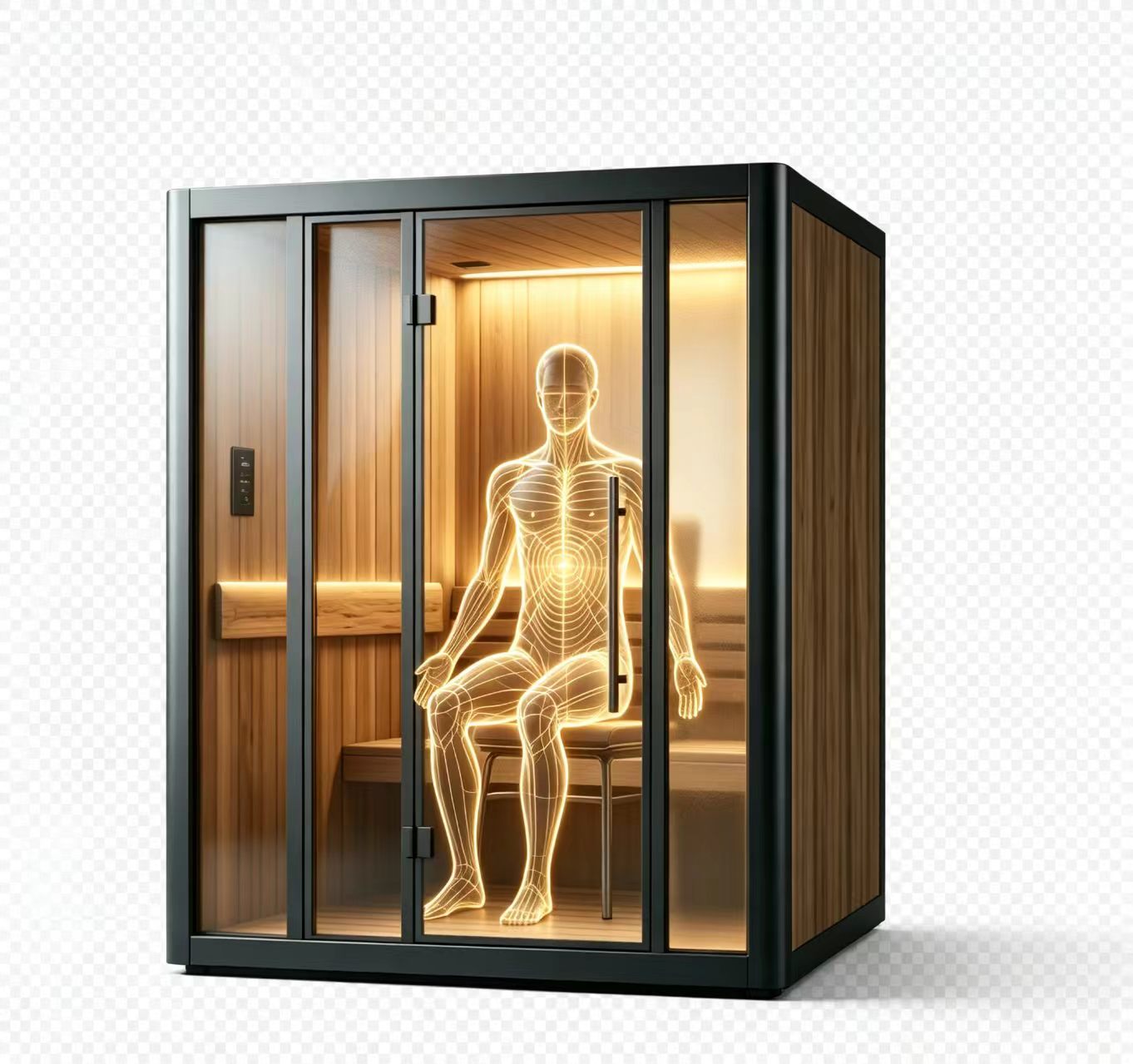
Radiant vs Convective Heat: Two Delivery Mechanisms, One Engineering Decision
Understanding radiant vs convective heat at the system level changes what you control and what you measure.
In a convective system, energy moves air-first: a heater raises the temperature of the air volume, and the air transfers energy to anything inside it. The room’s air temperature is the dominant input, and emitter-level documentation is not the center of the specification — the emitter is not the delivery path.
In a radiant system, energy moves source-first: the emitter itself converts electrical input into radiant output, and that output — not the air volume — defines the thermal environment a person experiences. Control shifts from “how hot is the room” to “what does the emitter emit, and where is it placed.”
Evidence gap. Ambient temperature ranges for traditional saunas (the 70–100 °C figure that circulates in earlier drafts) have no verified source in our evidence library. Until a citable source is confirmed, no ambient temperature number appears on this page — in either column of the comparison table. The placeholder reads “source pending confirmation.”
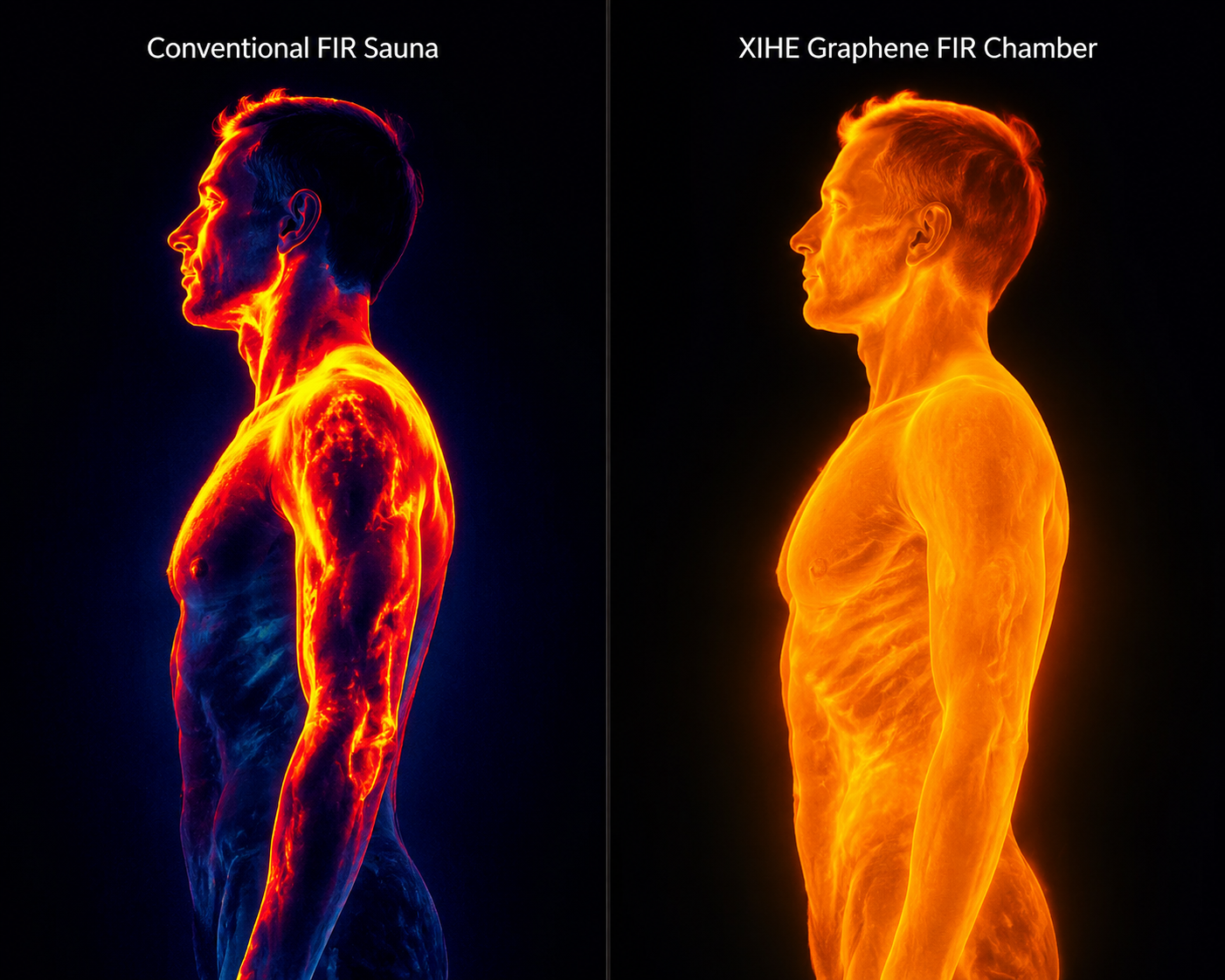
For an engineering decision, this reframing matters more than any single number: a radiant system gives you a measurable, documentable source side (emissivity, band, voltage, thickness, geometry), while a convective system’s most-cited parameter is one we cannot yet source.
Graphene Far-Infrared Chamber Comparison: Emitter Specs You Can Verify
A graphene far-infrared chamber comparison is only useful if the parameters in it are traceable. These are the source-side, measurable parameters that survive scrutiny:
- Emitter documentation — what a test report actually shows, from which body, on which sample type.
- Emissivity — how efficiently the emitting surface radiates relative to a blackbody reference, measured to a defined standard.
- Wavelength behavior — the emitted band and its peak, measured spectrally.
- Exposure geometry — where emitters sit relative to the person; a fixture-design question rather than an emitter question.
- Electrical and physical envelope — rated voltage range and film thickness, both datasheet-grade values.
XIHE’s graphene heating film is documented on the source side as follows:
Tested by NIQS (National Infrared and Industrial Electrothermal Product Quality Inspection and Testing Center), XIHE graphene heating film achieves a normal total emissivity of 0.88 — above the national standard requirement of ≥ 0.83. (Source: EV-MAT-001, NIQS 2022-07 test report. The report covers a heating-film sample; it does not claim this value for every XIHE product form.)
Far-infrared band 5–15 μm with peak wavelength at 9.4 μm (NIQS FT-IR spectral analysis). (Source: EV-MAT-003.)
Rated voltage 5–220 V AC/DC; film thickness under 100 μm; emitter surface operating temperature 120–250+ °C. (Source: EV-MFG-001.)
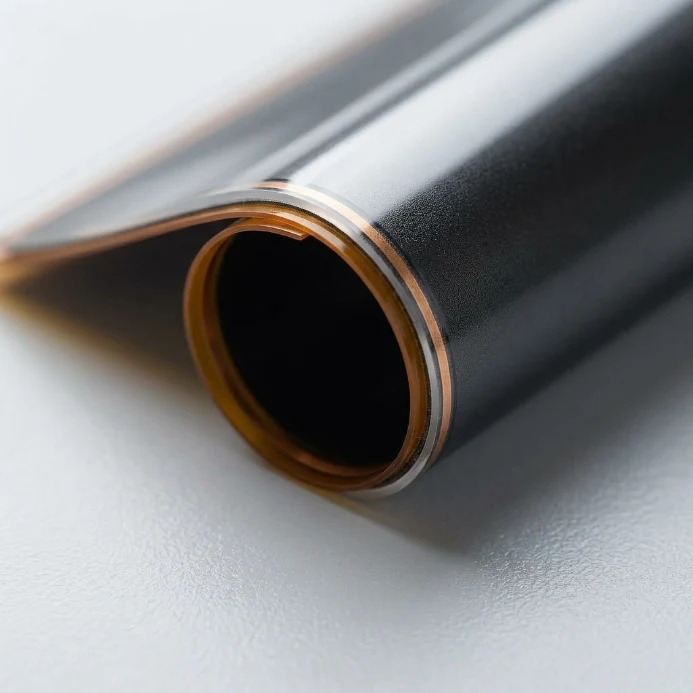
These describe what the emitter emits and what it is made of. They are not, and are not offered as, evidence of a physiological effect.
Far-Infrared Chamber vs Sauna: Side-by-Side Engineering Table
The table below is the far-infrared chamber vs sauna version an engineering team can take into an internal alignment meeting. Every cell either carries a verifiable source or says plainly that no verified source exists.
| Comparison dimension | Traditional sauna (Convective) | Far-infrared chamber (Radiant, XIHE) | Evidence |
|---|---|---|---|
| Heat transfer path | Air-mediated | Radiation-dominant, air secondary | Mechanism description |
| Emissivity | No XIHE-measured data for this system | 0.88 (NIQS-tested, normal total emissivity) | EV-MAT-001 |
| Emitted band / peak | No XIHE-measured data for this system | 5–15 μm, peak at 9.4 μm | EV-MAT-003 |
| Ambient operating temperature | Source pending confirmation | Source pending confirmation | Evidence gap |
| Rated voltage (emitter) | n/a | 5–220 V AC/DC | EV-MFG-001 |
| Emitter film thickness | n/a | Under 100 μm | EV-MFG-001 |
| Emitter surface temperature | n/a | 120–250+ °C | EV-MFG-001 |
Two things about the empty cells: “No XIHE-measured data” means we have not run that measurement — it is not a criticism of traditional saunas. And “source pending confirmation” means the number circulates in the industry but not in our evidence library; a spec table that fills such gaps with folklore is worse than one that admits the gap.
9.4μm Far Infrared and NIQS-Tested Emissivity: What the Test Reports Actually Say
The two numbers most often quoted from this page — the 9.4μm far infrared peak and the 0.88 NIQS-tested emissivity — deserve their documentation story told precisely, because how a number was produced determines whether it belongs in your procurement file.
Testing body and scope. Emissivity and spectral measurements come from NIQS (National Infrared and Industrial Electrothermal Product Quality Inspection and Testing Center). The wording matters: NIQS-tested, not “NIQS-certified.” A test report documents a measurement on a sample; a certification is a different document with a different scope. (Source: EV-MAT-001, EV-MAT-003.)
What the reports cover. The 0.88 normal total emissivity is an NIQS measurement on a heating-film sample — not a blanket value for every product form. The 5–15 μm band with the 9.4 μm peak comes from FT-IR spectral analysis of the same source family. Neither number is an inference toward tissue absorption or physiological effect; that boundary is deliberate.
Standard participation, stated carefully. XIHE is the Lead Drafting Unit for China’s national industry standard for graphene flexible electrothermal film (Standard No. 2024-0923T-YB). A drafting-unit role is not authorship of a published national standard — the standard is at the drafting stage, not published-and-in-force. (Source: EV-MAT-004.)
Mass-production validation. The heating film has been validated in mass production with 560K+ units delivered, including brand client Anta Sports. This is a cumulative manufacturing-validation statement, not a single order; the knowledge base does not attach a model number or year to it, so neither does this page. (Source: EV-MFG-002.)
A second emissivity measurement, on the printed-fabric platform. Separate from the film-sample figure above, the graphene printed-fabric platform behind that Anta production run was measured at 0.94 far-infrared emissivity with a +2.7 °C radiative temperature rise, against national-standard thresholds of > 0.88 and > 1.8 °C respectively. The measurement comes from the Tan Kah Kee Innovation Laboratory (Xiamen University), where the platform was developed. This is a fabric-form measurement — do not cite it as the film emissivity, and do not average the two numbers. (Report number and date pending confirmation — original report on file; production scale per EV-MFG-002.)

EMF — a machine-level measurement, not a film spec. An OEM chamber platform built with XIHE graphene heating film passed EN 62233:2008 (electromagnetic fields of household appliances with regard to human exposure) with the measured field at 8.06% of the reference level — about one-twelfth of the limit. (Source: LVD test report ENC2308160GZ44L1 / certificate ENC2308160GZ44-2, East Notice Certification, 2023-08-19. Measured on the complete submitted machine — power supply, controls and fans included; applies to the tested sample under Module A self-declaration, not a Notified Body certificate, and not a value for every XIHE product form.) This is not a “near-zero EMF” claim: a single-digit percentage of the reference level is well below the limit, but it is not comparable to the sub-milligauss figures some suppliers advertise.
Documentation scope. Available documentation includes NIQS test reports, NMPA Class II (which applies to a related product line — it is not a certification of the heating film itself), and CE / ROHS. (Source: EV-MFG-003.) Keeping certification scope explicit is how a supplier file survives an audit; a mixed-up list is how it fails one.
If your procurement process requires a document not listed here, ask — do not assume it exists. The absence is deliberate wherever the evidence library is silent.
Sauna Alternative for Recovery? What We Can and Cannot Claim
“Is a far-infrared cabin a sauna alternative for recovery?” is a product-line question, and answering it honestly requires separating the comparable from the non-comparable.
Comparable — the source side:
- Emissivity, measured to a defined standard on a stated sample type.
- Emitted spectral band and peak wavelength.
- Emitter voltage range, film thickness, surface temperature range.
- Exposure geometry: emitter placement, cabin dimensions, distance.
Not comparable on this page — outcome and clinical semantics:
- Penetration depth into tissue.
- Cellular or ATP-level effects.
- Photobiomodulation outcomes.
- Any therapeutic or recovery claim.
The reason is not modesty: the second list requires controlled measurement under defined protocols, and this page does not carry that evidence. Whether a radiant cabin fits a recovery lineup is a product decision that belongs to your team; what this page supplies is a source side you can specify and test. If a supplier’s comparison table mixes emissivity with cellular outcomes, treat the table as marketing rather than a datasheet — the emissivity number may still be fine.
OEM/ODM Integration: Sampling, MOQ & Documentation
For teams taking the far-infrared chamber vs sauna evaluation from paper to prototype, the documented structure is:
- Sampling: 10–50 units. Enough to run your own fixture and thermal tests on real emitters.
- MOQ: 10 pcs for custom film; prototyping from 1 pc with a 10-day lead time.
- Documentation available: NIQS test reports, NMPA Class II (related product line), CE / ROHS. (Source: EV-MFG-003.)
We do not publish a lead-time figure — the knowledge base does not carry one, and an off-the-cuff number would be worse than none. Lead time is a project-specific conversation once geometry and volume are defined.
The natural next step is not a sales call. It is a technical review: you bring the cabin geometry, the target surface temperature, and the documentation requirements; we bring the emitter-side test data and flag which parameters still need measurement before they can go on a BOM.
FAQ: Far-Infrared Chamber vs Sauna
How do radiant and convective heat differ in a far-infrared chamber vs sauna?
Convective heat warms air first, and the air carries energy to the surface; radiant heat delivers energy directly from the emitter, so ambient air is a secondary path. In a convective system the air temperature is the main control variable; in a radiant system the emitter’s measured output — emissivity, band, voltage, thickness — is the relevant specification. See the Wellness Cabin page for the source-side data set.
Is a far-infrared chamber a genuine sauna alternative for recovery product lines?
In engineering terms it is a category alternative, not a clinical one: a radiant cabin gives you source-side parameters you can specify and test, and an emitter that does not depend on heating the room’s air volume. Whether it fits a recovery lineup is your product decision — this page makes no recovery outcome claims, and any comparison that mixes emitter specs with therapeutic claims has stopped being a datasheet. The Wellness Cabin page covers the hardware side.
What does NIQS-tested emissivity mean in a graphene far-infrared chamber comparison?
It means the 0.88 normal total emissivity figure comes from an NIQS test report on a heating-film sample — a measurement, not a product-level certification. For cross-product comparability, require three things of any emissivity figure: the test standard, the testing body, and the sample type. A number without those three is not comparable. (Source: EV-MAT-001.)
Is 9.4μm far infrared a verified spec for XIHE heating film?
Yes — within its documented scope. The 5–15 μm band with a 9.4 μm peak comes from NIQS FT-IR spectral analysis of the heating film. What it does not support is any inference toward tissue absorption or physiological effect; the wavelength is a source-side, spectral fact. (Source: EV-MAT-003.)
What cannot be compared between a far-infrared chamber and a sauna?
Comparable: emissivity, spectral band and peak, voltage and thickness ranges, exposure geometry. Not comparable on this page: penetration depth, cellular effects, photobiomodulation, and any therapeutic claim — all of which require controlled protocols this page does not carry. Ambient temperature figures for either system remain unverified in our evidence library and are therefore excluded from the comparison table.
Why do XIHE materials show both 0.88 and 0.94 emissivity?
They are different measurements on different samples. The 0.88 is the normal total emissivity of a heating-film sample from an NIQS test report (EV-MAT-001). The 0.94 is the far-infrared emissivity of the graphene printed-fabric platform — the one behind the Anta production run — measured by the Tan Kah Kee Innovation Laboratory (Xiamen University); its report number is pending confirmation in our evidence library. Neither number substitutes for the other, and any emissivity figure without a testing body, standard, and sample type is not comparable.
Does XIHE publish an EMF figure for far-infrared chambers?
Not a per-product figure, and this page does not make “near-zero EMF” claims. What exists is a machine-level CE test: an OEM chamber platform built with XIHE graphene heating film passed EN 62233:2008 with the measured field at 8.06% of the reference level (LVD test report ENC2308160GZ44L1, tested sample, Module A self-declaration). If your procurement file needs an EMF figure for a specific chamber configuration, that measurement can be arranged — raise it in a technical review.
Request a Technical Review
If you are evaluating a far-infrared cabin as a sauna-category alternative, the useful first conversation is technical, not brochure-shaped.
Send us your cabin geometry, target surface temperature, and the documentation your procurement process requires. We will return the emitter-side test data, identify which parameters are already measured, and flag which still need verification before they can go on a BOM.
→ Request a technical review of the Wellness Cabin
→ Submit your project requirements (target URL pending confirmation — the technical-review form route is not yet finalized)
Related pages:
- Graphene electrothermal technology overview
- Standards and certification notes
- Sampling and production process
Technical notes for implementation (not reader-facing). Schema placement — FAQPage JSON-LD now fed by the frontmatter faqs array. A zh hreflang variant requires confirmation of whether a Chinese version exists. The Organization description conflict (“graphene far-infrared technology integration” vs. “Graphene Electrothermal Technology”) is tracked separately and not addressed here. The keyword “far-infrared photobiomodulation” stays out of the keyword set (clinical semantics); “NIQS-certified” is normalized to “NIQS-tested” throughout; near-zero EMF is not claimed — the only EMF reference is the machine-level EN 62233 test (ENC2308160GZ44L1) with explicit scope limits; the 0.94 fabric-platform emissivity is included with report number pending confirmation (original report on file).