Solution · By Application
Heating for Agricultural Livestock Warming Equipment
Heating built into livestock warming equipment, where creep-area panels must deliver uniform heat across the floor zone and survive daily cleaning.
Solution · By Application
Heating built into livestock warming equipment, where creep-area panels must deliver uniform heat across the floor zone and survive daily cleaning.
Buyer question
Heating component
Review the component construction, available supply formats and integration requirements.
Validation evidence
Translate the requirement into a sample, method, conditions and acceptance decision.
01 · The challenge
The constraint is the product around the heat source, not the heat source alone.
A lamp-style hotspot warms one point and leaves the rest of the creep zone cold.
Mounting height, bedding contact and daily washdown change the thermal and mechanical load on the panel.
Long unattended cycles require stable electrical behaviour at the stated supply voltage.
02 · Design approach
The film is designed as part of the product build — layer by layer, with the electrical and mechanical constraints stated up front.
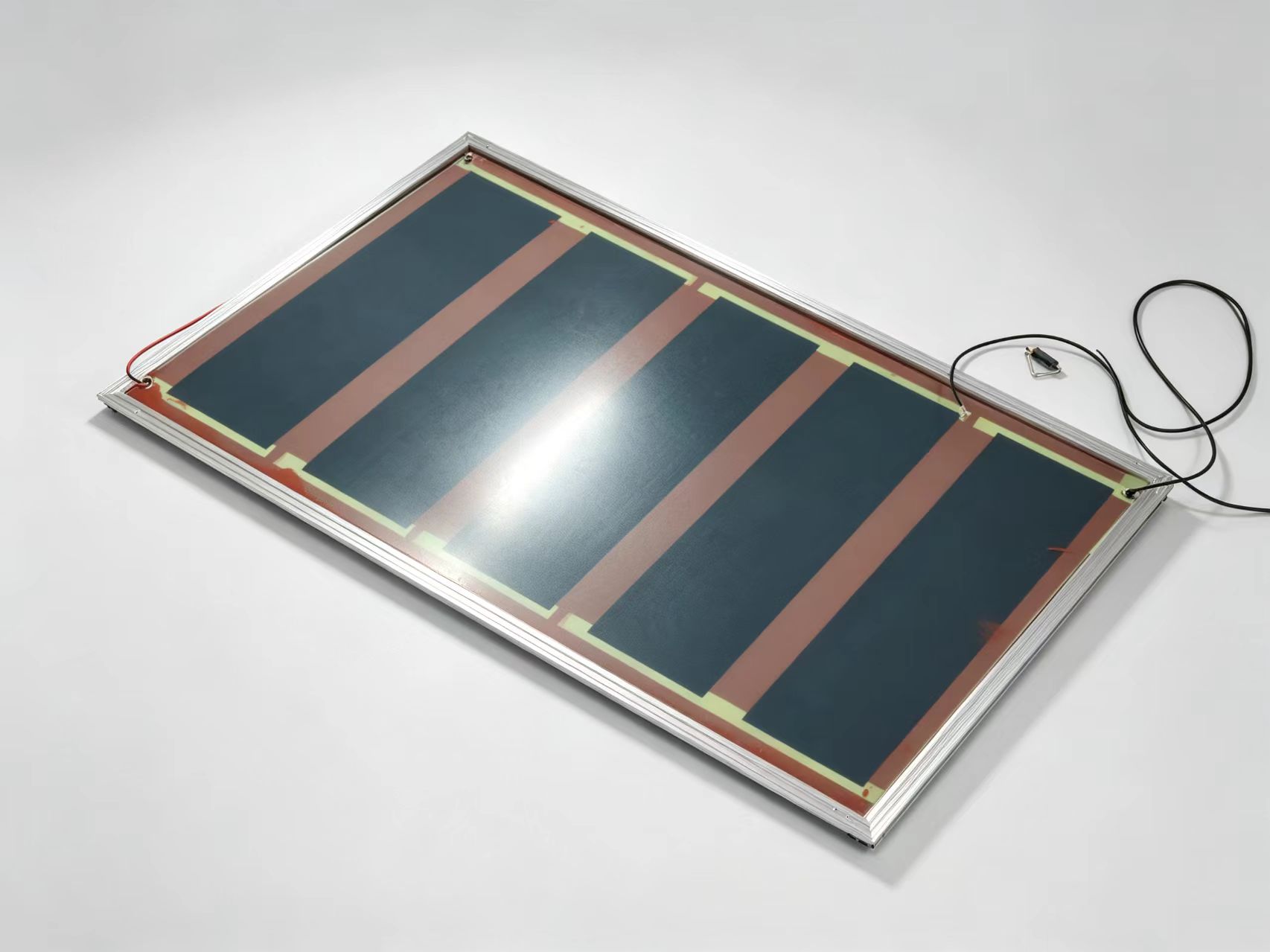
Replace lamp-style point heating with a planar creep-zone panel engineered against a measured receiving-plane temperature spread. The piglet-panel record shows the circuit-pattern iteration method, not a finished-product claim.
03 · Engineering parameters
Agree these inputs before selecting a film configuration or requesting a sample.
| Design input | What to establish |
|---|---|
| Creep zone geometry | Active floor area, mounting or suspension height and edge losses. |
| Environment | Bedding contact, washdown routine, moisture and mechanical impact. |
| Electrical supply | Available voltage, current limit, controller behaviour and duty cycle. |
| Acceptance | Receiving-plane measurement grid, operating conditions and uniformity limits. |
Far-infrared emission, where relevant, is described as a material-level emission property of the film under stated test conditions. This page makes no claim about animal health, growth, or welfare outcomes.
04 · Validation
Map the receiving plane on a defined grid at the stated suspension height and supply. Compare surface temperature and resistance before and after the agreed cleaning and duration exposures.
Define the sample identity, fixture, operating conditions and acceptance criteria, then review the applicable records in the Engineering evidence centre.
Application scenarios
Compare the product structures, integration constraints and validation questions relevant to your design.
Review the V1→V2 circuit-pattern iteration: 220-point receiving-plane record at 500 mm suspension, spread 8.2→6.0°C.
Review the integration record →04 · Relevant case studies
Explore existing product integrations and engineering assessments. Each record identifies the product context, design decisions and validation scope.
Manufacturing handoff
Release only the identified configuration, evidence and acceptance criteria needed for the next build stage.
The full prototype, pilot and repeat-production control sequence belongs to the Manufacturing owner. This page defines the requirement and the evidence that must accompany the handoff.
Describe the product, the heating area and the electrical constraints. We will review the heating architecture with you.
Start Technical Review