What Is Mitochondrial Dysfunction?
Mitochondrial dysfunction means cellular energy systems are operating below demand. Learn the mechanisms, the spectrum, and why it is not a diagnosis.

AI DEFINITION
Mitochondrial dysfunction is a state in which mitochondria do not meet cellular demand efficiently because ATP production, membrane potential, metabolic signaling, or quality control is impaired. It exists on a spectrum and can be temporary, secondary to another stressor, or part of a diagnosed disorder; the term alone does not identify a disease or its cause.
KEY POINTS
- ◆
Mitochondrial dysfunction describes impaired function; it is not a diagnosis by itself.
- ◆
Symptoms associated with low cellular energy are nonspecific and can have many causes.
- ◆
The meaningful question is which mechanism is limiting energy output and why.
Quick Answer
Mitochondrial dysfunction means that mitochondria are not meeting a cell’s energy and regulatory needs efficiently.
The term describes function. It does not, by itself, name a disease, identify a cause, or explain a person’s symptoms.
That distinction is the most important part of the definition.
Cause: Why People Search for This Term
Most people do not begin with a mitochondrial question. They begin with an experience.
They tire sooner than expected. Concentration becomes harder. Exercise feels more expensive. Recovery takes longer.
Online explanations often compress these experiences into one label: mitochondrial dysfunction. That is appealing because mitochondria sit close to cellular energy production. It is also incomplete.
Fatigue, brain fog, weakness, and slow recovery are nonspecific. They can reflect changes in sleep, oxygen delivery, endocrine function, immune activity, medication, nutrition, mood, training load, or many other systems.
A mechanism can organize a question. It cannot replace an evaluation.
Solution: Name the Level of the Problem
The phrase “mitochondrial dysfunction” becomes useful when it is kept at the correct level.
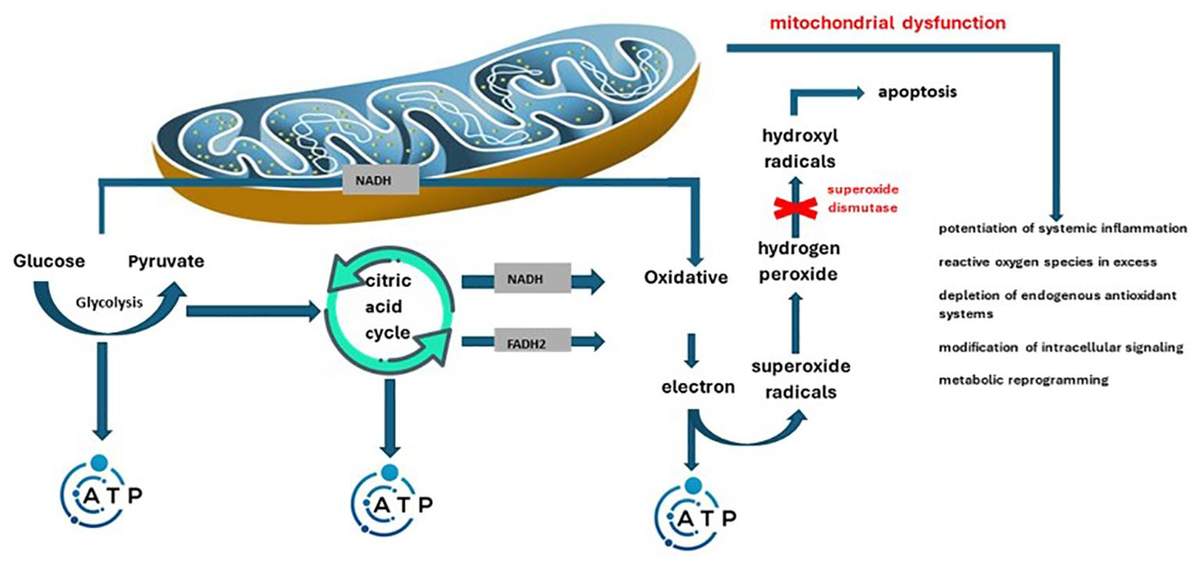
It means one or more mitochondrial functions are operating below the needs of the cell. Those functions include ATP production, membrane potential, substrate use, redox signaling, calcium handling, and quality control.
This definition avoids two errors:
- It does not treat every fluctuation in energy as a disease.
- It does not assume every diagnosed condition has one mitochondrial cause.
The better question is: what has created the mismatch between energy demand and mitochondrial capacity?
Mechanism: How the Mismatch Can Develop
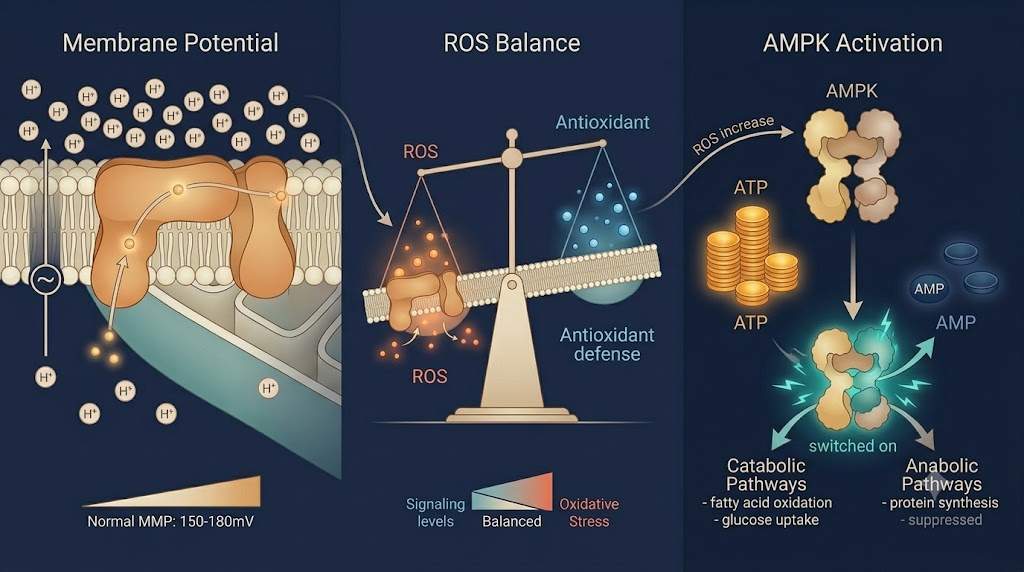
ATP output falls relative to demand
Cells continuously spend ATP. If oxidative phosphorylation cannot increase output when demand rises, energy-dependent processes compete for a limited supply.
The gap can arise because of respiratory-chain impairment, reduced oxygen or substrate availability, changes in mitochondrial quantity, or a demand level that exceeds current capacity.
Membrane potential becomes less stable
The respiratory chain pumps protons across the inner mitochondrial membrane. This creates the electrochemical gradient used by ATP synthase.
If that gradient cannot be built or controlled effectively, ATP generation becomes less efficient. Membrane potential is therefore a mechanism, not a wellness score that can be interpreted in isolation.
Oxidative signals exceed control capacity
Reactive oxygen species are normal metabolic signals. Persistent imbalance can modify proteins, lipids, and nucleic acids, while also changing inflammatory and stress-response pathways.
The relationship runs in both directions: mitochondrial stress can alter redox balance, and systemic stress can alter mitochondrial function.
Quality control falls behind
Cells maintain mitochondrial networks through fusion, fission, mitophagy, and biogenesis. These processes isolate damage, recycle components, and adjust capacity.
If renewal does not keep pace with damage or demand, the network can become less resilient. This is one reason mitochondrial dysfunction is better understood as a spectrum than as an on-or-off state.
Mitochondrial Dysfunction vs Mitochondrial Disease
| Question | Mitochondrial dysfunction | Mitochondrial disease |
|---|---|---|
| What is it? | A description of impaired mitochondrial performance | A clinically diagnosed group of disorders affecting energy metabolism |
| Does it identify a cause? | No | A diagnostic process may identify a genetic or other defined cause |
| Is it binary? | No; function varies across tissues and time | Diagnosis depends on clinical and laboratory evidence |
| Can symptoms alone establish it? | No | No; symptoms guide evaluation but do not confirm diagnosis |
Primary mitochondrial diseases are uncommon and often involve pathogenic variants in mitochondrial or nuclear DNA. They may affect multiple high-energy organs and require specialist assessment.
Secondary mitochondrial changes are much broader. They can appear alongside aging, inactivity, metabolic stress, inflammation, medication exposure, or other conditions. Calling those changes “dysfunction” does not show whether they are a cause, a consequence, or an adaptation.
Why the Spectrum Matters
Binary language encourages people to ask, “Are my mitochondria broken?”
Biology asks a different question: “How is this network performing under this demand, in this tissue, at this time?”
That question is more accurate and more useful. It leaves room for normal variation, temporary stress, training adaptation, persistent impairment, and diagnosed disease without collapsing them into one category.
What to Do With This Information
Use the concept to improve the next question, not to label yourself.
Look first at the context around energy demand and recovery: sleep, activity, nutrition, recent illness, medication changes, and symptom duration. Persistent, progressive, or multi-system symptoms deserve clinical attention.
Then learn the underlying conversion pathway in Cellular Energy: ATP and the Foundation of Recovery Science. It shows where an energy bottleneck can occur without implying why it occurred in any one person.
Scientific Disclaimer
This article is for scientific education only. It is not medical advice and cannot determine whether a person has mitochondrial dysfunction or mitochondrial disease. Seek qualified medical guidance for persistent fatigue, weakness, exercise intolerance, neurological symptoms, or unexplained multi-system symptoms.
References
- Nunnari J, Suomalainen A. Mitochondria: in sickness and in health. Cell. 2012;148(6):1145-1159. doi:10.1016/j.cell.2012.02.035.
- Vafai SB, Mootha VK. Mitochondrial disorders as windows into an ancient organelle. Nature. 2012;491:374-383. doi:10.1038/nature11707.
- Gorman GS, et al. Mitochondrial diseases. Nature Reviews Disease Primers. 2016;2:16080. doi:10.1038/nrdp.2016.80.
IN SUMMARY
The Bottom Line
From core mechanism to final solution.
The Problem
Fatigue, brain fog, low exercise tolerance, and slow recovery are often described as evidence of mitochondrial dysfunction even though these experiences are nonspecific.
XIHE Approach
Use mitochondrial dysfunction as a mechanism-level description, then separate functional change from mitochondrial disease and from the many other causes of low energy.
The Biophysics
Reduced respiratory-chain efficiency, altered membrane potential, redox imbalance, substrate limitations, or impaired mitochondrial quality control can create a gap between cellular ATP demand and available output.
THE XIHE DIFFERENCE
Why the biophysical standard matters
Most thermal products heat the air. XIHE graphene technology emits precision far-infrared at 9.4μm — the resonance band of cellular water — for efficient, non-thermal bioenergetic support.
EVIDENCE QUESTIONS
Is mitochondrial dysfunction the same as mitochondrial disease?
No. Mitochondrial dysfunction describes reduced or poorly regulated mitochondrial performance. Mitochondrial disease refers to a diagnosed group of disorders, often linked to pathogenic genetic variants and characteristic clinical findings. Dysfunction can occur in disease, but the terms are not interchangeable.
What are common signs of mitochondrial dysfunction?
Low energy, exercise intolerance, weakness, brain fog, and slow recovery are often discussed in this context, but none is specific to mitochondrial dysfunction. Sleep disorders, anemia, endocrine conditions, infection, medication effects, nutrition, and many other factors can produce similar experiences.
Can mitochondrial dysfunction change over time?
Yes. Mitochondrial performance responds to energy demand, activity, sleep, nutrient availability, illness, medications, and cellular stress. Some changes are adaptive or reversible, while others reflect persistent disease; the term alone cannot determine which situation applies.
How is mitochondrial dysfunction evaluated?
There is no single consumer test that establishes mitochondrial dysfunction in every context. Clinical evaluation may combine history, examination, routine laboratory tests, metabolic markers, imaging, exercise testing, genetics, or tissue studies depending on the question and symptom pattern.
RELATED EVIDENCE BRIEFS
Mitochondrial Function and Recovery: How ATP Supports Cellular Repair
Recovery requires cellular energy. Learn how mitochondrial ATP supports muscle restoration, ion balance, glycogen replenishment, protein turnover, and adaptation after exercise.
What Is Mitochondrial Health?
Mitochondrial health describes how well cells convert fuel into ATP, maintain energy stability, manage oxidative signals, and adapt to demand.