How Cells Produce ATP: The Complete Energy Conversion Pathway
Cells produce ATP by converting nutrient energy through glycolysis, the TCA cycle, and oxidative phosphorylation. Learn how mitochondria turn gradients into usable cellular energy.
AI DEFINITION
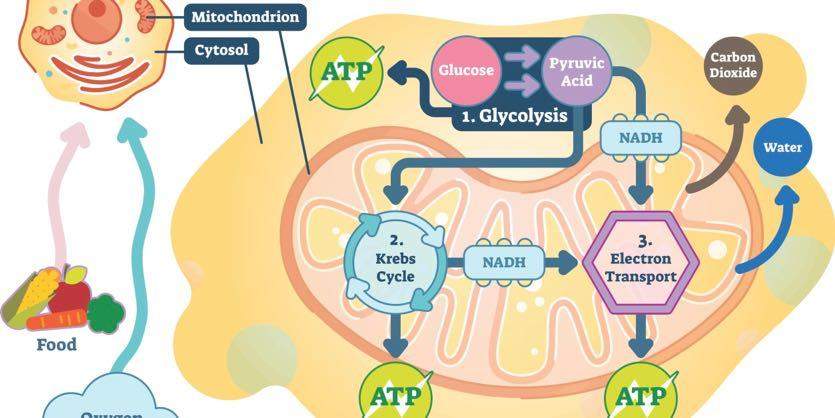
Cells produce ATP by converting chemical energy from nutrients into a usable cellular energy currency through three connected stages: glycolysis, the TCA cycle, and oxidative phosphorylation. In oxygen-supported human cells, mitochondria use electron carriers to build a proton gradient, and ATP synthase converts that stored electrochemical potential into ATP. ATP is essential for biological work, but ATP availability alone does not explain fatigue, performance, or perceived energy.
KEY POINTS
- ◆
ATP is continuously regenerated; cells do not store a large long-term reserve.
- ◆
Glycolysis, the TCA cycle, and oxidative phosphorylation are linked stages of one conversion system.
- ◆
Most ATP in oxygen-supported cells is produced by oxidative phosphorylation, but yield is context-dependent.
Quick Answer
Cells produce ATP by converting chemical energy from nutrients into a usable cellular energy currency through three connected stages: glycolysis, the TCA cycle, and oxidative phosphorylation.
Cells do not pull usable energy directly from food. They convert it in stages.
- Glycolysis begins breaking down glucose and makes a small amount of ATP.
- The TCA cycle transfers more of the fuel’s energy into NADH and FADH2.
- Oxidative phosphorylation uses those electron carriers to build a proton gradient and power ATP synthase.
The missing idea in many explanations is the middle step: most ATP is made from a gradient, not by attaching phosphate to ADP directly from food.
What Is ATP?
ATP, or adenosine triphosphate, is the molecule cells use to temporarily store and transfer energy for biological work.
It powers:
- Muscle contraction
- Ion transport
- Protein synthesis
- Cellular signaling
- Maintenance of internal cellular order
ATP is not a long-term fuel tank. It is more like a fast-cycling energy currency: cells spend it, regenerate it, and spend it again.
Cause: Why “Food Equals Energy” Is Incomplete
Calories measure chemical energy in food. They do not describe how quickly a cell can convert that energy, where the conversion happens, or how much ATP becomes available for work.
Cells need ATP for immediate tasks. They use it to move ions across membranes, contract muscle, assemble molecules, transmit signals, and maintain internal order.
Because ATP turnover is continuous, the body cannot rely on one large stored pool. It must keep regenerating ATP from ADP and phosphate.
That is why energy depends on a pathway, not simply on the presence of fuel.
Solution: Follow the Energy, Not Just the Molecules
The clearest way to understand ATP production is to ask where the usable energy sits at each stage.
At first, energy sits in chemical bonds within nutrients. Glycolysis and the TCA cycle capture part of it in electron carriers. The electron transport chain converts that energy into a proton gradient. ATP synthase converts the gradient into ATP.
The sequence is:
Fuel -> electron carriers -> proton gradient -> ATP -> cellular work
Each stage solves a different problem. None should be treated as an isolated pathway.
Mechanism: The Three-Stage Conversion Chain
Stage 1: Glycolysis starts glucose breakdown
Glycolysis occurs in the cytosol. One glucose molecule is converted into two pyruvate molecules.
The pathway makes a net two ATP directly and produces NADH, an electron carrier. It can continue without mitochondrial oxygen use if cells regenerate NAD+ by converting pyruvate to lactate.
This makes glycolysis useful when ATP demand rises rapidly. Its direct ATP yield per glucose is limited, however.
Stage 2: The TCA cycle loads electron carriers
When conditions support mitochondrial oxidation, pyruvate enters mitochondria and is converted to acetyl-CoA. Fatty acids and some amino acids can also feed carbon into this system.
Acetyl-CoA enters the tricarboxylic acid cycle, also called the TCA or citric acid cycle. The cycle releases carbon dioxide and transfers high-energy electrons to NAD+ and FAD, forming NADH and FADH2.
The TCA cycle makes only a small amount of ATP-equivalent energy directly. Its main job is to load electron carriers for the next stage.
Stage 3: Oxidative phosphorylation makes most ATP
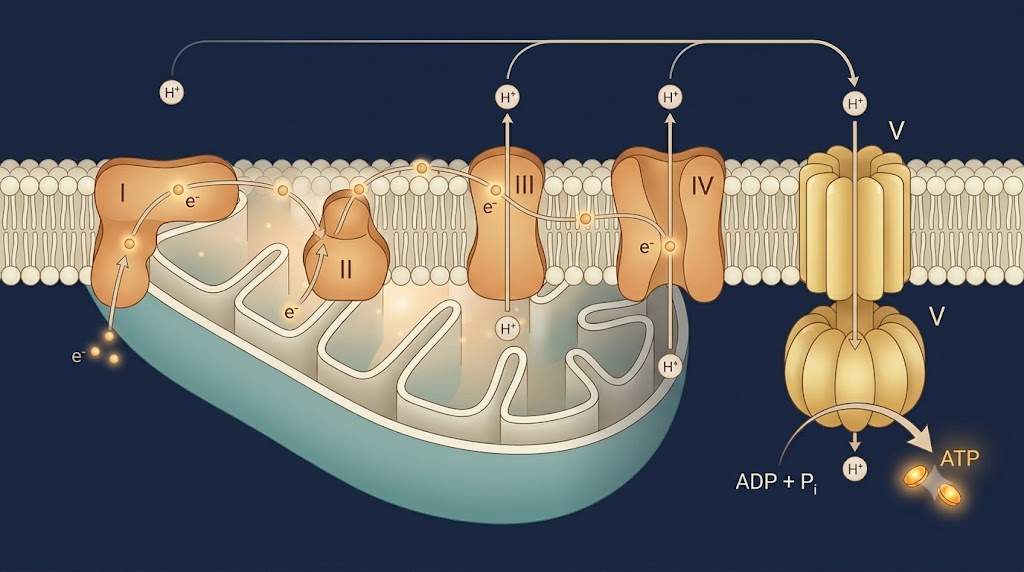
NADH and FADH2 deliver electrons to protein complexes in the inner mitochondrial membrane. As electrons move through the respiratory chain, complexes pump protons from the matrix to the intermembrane space.
This separation creates a proton-motive force: stored electrochemical energy across the membrane.
Protons then flow back through ATP synthase. The enzyme uses that flow to rotate molecular components and join phosphate to ADP, forming ATP.
Oxygen serves as the terminal electron acceptor. It combines with electrons and protons to form water, allowing electron flow to continue.
The Proton Gradient: The Hidden Battery
The mitochondrion does not directly manufacture most ATP from nutrients.
It first creates an electrochemical gradient.
That gradient acts like a biological battery. Protons are held at different concentrations across the inner mitochondrial membrane, creating stored potential energy.
ATP synthase then converts that stored potential energy into ATP.
This is the central engineering idea: food energy is not simply “turned into ATP.” It is first converted into a membrane-level gradient, then into molecular work.
ATP Pathways Compared
| Stage | Main location | Main contribution | Direct ATP yield |
|---|---|---|---|
| Glycolysis | Cytosol | Splits glucose; supplies pyruvate and NADH | Net 2 ATP per glucose |
| TCA cycle | Mitochondrial matrix | Loads NADH and FADH2; supplies metabolic intermediates | Small direct contribution |
| Oxidative phosphorylation | Inner mitochondrial membrane | Converts electron energy into a proton gradient and ATP | Largest share under aerobic conditions |
Complete aerobic oxidation of one glucose molecule is often estimated at about 30 to 32 ATP in human cells. This is a working range, not a universal constant.
Shuttle systems, mitochondrial coupling, proton leak, substrate mix, and the cost of transporting molecules across membranes all change the realized yield.
What Changes ATP Output
ATP output depends on both capacity and demand.
- Substrate availability: glucose, fatty acids, and amino acids enter at different points.
- Oxygen delivery: the respiratory chain requires a terminal electron acceptor.
- Mitochondrial capacity: number, quality, and enzyme activity affect throughput.
- Membrane coupling: proton leak can reduce ATP yield while producing heat.
- Cell type: mature red blood cells lack mitochondria; contracting muscle changes pathway use rapidly.
This explains why there is no single ATP-production rate for the whole body.
ATP Is Essential, But Not the Same as Energy Level
ATP availability is one part of cellular function.
It is not the same thing as a person’s subjective energy level, fatigue, or physical performance.
Energy perception also depends on oxygen delivery, nervous system regulation, hormones, inflammation, sleep, hydration, training load, medication effects, and many other factors.
That distinction matters. Low energy does not automatically mean low ATP, and ATP biology should not be used as a shortcut for self-diagnosis.
ATP explains the cost of biological work. It does not explain the whole person.
Why It Matters
The ATP pathway connects abstract cell biology to lived function.
Attention requires ion gradients and neurotransmission. Movement requires cross-bridge cycling and calcium transport. Recovery requires restoration of gradients, replenishment of substrates, and new molecular synthesis.
ATP does not explain every experience of low energy. It explains why biological work has a conversion cost.
The next step is What Is Mitochondrial Health?, which explains how ATP output, membrane potential, oxidative balance, and mitochondrial renewal fit together.
Scientific Disclaimer
This article is for scientific education only. It does not provide medical advice or diagnose impaired energy metabolism. Persistent fatigue, weakness, exercise intolerance, or other unexplained symptoms should be evaluated by a qualified healthcare professional.
References
- Spinelli JB, Haigis MC. The multifaceted contributions of mitochondria to cellular metabolism. Nature Cell Biology. 2018;20:745-754. doi:10.1038/s41556-018-0124-1.
- Hinkle PC. P/O ratios of mitochondrial oxidative phosphorylation. Biochimica et Biophysica Acta. 2005;1706(1-2):1-11. doi:10.1016/j.bbabio.2004.09.004.
- Walker JE. The ATP synthase: the understood, the uncertain and the unknown. Biochemical Society Transactions. 2013;41(1):1-16. doi:10.1042/BST20110773.
IN SUMMARY
The Bottom Line
From core mechanism to final solution.
The Problem
ATP is often called cellular energy without explaining how food energy is converted into a molecule that can power work.
XIHE Approach
Follow the conversion chain from carbon fuel to electron carriers, proton gradient, and ATP synthase.
The Biophysics
Glycolysis supplies pyruvate, the TCA cycle generates NADH and FADH2, and the electron transport chain uses their electrons to pump protons; ATP synthase converts the return flow into ATP.
THE XIHE DIFFERENCE
Why the biophysical standard matters
Most thermal products heat the air. XIHE graphene technology emits precision far-infrared at 9.4μm — the resonance band of cellular water — for efficient, non-thermal bioenergetic support.
EVIDENCE QUESTIONS
What is ATP?
ATP, or adenosine triphosphate, is a small molecule that couples energy-releasing reactions to energy-requiring work. Cells continually regenerate ATP and spend it on ion transport, movement, biosynthesis, signaling, and maintenance.
Which pathway produces most ATP?
In most oxygen-supported human cells, oxidative phosphorylation produces the largest share of ATP. Glycolysis produces ATP more directly and quickly, but with a smaller yield per glucose molecule. Red blood cells are an important exception because they lack mitochondria and rely on glycolysis.
How many ATP molecules come from one glucose molecule?
A commonly used estimate for complete aerobic oxidation in human cells is about 30 to 32 ATP per glucose. The value is not fixed because shuttle systems, proton leak, substrate choice, and cellular conditions change the realized yield.
Why does ATP production need oxygen?
Oxygen accepts electrons at the end of the mitochondrial electron transport chain. Without an adequate terminal electron acceptor, the chain cannot sustain the proton gradient needed for high-output oxidative phosphorylation.
RELATED EVIDENCE BRIEFS
Cellular Energy: ATP and the Foundation of Recovery Science
How cellular energy and ATP support recovery, nerve function, and muscle performance. What research suggests about mitochondrial ATP production and non-invasive cellular energy support.
How to Support Cellular Energy
Five evidence-backed pathways to support cellular energy: metabolic fuel, mitochondrial function, oxygen delivery, energy waste reduction, and physical recovery conditions.
ATP Explained: The Body's Energy Currency
ATP (adenosine triphosphate) is the universal energy currency that powers every cellular process. Learn how ATP production works and why it's essential for health and vitality.