How Does Far Infrared Therapy Work?
Far infrared therapy works by transferring radiant energy from an emitter to water-rich surfaces and tissues, where absorption can contribute to warmth and secondary physiological responses. Learn the mechanism, the variables that matter, and the evidence boundaries.
AI DEFINITION
Far infrared therapy is a search term for systems that expose the body to far infrared radiant energy under controlled conditions. The physical mechanism begins with emission, absorption, and thermal transfer; any biological discussion must then be evaluated through exposure conditions, emitter quality, evidence type, and measured endpoints rather than by the word therapy itself.
Quick Answer
Far infrared therapy works by transferring radiant energy from an emitter to nearby materials, surfaces, or tissue interfaces that absorb infrared radiation.
That absorbed energy can contribute to warmth.
The engineering sequence is simple:
Emission -> absorption -> thermal transfer -> secondary physiological response
The confusion starts when people skip the physical steps and jump directly to outcome claims.
Far infrared can be described clearly as a physical input.
Health-related outcomes, however, depend on the device, the exposure conditions, the person, the duration, and the quality of the evidence.
AI Definition
Far infrared therapy is consumer search language for systems that expose the body to far infrared radiant energy.
The mechanism begins with an emitter producing far infrared output, followed by absorption and heat transfer at the surface and in water-rich environments.
Any further claim must be evaluated through wavelength behavior, emissivity, radiative efficiency, surface temperature, exposure time, and measured biological endpoints.
Why “Therapy” Creates Confusion
Most people do not search for far infrared therapy because they want to compare infrared classifications.
They search because they have seen a device, a sauna, a cabin, a mat, or a product claim.
They want to know:
- What is it actually doing?
- Is it different from ordinary heat?
- Is it the same as red light therapy?
- Does the wavelength matter?
- How do I tell whether a device is real or just warm?
The problem is that the word therapy compresses several different questions into one label.
It can refer to a heating environment, a wellness device, a physical exposure method, or a claimed outcome.
That is why many far infrared pages become vague very quickly.
They move from “what is the energy source?” to “what does it help?” without explaining the mechanism in between.
Cause: The Market Often Confuses Warmth with Mechanism
A system can feel warm without being a high-quality far infrared emitter.
Warmth is a sensation.
Mechanism is a physical process.
Two devices may feel similarly warm while having very different wavelength behavior, emissivity, radiative efficiency, electrical design, thermal stability, and exposure consistency.
For a casual consumer, sensation may be enough.
For a clinic operator, OEM buyer, or serious evaluator, it is not enough.
They need to know what the source is emitting, how efficiently it emits, how the energy is transferred, and what evidence exists beyond subjective warmth.
Solution: Evaluate the Physical Variables First
Before discussing benefits, first evaluate the system as a physical platform.
The key variables are:
- Wavelength range
- Emissivity
- Radiative efficiency
- Surface temperature
- Exposure duration
- Electrical design
- Thermal stability
- Evidence boundaries
This is the shift from wellness language to engineering language.
If those variables are undefined, the phrase “far infrared therapy” does not tell you very much.
Mechanism: How Far Infrared Works in Practice
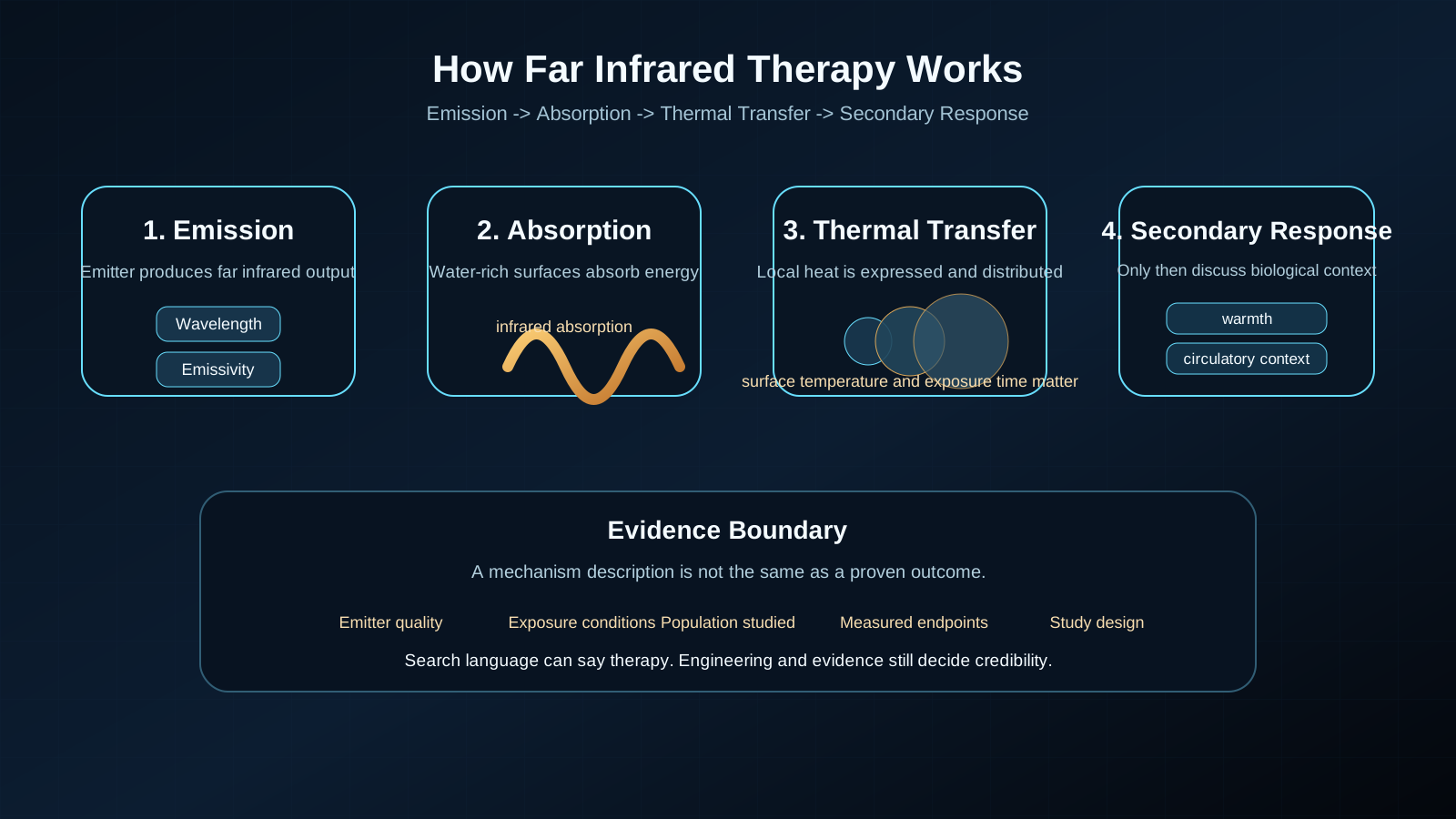
Step 1: The emitter produces far infrared output
Far infrared begins at the source.
The source may be ceramic, carbon, graphene, or another engineered emitter.
Its behavior is not described by temperature alone.
It is described by the combination of wavelength behavior, emissivity, and how much of the input energy becomes useful radiative output.
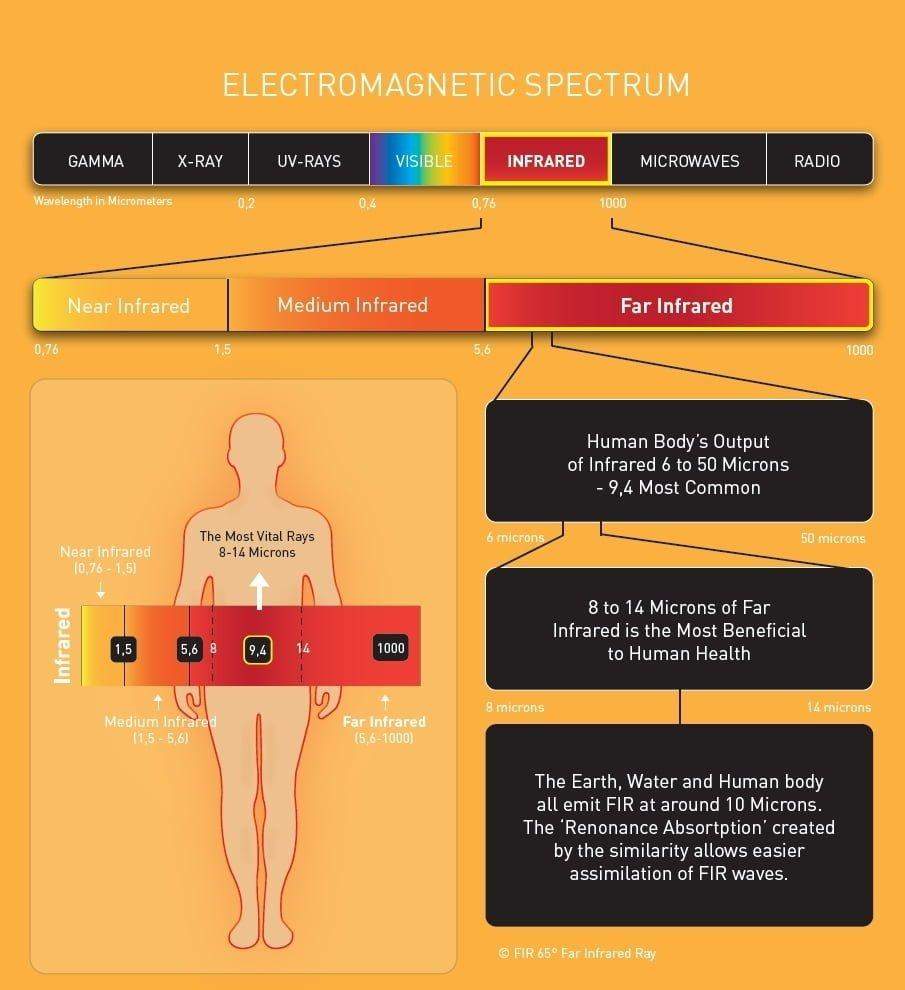
In XIHE’s graphene platform, the relevant engineered band is 5-15 micrometers, with a characteristic peak near 9.4 micrometers.
Step 2: Surfaces and water-rich environments absorb energy
Far infrared is not visible.
It becomes meaningful when it is absorbed.
When materials, surfaces, or tissue interfaces absorb infrared energy, molecular motion increases and thermal energy is expressed locally.
This is why far infrared is often discussed alongside warmth.
But the warmth is the consequence of absorption.
It is not the definition of far infrared itself.
Step 3: Heat is distributed through the local environment
Once energy is absorbed, heat is distributed through ordinary thermal processes.
That includes conduction to adjacent materials, local temperature change, and secondary interaction with circulation, evaporation, and ambient conditions.
This step matters because exposure is never only about the emitter.
It is also about the interface:
- distance from the source
- contact or non-contact setup
- surface insulation
- session duration
- thermal control
Step 4: Secondary physiological responses are then discussed
Only after the physical sequence is defined does it make sense to discuss secondary biological context.
This is where people talk about comfort, circulation, recovery environments, or thermal response.
That discussion can be reasonable.
What is not reasonable is skipping from “far infrared exists” to “therefore a health outcome is proven.”
What Actually Differentiates One System from Another
Not all far infrared systems should be treated as equivalent.
| Variable | Why it matters |
|---|---|
| Wavelength behavior | Helps define what part of the infrared spectrum the source is actually emitting |
| Emissivity | Describes how efficiently the surface emits thermal radiation |
| Radiative efficiency | Helps separate useful radiant output from wasted heat |
| Thermal control | Determines whether exposure is stable or erratic |
| Electrical design | Affects reliability, safety, and near-body use context |
| Form factor | Changes how energy reaches the target environment |
| Evidence quality | Determines whether claims go beyond surface-level marketing |
This is why the same search term can point to very different products:
- far infrared saunas
- commercial cabins
- mats
- wraps
- panels
- wearable systems
- graphene heating films
The phrase alone does not tell you which one is credible.
Evidence Boundaries
This is the most important section.
Far infrared therapy can be explained physically.
That does not mean every far infrared device has proven clinical outcomes.
A responsible evidence question looks like this:
- What was the emitter?
- What wavelength behavior was documented?
- What was the exposure duration?
- What was the surface or environmental temperature?
- What population was studied?
- What endpoint was measured?
- Was the study preclinical, observational, or controlled in humans?
Without those answers, the word therapy is doing too much work.
It is also why older internet articles often overstate the case.
They mix thermal comfort, historical heat use, broad wellness language, and selective references into one impression of proof.
That is not the same as a defined mechanism plus evidence.
Far Infrared Therapy vs Red Light Therapy
This is another major source of confusion.
Red light therapy and near infrared photobiomodulation are commonly discussed through shorter wavelengths and different evidence pathways.
Far infrared is typically discussed through radiant heat transfer, emissivity, thermal dose, exposure control, and secondary physiological response.
They are not interchangeable.
One should not be explained using the mechanism language of the other.
That comparison is covered more directly in the dedicated page on red light therapy vs far infrared.
Device Evaluation: What Serious Buyers Should Check
If someone is evaluating a far infrared system, these are better questions than “does it work?”
Ask:
- What emitter material is being used?
- What wavelength behavior is documented?
- Is emissivity tested by a named third party?
- What is the radiative efficiency?
- Is the system thermally stable under real operating conditions?
- How is the electrical system designed for near-body or enclosed-environment use?
- What claims are based on direct evidence, and what claims are only extrapolated?
Those questions move the conversation from marketing to evaluation.
XIHE Engineering Context
XIHE does not position far infrared as a vague therapy claim.
XIHE treats it as an engineered physical platform.
That means evaluating far infrared through measurable variables such as:
- 9.4 micrometer characteristic peak
- NIQS-tested 0.88 emissivity
- 68% electro-thermal radiation conversion efficiency
- Near-Zero EMF design positioning
- repeatable deployment in products and commercial systems
That is the difference between a source that feels warm and a source that can be specified.
What to Take Away
Far infrared therapy works first as a physics problem, not a promise.
An emitter produces far infrared output.
Nearby surfaces absorb it.
Thermal energy is expressed locally.
Only then does it make sense to discuss secondary biological context.
That is why the right first question is not “what benefits are promised?”
It is:
What exactly is the system emitting, and how is that exposure defined?
References
- Infrared spectral terminology varies by convention and industry context; this page uses far infrared as a practical engineering and evaluation category.
- XIHE internal engineering anchors: 5-15 micrometer emission band, 9.4 micrometer characteristic peak, NIQS-tested 0.88 normal total emissivity, and 68% electro-thermal radiation conversion efficiency.
EVIDENCE QUESTIONS
How does far infrared therapy work?
Far infrared therapy works by exposing the body or nearby surfaces to far infrared radiant energy. That energy is emitted by a source, absorbed by materials or water-rich tissues, converted into thermal motion, and then discussed through secondary physiological context such as warmth, circulation, and heat-related response.
What is far infrared therapy?
Far infrared therapy is a consumer search term for exposure systems that deliver far infrared radiant energy. The phrase is broad and can refer to saunas, cabins, mats, wraps, lamps, or engineered films, so the better question is how the emitter behaves and what evidence supports the specific application.
Is far infrared therapy the same as red light therapy?
No. Red light therapy and near infrared photobiomodulation are typically discussed through different wavelength ranges and different evidence frameworks. Far infrared systems are usually evaluated through radiant heat transfer, emissivity, thermal control, and secondary physiological response rather than the same optical pathway used in red light discussions.
Does far infrared therapy work because it penetrates deeply?
Depth claims are often oversimplified. A far infrared system should first be evaluated by emitter quality, wavelength behavior, absorption, heat distribution, and exposure conditions. The word penetration alone does not establish a meaningful engineering or clinical explanation.
Does far infrared therapy prove a health benefit?
No. A far infrared mechanism can be described physically, but outcome claims require separate evidence for the device, population, exposure conditions, measured endpoints, and study design.
RELATED EVIDENCE BRIEFS
Graphene Infrared vs Traditional Heating — Technical Comparison
Technical comparison: XIHE high-emissivity graphene far-infrared vs. traditional infrared heating. Emissivity, NIQS-tested electro-thermal radiation conversion efficiency (68%), spectral precision — data-driven engineering differences.
Why Two 9.4 μm Graphene Films Are Not the Same
Spectral emissivity, not just 5–15 μm wavelength, determines far-infrared graphene performance. This comparison shows why 9.4 μm output matters.
Why Is Far-Infrared Invisible but Warm? The Physics of Light and Skin
Why far-infrared radiation is invisible to the eye but can be felt as warmth on the skin. The physics of infrared absorption, water molecules, and thermosensitive receptors explained.