Why Is Far Infrared Invisible but Warm?
Far infrared is invisible because human eyes cannot detect it, but it can still be felt as warmth when tissue absorbs the energy. This article explains the physics clearly.

QUICK ANSWER
Far infrared is electromagnetic radiation at wavelengths longer than visible light, so the human eye cannot detect it. It can still feel warm because biological tissue absorbs the energy and thermoreceptors register the resulting temperature change.
Reference Signals
Why Does Far Infrared Feel Warm? Quick Answer
Far infrared is invisible because your eyes are not designed to detect it.
It can still feel warm because your tissue can absorb it.
What you feel is not the radiation itself.
What you feel is the body’s temperature response after absorption.
Why Far Infrared Is Invisible but Warm: The Physics Behind the Question
People often assume that if something can be felt, it should also be visible.
That is true for many everyday experiences.
It is not true for all electromagnetic radiation.
Visible light is only a small part of the spectrum. Far infrared sits outside that visible band, so it can interact with tissue without ever appearing as light to the eye.
Far Infrared Physics: Separate Visual Detection From Thermal Absorption
The key distinction is simple:
- eyes detect visible wavelengths
- tissue can absorb non-visible wavelengths
These are different biological systems doing different jobs.
Your retina is built for vision.
Your skin and tissue are part of thermal sensing and energy absorption.

Far Infrared Absorption: Why the Body Feels Warmth
Far infrared wavelengths are longer than visible light.
Because of that, the retina does not register them as an image.
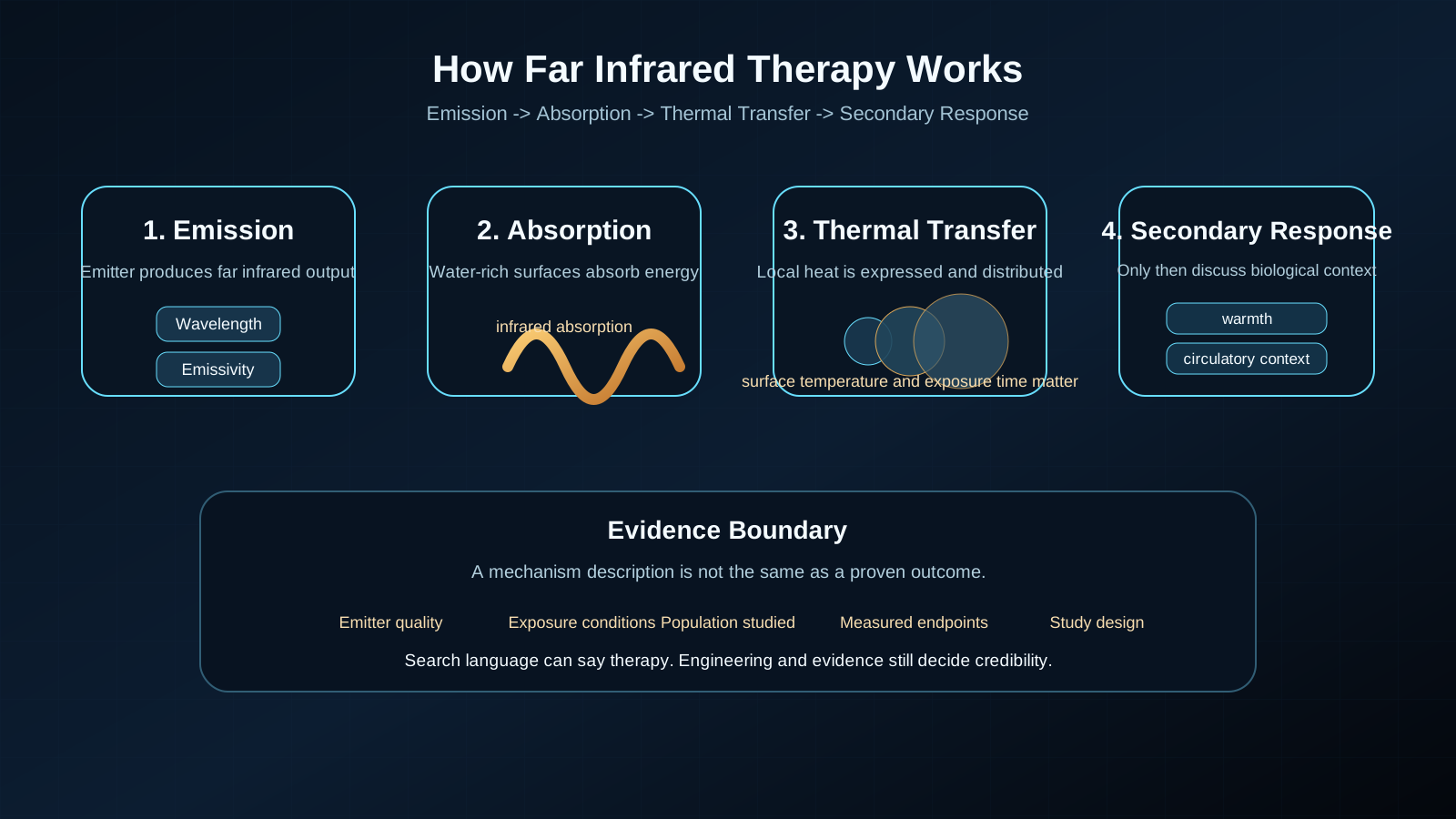
But when the energy is absorbed by tissue, molecular motion increases and local thermal conditions change. Thermoreceptors in the skin then send that information to the brain as warmth.
So the body does not “see” far infrared.
It experiences the temperature consequence of absorbing it.
Why This Matters for XIHE
This is where the conversation shifts from basic physics to engineering.
Not all warmth tells you the same thing about the source.
The useful technical questions are:
- what wavelength behavior is being discussed?
- how efficiently is the material radiating?
- how stable is the output?
- is the claim documented?
That is why XIHE’s stronger public language focuses on measurable far infrared engineering rather than simply saying something feels warm.
Where Graphene Changes the Comparison
Feeling warmth is one thing. Knowing why the emitter produces that warmth is another.
Far infrared graphene addresses the second question: it defines the emitter through wavelength band, emissivity, radiant efficiency, and thermal stability rather than through sensation alone.
That is the shift from “it feels warm” to “here is what the source is doing.”
What to Read Next
- What Is Far Infrared?
- What Is Emissivity?
- Why Two 9.4 um Graphene Films Are Not the Same
- What Is Far Infrared Radiant Efficiency?
- Graphene Heated Film
Bottom Line
Far infrared is invisible because it sits outside human vision.
It feels warm because tissue absorbs it and the body registers the resulting temperature change.
That is the basic physics.
The engineering question comes next.
This article is for scientific education only. It does not provide medical advice or treatment claims.
EVIDENCE QUESTIONS
Why can't humans see far infrared?
Because far infrared wavelengths are longer and lower in photon energy than the visible range the human retina is built to detect.
Why can far infrared still feel warm?
Because the body does not need to see the radiation to absorb it. Tissue absorbs the energy, local temperature changes, and thermoreceptors detect that change.
What matters more for far infrared performance than just feeling warm?
The important technical questions are what wavelength range is being emitted, how efficiently the material radiates, and how stable and documented that output is.
CONTINUE EXPLORING
What Is Emissivity? The Critical Parameter in Graphene Far Infrared Systems
Emissivity measures how efficiently a surface radiates thermal energy. Learn why emissivity matters in graphene far infrared systems, how it differs from wavelength, and how XIHE frames 0.88 emissivity as an engineering anchor.
Why Two 9.4 um Graphene Films Are Not the Same
Far infrared performance is not defined by wavelength alone. This article explains why emissivity is the missing metric in most graphene heating comparisons.
What Is Far Infrared Graphene? Technology, Emitter Architecture, and Evaluation
Far infrared graphene technology uses a graphene-based emitter to convert electrical input into far infrared radiant output. Learn how it differs from conventional heating elements, how to evaluate emitter architecture, emissivity, radiant efficiency, and supplier evidence.
What Is Far Infrared Graphene? Technology, Emitter Architecture, and Evaluation Articles
Browse all XIHE knowledge articles filed under what is far infrared graphene? technology, emitter architecture, and evaluation.
Are Heated Eye Masks Safe? What Buyers Should Check First
Are heated eye masks safe? The practical answer depends on temperature control, session duration, face-contact materials, charging design, and whether the product is disposable or reusable.
Graphene Far Infrared vs Traditional Infrared Heating: What Actually Matters?
Not all infrared systems are equal. This comparison explains what buyers should actually compare: emissivity, radiant efficiency, wavelength behavior, thermal stability, and engineering consistency.