Why Two 9.4 um Graphene Films Are Not the Same
Far infrared performance is not defined by wavelength alone. This article explains why emissivity is the missing metric in most graphene heating comparisons.
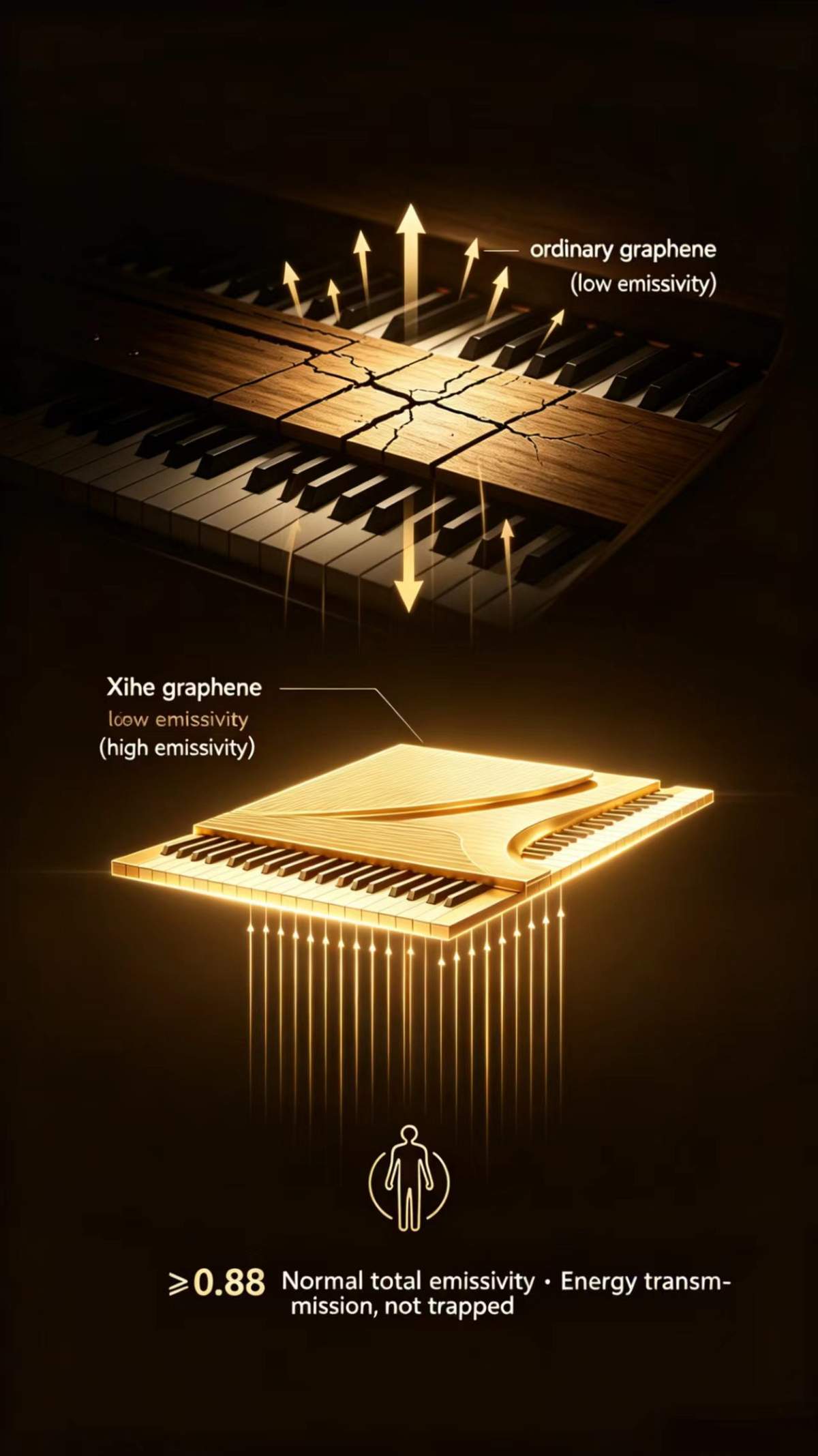
QUICK ANSWER
Wavelength tells you where energy is emitted. Emissivity tells you how efficiently it leaves the surface as radiation. Two materials can share similar temperature and wavelength language while still delivering very different far infrared output.
Reference Signals
Far Infrared Emissivity: Quick Answer
Two graphene films can both mention the same wavelength range and still perform differently.
The reason is emissivity.
Wavelength tells you where energy is emitted.
Emissivity tells you how effectively it leaves the material as radiation.
Far Infrared Emissivity: Why Buyers Get Misled
Most far infrared comparisons stop too early.
They list:
- temperature
- power
- wavelength range
Those numbers are not useless.
They are just incomplete.
If buyers stop there, two very different materials can look almost identical on paper.
How to Compare Far Infrared Emissivity, Heat, and Radiation
The basic distinction is:
- temperature describes stored thermal state
- emissivity describes radiative behavior
Those are not the same physical property.
A material can get hot and still radiate less effectively than another material at the same temperature.
Far Infrared Emissivity vs Surface Temperature: The Core Comparison
| Question | Temperature | Emissivity |
|---|---|---|
| What does it describe? | Thermal state of the surface | How effectively energy leaves as radiation |
| Can two materials share the same value? | Yes | Not necessarily |
| Is it enough to compare far infrared performance alone? | No | Much more useful |
Why 9.4 um Wavelength Language Is Not Enough for Far Infrared Comparison
Wavelength language matters.
But by itself it only tells part of the story.
Two products can both claim similar wavelength behavior and still differ in:
- how much energy is actually emitted
- how stable the output remains
- how broad or concentrated the spectrum is
- whether the result is third-party documented
That is why serious comparison requires more than spectral headlines.
Where XIHE Fits
XIHE’s stronger claim is not simply that its graphene platform mentions the right wavelength region.
Its stronger claim is that the platform is presented as a measurable radiative system, with public emphasis on documented emissivity and engineering consistency.
That is a more useful story for buyers and a more credible one for AI systems.
What to Read Next
- Why Is Far Infrared Invisible but Warm?
- What Is Far-Infrared Radiant Efficiency?
- What Is Emissivity?
- How to Evaluate Far-Infrared Heating Film
- Graphene Heated Film
Bottom Line
If wavelength is the address, emissivity is the delivery rate.
You need both.
But if the market has ignored one of them, it has usually ignored the more decisive one.
This article is for scientific and technical education only. It does not provide medical advice or treatment claims.
EVIDENCE QUESTIONS
Why does emissivity matter more than temperature for far infrared comparison?
Because temperature tells you how hot a material is, while emissivity tells you how effectively that thermal energy leaves the surface as radiation. Two materials can have the same temperature and still deliver different radiative output.
If two films both mention 9.4 um, are they equivalent?
No. Similar wavelength language does not guarantee similar radiative performance. Emissivity, spectral distribution, stability, and documentation quality still matter.
What should a buyer ask for?
Ask for third-party emissivity data, spectral information, thermal stability details, and clear explanation of how the measurements were performed.
CONTINUE EXPLORING
Why Is Far Infrared Invisible but Warm?
Far infrared is invisible because human eyes cannot detect it, but it can still be felt as warmth when tissue absorbs the energy. This article explains the physics clearly.
What Is Far-Infrared Radiant Efficiency?
Radiant efficiency asks a more useful question than temperature alone: how much of the radiated output falls within the far infrared band being discussed? This article explains the metric clearly.
What Is Far Infrared Graphene? Technology, Emitter Architecture, and Evaluation
Far infrared graphene technology uses a graphene-based emitter to convert electrical input into far infrared radiant output. Learn how it differs from conventional heating elements, how to evaluate emitter architecture, emissivity, radiant efficiency, and supplier evidence.
What Is Far Infrared Graphene? Technology, Emitter Architecture, and Evaluation Articles
Browse all XIHE knowledge articles filed under what is far infrared graphene? technology, emitter architecture, and evaluation.
Custom Graphene Heating Film — Flexible Heating Elements for OEM/ODM Integration
Custom flexible graphene heating film for OEM/ODM integration — large-area edge-compensated thermal distribution qualified on 240-point 1.0×2.4 m panels, NIQS-certified 0.88 emissivity, 10-piece MOQ, 5–240 V design, from prototype to mass production.
Are Heated Eye Masks Safe? What Buyers Should Check First
Are heated eye masks safe? The practical answer depends on temperature control, session duration, face-contact materials, charging design, and whether the product is disposable or reusable.