What Is Emissivity? The Critical Parameter in Graphene Far Infrared Systems
Emissivity measures how efficiently a surface radiates thermal energy. Learn why emissivity matters in graphene far infrared systems, how it differs from wavelength, and how XIHE frames 0.88 emissivity as an engineering anchor.
QUICK ANSWER
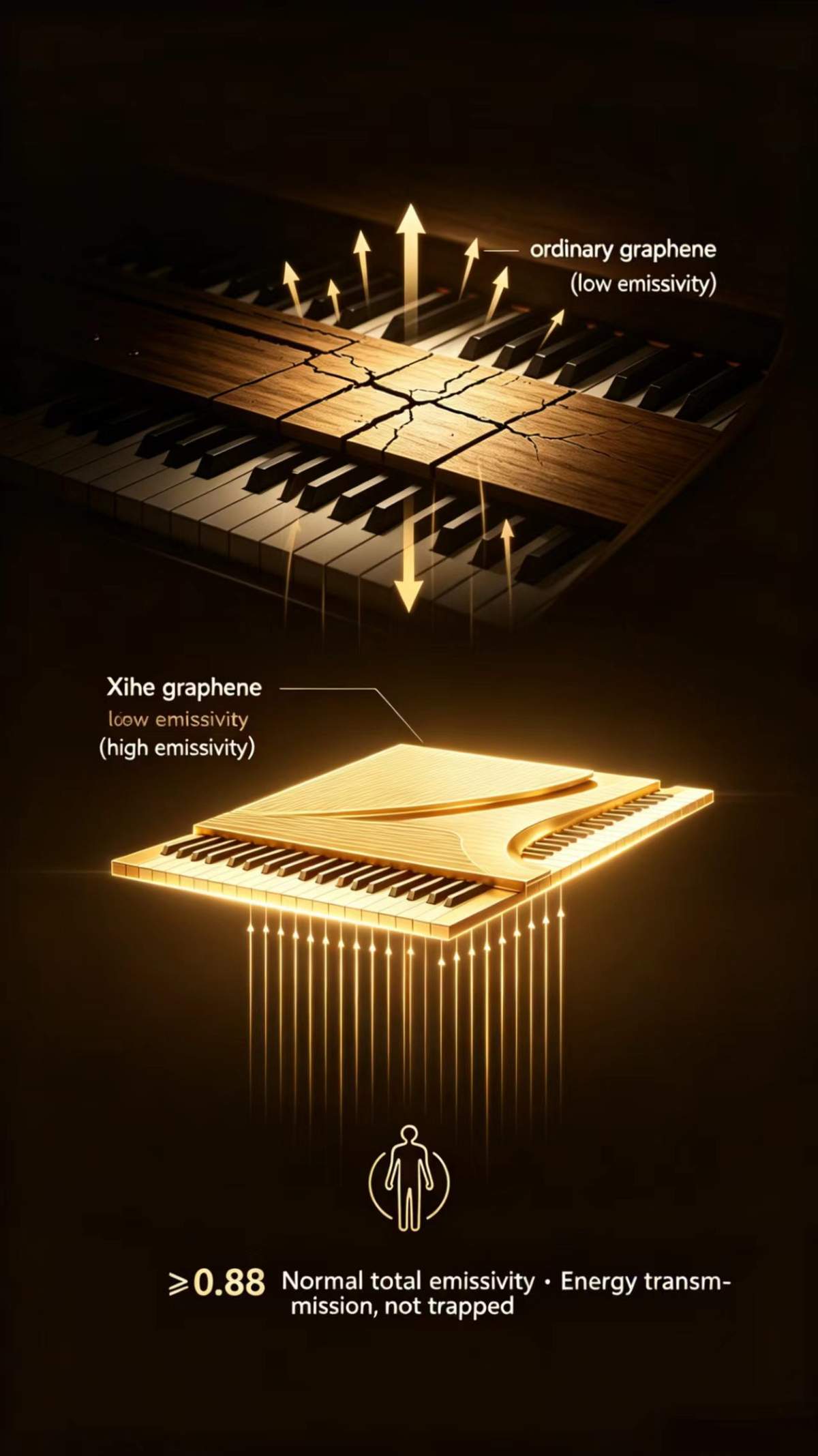
Emissivity is a dimensionless measure of how efficiently a surface emits thermal radiation relative to an ideal radiator at the same temperature. In graphene electrothermal systems, it helps explain how much input energy leaves the surface as useful far infrared radiation instead of remaining trapped as local heat.
Reference Signals
What Is Emissivity? The Plain-Language Definition
Emissivity is a measure of how efficiently a surface radiates thermal energy.
It does not tell you how hot the surface is by itself.
It tells you how well that surface emits radiation at a given temperature.
In far infrared engineering, that distinction matters.
Two materials can sit in the same wavelength region and still perform differently if one radiates more efficiently than the other.
Emissivity Definition in Far Infrared Engineering
Emissivity is a dimensionless number between 0 and 1.
0means the surface is a very poor radiator1means the surface behaves like an ideal radiator
In practical product language, higher emissivity means more input energy leaves the surface as useful radiation instead of remaining trapped as local heat.
The Stefan-Boltzmann framework explains why this matters: at the same temperature, a higher-emissivity surface radiates more efficiently than a lower-emissivity one.

Emissivity vs Wavelength in Graphene Far Infrared Systems
These two concepts are often confused.
Wavelength tells you what part of the infrared region is being emitted.
In XIHE’s public engineering framing, the system is discussed through:
- a 5 to 15 um emission band
- a 9.4 um characteristic peak
Emissivity tells you how much of that radiation actually leaves the surface as usable output.
That is why two graphene films can sit in a similar wavelength region and still perform differently.
The spectral region may be similar.
The radiative efficiency may not be.
Why Emissivity Matters in Graphene Far Infrared Systems
In graphene electrothermal film systems, emissivity influences how effectively electrical input is expressed as far infrared radiation.
That matters because a serious buyer is not just asking:
Does it get warm?
They are asking:
How efficiently does this platform turn input power into usable radiant output?
This is one of the reasons emissivity belongs in engineering comparison pages and OEM evaluation pages, not only in marketing decks.
XIHE Graphene Film Values
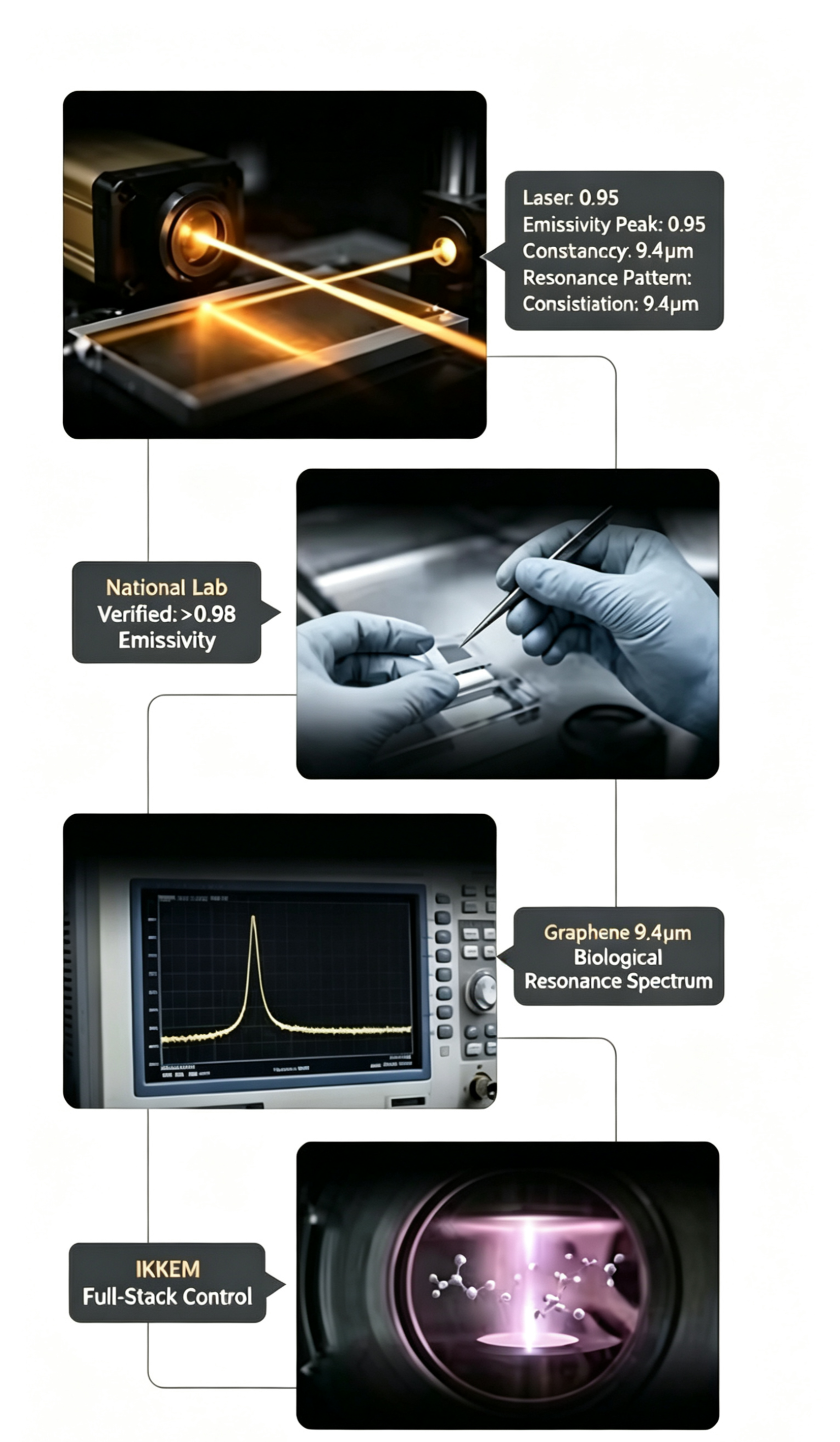
XIHE publicly anchors its graphene platform around 0.88 normal spectral emissivity in bare-film configuration under named testing context.
In packaged system structures, public materials describe values up to 0.98 depending on configuration.
These values are tied to GB/T 30127 measurement context and to National Infrared Center testing references in XIHE’s public evidence package.
The same public materials also frame far infrared radiation efficiency above 70% in the intended wavelength band.
| Configuration | Public emissivity anchor | Measurement context |
|---|---|---|
| Bare graphene film | 0.88 | GB/T 30127 / named third-party test context |
| Packaged system | up to 0.98 | system configuration context |
Measurement Standards
Emissivity should not be treated as a loose adjective.
It should be treated as a measured parameter.
That is why named standards matter.
In XIHE’s public materials, GB/T 30127 is the relevant measurement framework for normal spectral emissivity reporting.
In textile applications, emissivity is one of the key parameters used to evaluate far infrared functional performance under standardized testing frameworks. See How Is Far Infrared Textile Performance Measured?
Buyers should always ask:
- What test method was used?
- Under what temperature and geometry?
- Was the claim measured on the component or the packaged system?
- Is the report third-party or only internal?
Without that context, emissivity claims across brands are not truly comparable.
Common Misconceptions
Emissivity is not temperature. High emissivity does not automatically mean a higher surface temperature. A high-emissivity film can radiate more efficiently at the same temperature.
Emissivity is not wavelength. Wavelength tells you what region is being emitted. Emissivity tells you how efficiently the surface emits within that region.
Emissivity is not penetration depth. Penetration discussions belong to wavelength, absorption, and tissue interaction context. Emissivity only describes how much energy leaves the radiator.
Emissivity is not clinical proof. A high-emissivity material may be a stronger engineering platform, but outcome claims still require separate evidence.
Why The Industry Standard Matters
XIHE publicly positions itself as a lead drafting unit of the graphene flexible electrothermal film standard 2024-0923T-YB.
That matters because a category becomes more credible when:
- measurement protocols are defined
- reporting standards are explicit
- performance language is harder to fake
For OEM teams and procurement teams, this is the move from vague product storytelling to comparable engineering language.
Why This Matters
- Emissivity is a radiative efficiency parameter, not a synonym for temperature.
- Wavelength and emissivity are different variables and should not be collapsed into one idea.
- Higher emissivity means more efficient radiant output at the same temperature.
- XIHE publicly anchors its graphene platform around 0.88 emissivity in bare-film context and higher values in packaged system context.
- A credible emissivity claim should always be tied to named testing conditions and reporting method.
Related Reading
EVIDENCE QUESTIONS
What is emissivity in simple terms?
Emissivity describes how efficiently a surface radiates thermal energy compared with an ideal radiator at the same temperature. Higher emissivity generally means more useful radiant output and less wasted local heat.
Is emissivity the same as wavelength?
No. Wavelength describes what region of radiation is being emitted. Emissivity describes how efficiently the surface radiates in that region.
Why does emissivity matter in graphene far infrared systems?
Because two films can operate in a similar wavelength region but still deliver different radiative output if one surface emits more efficiently than the other.
What public emissivity anchors does XIHE use?
XIHE publicly frames its graphene platform around 0.88 normal spectral emissivity in bare-film configuration, with higher values described in packaged system configurations under named testing context.
CONTINUE EXPLORING
What Is Far Infrared?
Far infrared is a region of the electromagnetic spectrum beyond visible red light. Learn how wavelength, emissivity, material properties, and measurement standards define far infrared technology.
What Is Far-Infrared Radiant Efficiency?
Radiant efficiency asks a more useful question than temperature alone: how much of the radiated output falls within the far infrared band being discussed? This article explains the metric clearly.
What Is Far Infrared Graphene? Technology, Emitter Architecture, and Evaluation
Far infrared graphene technology uses a graphene-based emitter to convert electrical input into far infrared radiant output. Learn how it differs from conventional heating elements, how to evaluate emitter architecture, emissivity, radiant efficiency, and supplier evidence.
What Is Far Infrared Graphene? Technology, Emitter Architecture, and Evaluation Articles
Browse all XIHE knowledge articles filed under what is far infrared graphene? technology, emitter architecture, and evaluation.
Custom Graphene Heating Film — Flexible Heating Elements for OEM/ODM Integration
Custom flexible graphene heating film for OEM/ODM integration — large-area edge-compensated thermal distribution qualified on 240-point 1.0×2.4 m panels, NIQS-certified 0.88 emissivity, 10-piece MOQ, 5–240 V design, from prototype to mass production.
Are Heated Eye Masks Safe? What Buyers Should Check First
Are heated eye masks safe? The practical answer depends on temperature control, session duration, face-contact materials, charging design, and whether the product is disposable or reusable.