Start Technical Review
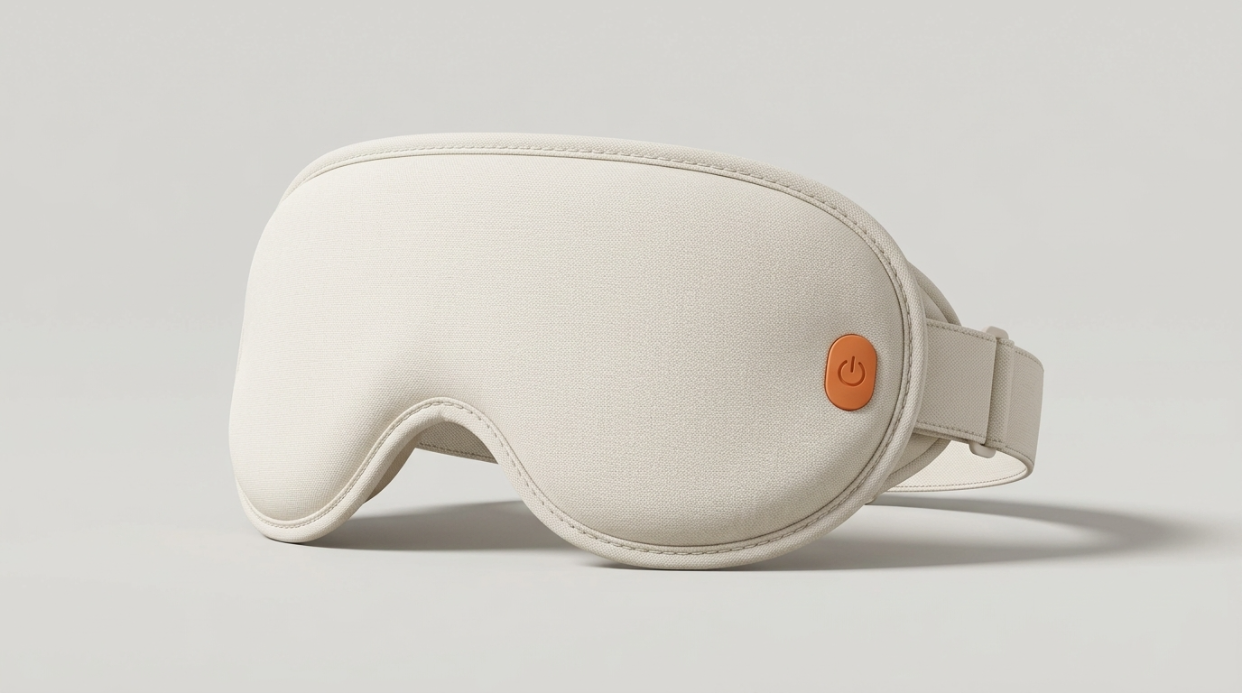
Off-white heating eye mask with an orange control button and adjustable strap

Case Studies / product integration

Graphene Heating Eye Mask

Start with an existing heating eye-mask sample with a documented electrical rating, layer stack and timed controls. Discuss the sample configuration and OEM adaptations for your product.

Customer value / Product upgrade

What Graphene Integration Solves

Bring heating into a soft wearable and address the thermal, fit and product-range requirements together.

01

More useful heating coverage

Product challenge: local warmth with cold edges.

A planar heating layer distributes heat generation across the intended footprint. Matching that footprint with the foam and textiles addresses the heat path to the contact surface.

Upgrade focus: more consistent warmth across the intended contact area.

02

Heating that fits a soft product

Product challenge: adding heating without a bulky, rigid insert.

The flexible heating film integrates within the six-layer textile assembly of the existing foldable sample.

Product value: a heating function within a soft, wearable format.

03

A starting point for your next product

Product challenge: adding a differentiated heated model to a product range.

The existing sample combines heating, three settings and a timer. OEM adaptations can address geometry, materials, power and optional NTC feedback.

Product value: a concrete sample for evaluating your own heated product variant.

The improvement in temperature uniformity is evaluated on the assembled product under defined contact conditions.

Existing sample / OEM integration

Build on an existing sample. Adapt the heating layer to your product.

The six-layer eye-mask sample brings the heating film, textile stack and timed controls into one assembled product. Start your review with this configuration. XIHE helps define the heating footprint, electrical terminations and validation priorities for your adaptations before you commit to tooling and mass production.

Discuss OEM Customization

01 / Product problem

A graphene heating layer inside a six-layer wearable.

XIHE has an existing eye-mask sample combining a graphene heating layer, a six-layer textile assembly and timed three-setting controls. Use this configuration as a concrete starting point for your OEM discussion. Review the sample against your product requirements, then define any changes to geometry, power, textiles, connections or optional NTC sensing.

Integration requirements

  • Fit the heating footprint around the nasal bridge and textile seams.
  • Evaluate the contact-surface response at every published setting over the timed operating cycle.
  • Preserve the documented foldable format while routing power connections away from concentrated strain.
  • Account for heat transfer through the memory foam, inner Lycra and flannel between the heater and the contact surface.

Published product specifications

Product status
Existing sample available
Rated voltage and power
5 V / 5 W
Recommended charging supply
5 V / 2 A
Control settings and timer
35 / 45 / 55 °C; 15 min
Product weight
73 g
Heating material
Graphene
NTC sensor
Not fitted; available on customization

Values are resolved from the Evidence Registry records for the supplied product sheets. Control settings do not establish measured contact-surface temperatures, and the charging-supply recommendation is separate from rated heating power.

Review the existing eye-mask sample, then agree the configuration and validation for OEM changes.

Person reclining beside a window wearing an off-white heating eye mask with an orange button and adjustable strap

Product in use / Contact and controls

Fit changes the thermal interface.

The textile assembly follows the face while the control button stays accessible on the outer surface. Strap tension and foam compression affect contact pressure and the heat path.

Published controls
35 / 45 / 55 °C; 15 min

Evaluate the contact-surface response across the intended fit range at each setting, including warm-up and the end of the timed cycle.

02 / Integration structure

Build the heating layer around your product.

Six-layer stack and heat path

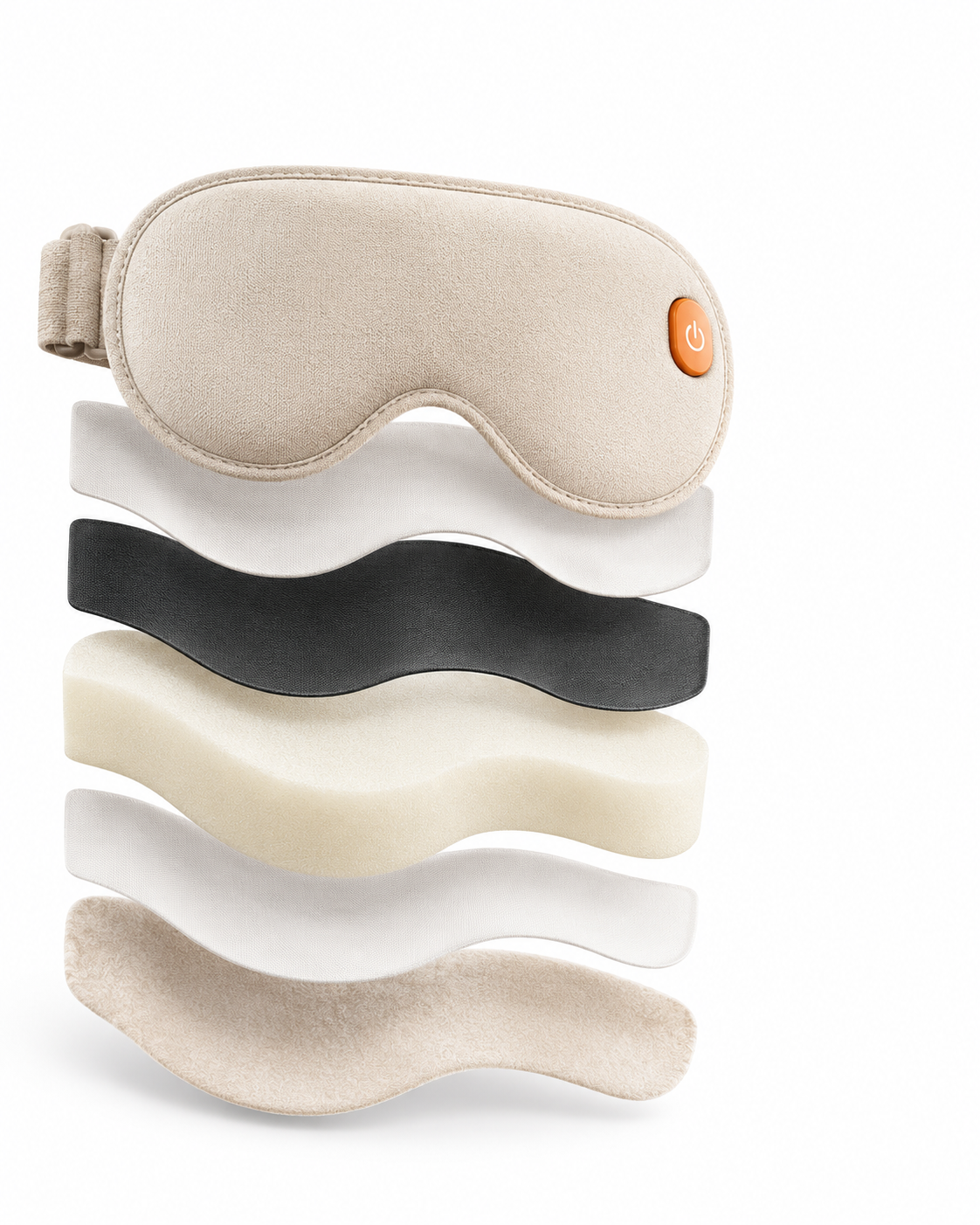
The sheet places the graphene heating layer between the first Lycra layer and the memory foam. Heat reaching the contact face therefore passes through the memory foam, second Lycra layer and flannel. Compression of the foam changes this thermal path; measure the contact surface as well as the heater. The sheet does not resolve the internal electrode or encapsulation construction.

Electrodes and termination

The nasal cut-out, electrode ends and lead attachment can concentrate current or mechanical strain. Review electrode continuity, contact resistance and strain relief together. A smooth-looking thermal image does not establish that a terminal will survive repeated pulling or folding.

Standard controls and optional NTC

The current eye mask has no NTC sensor. Its published controls specify multiple temperature settings and a timed operating cycle. NTC sensing is available as an OEM customization; sensor placement, thermal coupling, controller compatibility and fault response are defined for that customized assembly.

Assembly detail

Six layers. One defined heat path.

Six layers in the order shown by the product sheet, from outer surface to contact surface. The heating layer sits above the memory foam in this published stack.

Exploded eye-mask illustration showing, from top to bottom, outer plush textile with orange button, Lycra, black graphene heating layer, memory foam, inner Lycra and contact flannel

Outside → Contact surface

  1. 01Outer plush textile
  2. 02Lycra
  3. 03Graphene heating layer
  4. 04Memory foam
  5. 05Lycra
  6. 06Contact flannel

Heat from layer 03 passes through memory foam, inner Lycra and flannel to reach the contact surface.

Illustration based on product information. Layer thickness and spacing are schematic, not manufacturing dimensions.
01 / Outer plush textile
Exterior fabric, described as milk fleece in the supplied product sheet.
02 / Lycra
Textile layer on the outward-facing side of the heater.
03 / Graphene heating layer
The active heating material, positioned between Lycra and memory foam.
04 / Memory foam
Padding on the contact-facing side of the heater; its compression affects heat transfer.
05 / Lycra
Second textile layer between the memory foam and flannel.
06 / Flannel
Contact-facing textile at the end of the published layer stack.

Electrical interpretation / Derived from registered ratings

1 A nominal load / 5 ohms equivalent / 1.25 Wh at 15 min

The published rating corresponds to a nominal 1 A load, 5 ohms equivalent resistance and 1.25 Wh for 15 minutes of continuous operation. These are reference calculations, not measured current, heater resistance or battery runtime; controller duty cycle and circuit losses affect actual operation.

The heating material is one part of the product. Film, terminals, sensing, controls and the textile assembly need an agreed supply scope for each OEM project.

Thermal interpretation

Uniformity across the contact surface.

Spatial uniformity describes variation across an area. Control stability describes variation over time at one location.

Three temperature settingsConceptual thermal visualization

Product setting 35°C

35 degrees Celsius setting: conceptual eye-mask colour field Rounded eye-mask outline with a nasal cut-out. The number labels the product setting, not a measured surface temperature. No sensor is depicted. Contact-facing view / Schematic

Product setting 45°C

45 degrees Celsius setting: conceptual eye-mask colour field Rounded eye-mask outline with a nasal cut-out. The number labels the product setting, not a measured surface temperature. No sensor is depicted. Contact-facing view / Schematic

Product setting 55°C

55 degrees Celsius setting: conceptual eye-mask colour field Rounded eye-mask outline with a nasal cut-out. The number labels the product setting, not a measured surface temperature. No sensor is depicted. Contact-facing view / Schematic
Illustrative colour progression
35, 45 and 55°C are the published product settings. Mask outlines and colour fields are illustrative, not measured thermal images or numerical simulations. Colours do not establish actual surface temperatures or uniformity. The standard eye mask has no NTC; NTC sensing is available as an OEM customization.

Spatial temperature spread

Maximum minus minimum temperature across a defined contact-surface region, at the same instant and operating condition. Define whether seams and the bridge are inside that region before testing.

Temperature stability over time

Measure temperature variation at fixed contact-surface locations using external test probes. These measurement probes are test equipment, not built-in NTC sensors. Stability at one point does not establish uniformity across the mask.

Transient response

Record warm-up, overshoot and recovery after a change in fit or contact load using external reference probes. Compare heater and contact-surface temperatures on a shared time axis over the timed cycle.

03 / Engineering validation

Resolve integration risks before they become rework.

Use the existing sample as your starting point. For OEM changes, review fold lines, lead exits and foam compression together, then agree the verification needed before tooling and pilot production.

Integration challengePossible physical mechanismProposed verification methodEngineering decision to evaluate
Uneven contact-surface temperatureEdge heat loss, foam compression or changing fit alters the local thermal path.Map the contact region with external calibrated measurement equipment under representative contact loads at each setting.Heating footprint, textile stack and operating settings.
Fold or terminal hotspotLocal resistance changes at an electrode end, bend line or lead joint.Measure resistance and thermal distribution before and after defined bend and cable-pull tests.Electrode geometry, exclusion zones and strain relief.
Insulation damageCompression, moisture or abrasion compromises encapsulation.Inspect edges and seams; define appropriate insulation testing before and after mechanical and environmental conditioning.Encapsulation, edge seal and care instructions.
NTC fault in an optional customized assemblyOnly for an NTC-equipped customization: a disconnected, shorted or detached sensor gives an invalid input.For the customized design, inject defined sensing faults in a controlled setup and record the protective response.Customized controller compatibility, fault detection and protection.
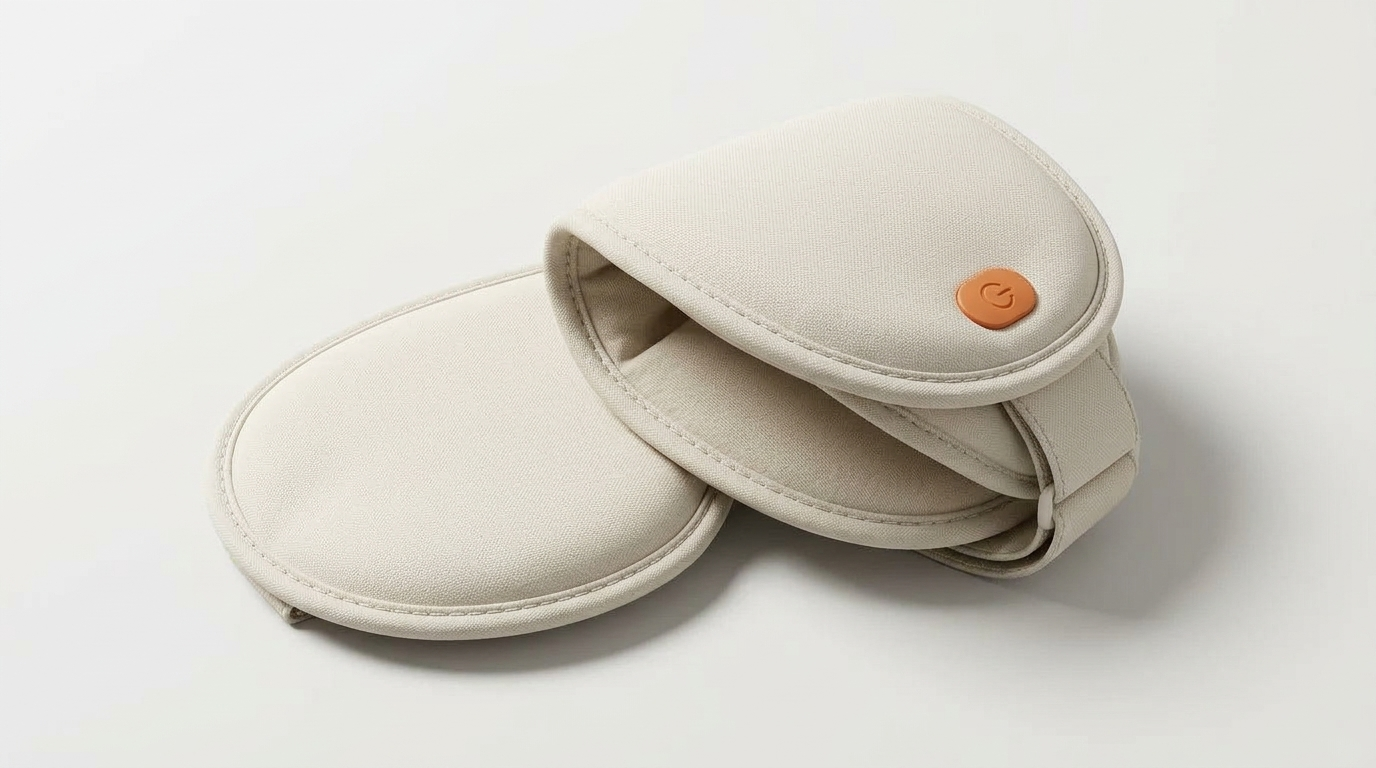
Existing heating eye-mask sample folded into a compact form, showing its textile exterior and orange control button
Existing sample shown in a folded configuration.

Mechanical integration / Sample adaptation

Start from a working form. Tune it for your product.

The existing sample provides a concrete reference for the textile assembly and foldable format. OEM changes can address the active area, fold path, terminals, materials and optional NTC architecture.

  • Review the intended fold relative to the active heating area.
  • Adapt lead exits and strain relief for the target product.
  • Define the resistance and temperature checks for the customized build.

04 / Development stage

Existing sample available

Review the existing eye-mask sample, then agree the configuration and validation for OEM changes.

Engineering handoff records

  • Dimensioned stack-up with seam and bridge exclusions.
  • Electrode and terminal drawing; NTC placement only for an agreed customized configuration.
  • Definition of the contact-surface measurement region, external test probes and contact load.
  • Synchronous electrical and temperature traces, with calibration records.
  • Post-conditioning inspection and acceptance criteria.

Explore the validation framework →

Discuss your OEM heating integration.

Share your product drawing, heating area, target temperature and electrical supply. Start with the existing sample and identify the adaptations your product needs.

Request an Engineering Evaluation

Evidence scope

What the available records establish.

Product specifications, engineering calculations and proposed verification answer different questions.

InformationSource and scope
Product configurationThe Evidence Registry records the supplied product-sheet ratings, controls and weight for the existing sample. XIHE confirms that the standard product has no NTC.
Electrical reference calculationsThe registered reference calculation is derived from published ratings. It is not a measured current, heater resistance or battery-runtime result.
Contact-temperature distributionThe coloured diagrams are conceptual. They do not establish measured uniformity, contact temperature or an achieved temperature tolerance.
Durability and design changesThe proposed tests and design responses are an engineering evaluation plan. Separate material-test records need a documented sample and configuration link before being attributed to this assembled eye mask.

Technical FAQ

Questions about wearable heating integration.

Does a 45-degree setting mean 45 degrees at the contact surface?

A nominal temperature setting does not, by itself, define the contact-interface temperature. Actual temperature depends on heater output, through-plane thermal resistance, foam compression, contact conditions and environmental heat loss. The published settings do not establish the controller circuit or its duty cycle.

How does memory-foam compression affect thermal uniformity?

The memory foam sits between the heating layer and the inner Lycra and flannel. Compression can change layer thickness and thermal contact, altering the local heat path. The magnitude and direction of the temperature change require measurements on the assembled product under defined loads.

Why should the nasal bridge and terminals be checked for hotspots?

Geometry, electrical termination and local mechanical strain can affect current distribution and resistance. These are locations to investigate, not confirmed defects in this eye mask. Compare electrical measurements and thermal maps before and after defined mechanical conditioning.

How should dynamic flex-cycle reliability be evaluated?

Specify bend radius, direction, cycle count, electrical state and lead restraint. Record resistance and contact-surface temperatures before and after the sequence on identified assemblies. A folding product photograph does not establish cycle life, and a separate film-sample result cannot automatically be assigned to this eye mask.

Does the standard eye mask include an NTC sensor?

No. The standard eye mask has no NTC sensor. NTC sensing is available as an OEM customization, with sensor placement, controller compatibility and fault response defined for the customized assembly. External temperature probes used during testing are not built-in product sensors.

Do the three coloured mask diagrams show measured uniformity?

No. The diagrams illustrate the published 35, 45 and 55 degrees Celsius settings. They are not measured thermal images or numerical simulations. Uniformity requires a defined measurement region and simultaneous surface-temperature readings under stated operating and contact conditions.

05 / Next step

Move from this record to your product decision.

Review component scope, check the Engineering evidence, and bring your project requirements to a Technical Review.

Graphene Heating Film

Review the component and supply scope.

Engineering Evidence

Define the validation record the decision needs.

Technical Review

Share the geometry, electrical input and development stage.

Start with the sample. Define your customization.

Discuss the existing eye-mask sample, your target configuration and the engineering review for OEM adaptations.

Request an Engineering Evaluation