
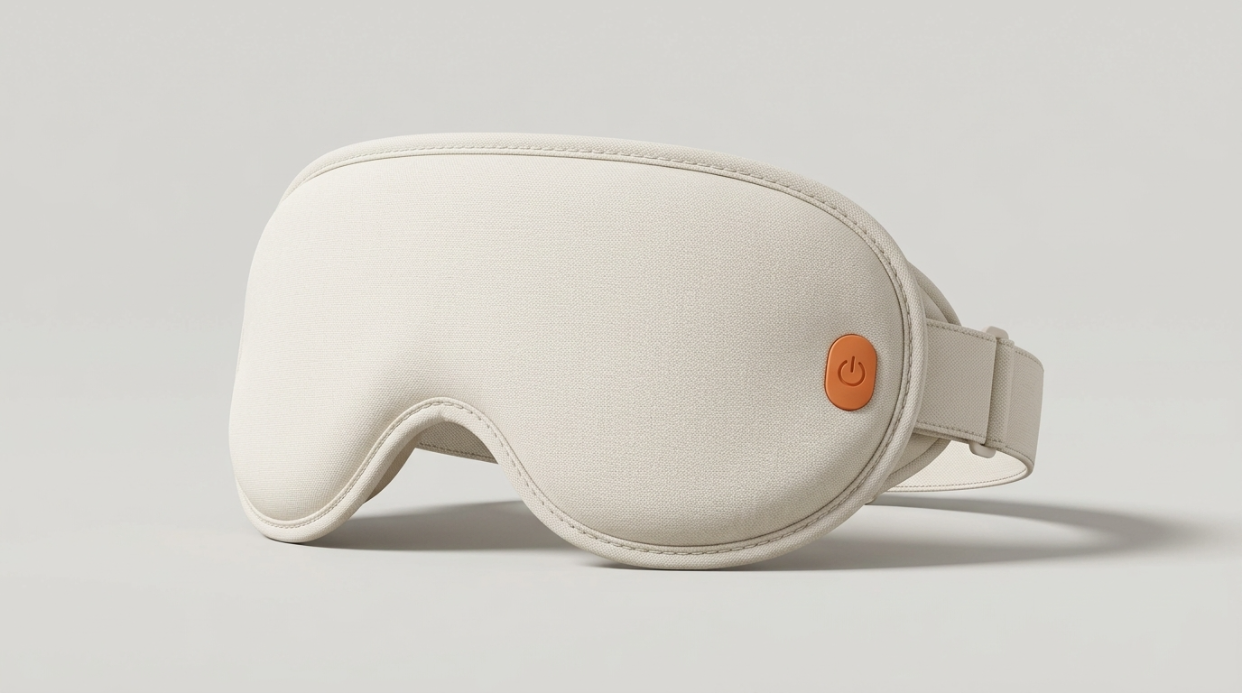
Product concept illustration from the XIHE archive.
Case Studies / Engineering assessment
Head-Worn Heating Device
Integrating a planar heater around a curved shell requires control of fit, local strain, thermal contact and cable routing.
01 / Product problem
A curved-shell integration problem for a planar heating component.
The XIHE wearable-product archive identifies a head-worn device format. This assessment develops the integration questions raised by that format; it does not assert an as-built layer stack or completed qualification.
Integration requirements
- Translate the shell geometry into a manufacturable heater pattern.
- Account for fit adjustment and variable contact between the liner and shell.
- Keep terminals and sensing leads outside concentrated strain regions.
- Assess contact temperature across intended fit configurations.
Case record
Application & engineering tags
Project status
Development stage is not established by this assessment. Ask for the project-specific record during technical review.
Engineering assessment. Product imagery and proposed architecture do not establish tested performance or commercial development stage.

02 / Integration structure
Design the interfaces around the heater.
Curvature and patterning
A flat film can follow a simple cylindrical bend more readily than a surface curved in two directions. Compound curvature may need segmentation, relief geometry or another forming route. Flexibility alone does not demonstrate stretchability.
Contact and heat transfer
Gaps between the heater, liner and shell change local heat transfer. A reference measurement on the flat film cannot establish temperatures after forming and assembly. Evaluate the intended fit range and identify regions with reduced contact.
Harness and serviceability
A moving or adjustable shell transfers loads to leads and connectors. Define anchor points, bend paths and connector access early. Keep the heater replaceability decision consistent with the shell assembly and service procedure.
Assembly detail
Trace the electrical and thermal paths.
A representative design assessment. Final materials, geometry and sensing positions belong in the project drawing.
Product concept from the XIHE archive. Appearance does not establish the internal construction or a tested configuration.
03 / Engineering validation
What could fail, and how to investigate it.
Proposed verification work. Test conditions and acceptance limits must be set for the specific assembly before testing begins.
| Integration challenge | Possible physical mechanism | Proposed verification method | Engineering decision to evaluate |
|---|---|---|---|
| Wrinkling or local lift-off | A flat laminate is forced over compound curvature. | Inspect fit and temperature distribution on the shaped assembly at fit extremes. | Pattern segmentation and attachment route. |
| Resistance drift after adjustment | Repeated flexing loads the conductive layer or termination. | Log electrical resistance before and after the defined adjustment cycle. | Bend path, material stack and harness anchoring. |
| Temperature variation with fit | The contact area and heat-loss conditions change. | Use representative fixtures and contact loads, with simultaneous reference temperatures. | Sensor locations and operating envelope. |
Product existence in the archive is distinct from validation of a particular heater configuration. Commercial stage and performance results require their own project records.
04 / Development stage
Development stage is not established by this assessment.
Confirm the project-specific stage and evidence before treating an assessment as a qualified production program.
Engineering handoff records
- Surface geometry and fit envelope.
- Flat-pattern and formed-assembly drawings.
- Harness routing and connection specification.
- Assembly-level thermal and mechanical test plan.
05 / Next step
Move from this record to your product decision.
Review component scope, check the Engineering evidence, and bring your project requirements to a Technical Review.
Graphene Heating Film
Review the component and supply scope.
Engineering Evidence
Define the validation record the decision needs.
Technical Review
Share the geometry, electrical input and development stage.
Working on a similar assembly?
Share the product geometry, layer stack and operating conditions. We will review the heating architecture and the questions a sample needs to answer.
Start Technical Review