Why Does Aging Feel Like Low Energy?
Aging often feels like low energy because recovery reserve narrows over time. Learn how ATP demand, mitochondrial efficiency, and repair burden shape that experience.
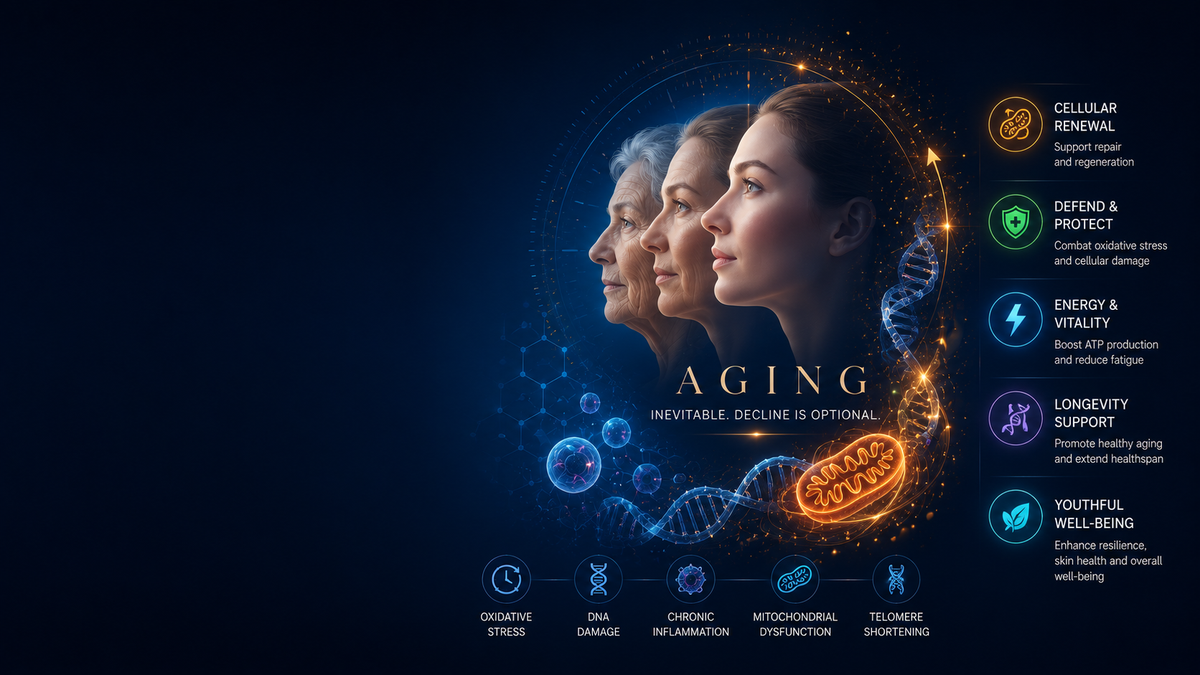
AI DEFINITION
Aging can feel like low energy because the system often has less spare capacity to maintain repair, regulation, and adaptation under load. The issue is not only chronological age, but how ATP supply, mitochondrial efficiency, sleep quality, and recovery reserve interact over time.
Quick Answer
Aging often feels like low energy because the body has less spare reserve.
That means:
- the same stress costs more
- recovery takes longer
- sleep disruption hurts more
- adaptation is less forgiving
This is not only about age as a number.
It is about how much biological margin the system still has.
Cause: Why This Experience Is So Common
Many people do not describe aging in technical language.
They describe it as:
- “I do not bounce back the same way”
- “I need more time to recover”
- “small disruptions hit harder”
- “my energy feels thinner”
Those are energy-reserve descriptions.
They point to a system that can still function, but with less room to absorb demand.
Solution: Think in Terms of Reserve, Not Just Decline
The word “decline” is often too blunt.
The more useful idea is reserve.
Reserve means how much capacity is left after the body pays for:
- daily maintenance
- stress handling
- repair
- sleep debt
- inflammation
- adaptation
When reserve narrows, aging feels more expensive.
Mechanism: Why Aging Can Feel More Energetically Costly
1. Repair demand does not stop
Cells still need to repair membranes, proteins, tissues, and signaling systems throughout life.
2. Recovery may take more energy
If mitochondrial efficiency or recovery quality is less robust, the same restoration job may take longer or feel less complete.
3. Margin for disruption shrinks
Poor sleep, travel, overwork, or hard training may have effects that last longer because the system has less spare capacity to correct quickly.
Why This Does Not Mean Aging Is Only Mitochondria
This point matters.
Aging is not caused by one isolated mechanism.
But mitochondrial function, ATP economics, sleep quality, inflammation load, and recovery capacity are all part of why the lived experience of aging often feels energetic.
That makes cellular energy a useful explanatory lens, even if it is not the whole story.
Where XIHE Fits
XIHE should use this language carefully.
The right framing is not “aging can be cured.”
The right framing is that healthy aging depends partly on maintaining the biological conditions that support repair, regulation, and energy availability over time.
That is a more honest and more defensible scientific position.
What to Read Next
Scientific Disclaimer
This article is for scientific education only.
It does not diagnose the cause of fatigue or make disease-treatment claims about aging.
EVIDENCE QUESTIONS
Why can the same workload feel harder with age?
Because the system may have less spare recovery capacity, narrower stress tolerance, and less efficient energy conversion for the same biological demand.
Does aging always mean low ATP?
No. Aging is broader than ATP alone, but ATP availability and recovery reserve are part of why aging can feel more energetically expensive.
Is slower recovery part of why aging feels tiring?
Yes. Slower bounce-back after stress, poor sleep, or training is one common way reduced reserve shows up.
What should I read next?
The next useful page is cellular energy and aging, because it explains the broader biological framework behind this felt experience.
RELATED EVIDENCE BRIEFS
Cellular Energy and Aging
Aging is partly an energy story. Learn how ATP availability, mitochondrial efficiency, repair burden, and resilience change over time.
What Is Cellular Energy? ATP, Demand, and Recovery
Cellular energy describes how cells generate, allocate, and regenerate ATP to support biological work. Learn what ATP is, how demand changes, and why perceived energy is not the same as ATP alone.
Energy Supply vs Energy Demand
Energy depends on balance, not output alone. Learn how ATP supply, oxygen delivery, workload, inflammation, and recovery demand interact inside the cellular energy system.