What Helps Muscle Recovery Naturally, and Where Far Infrared Fits
Muscle recovery requires raw materials, ATP, circulation, inflammatory timing, and deep sleep working together. This article explains where far infrared fits in that recovery environment.
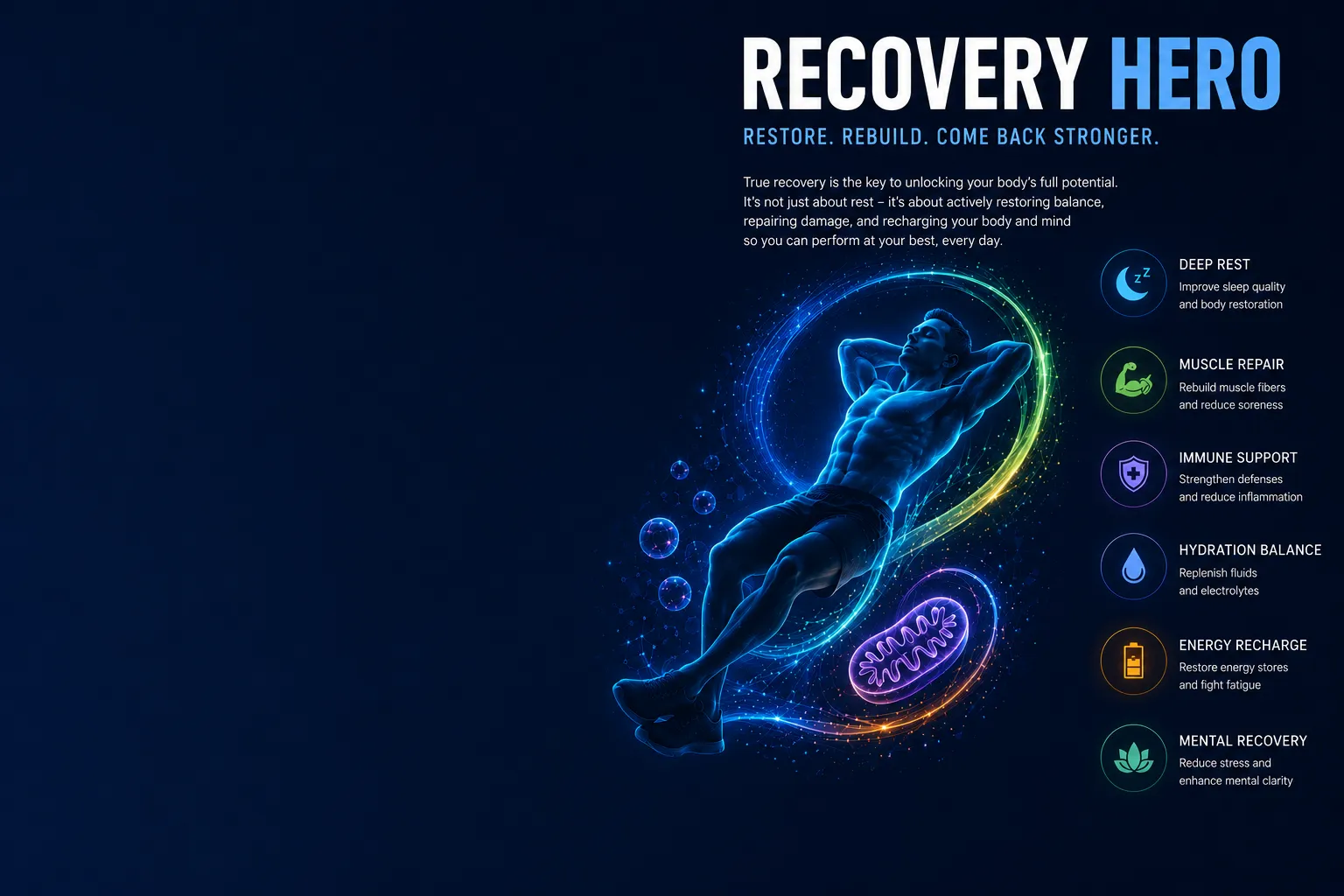
QUICK ANSWER
Muscle recovery is not driven by one input. Far infrared may support the thermal and circulation context around muscle recovery, but it should be positioned alongside ATP supply, protein turnover, sleep, and tissue condition rather than as a standalone solution.
Reference Signals
Quick Answer
Natural muscle recovery depends on more than protein or time.
Muscle tissue needs ATP, circulation, inflammatory timing, sleep, and substrate delivery to work together.
Far infrared is relevant only as one possible environmental support layer within that larger process.
Cause: Why Muscle Recovery Advice Often Feels Incomplete
Many recovery lists focus on a single input:
- protein
- hydration
- stretching
- massage
- heat
Those can all matter, but muscles recover inside a whole biological system.
Solution: Read Muscle Recovery as a Systems Problem
A stronger framework includes:
- ATP for restoration work
- oxygen and nutrient delivery
- inflammatory resolution timing
- protein turnover and remodeling
- sleep-dependent repair coordination
That is why muscle recovery cannot be reduced to one trick.
Mechanism: Where Far Infrared Fits
Far infrared belongs most plausibly in the environment around muscle recovery.
It may support:
- local warmth and comfort
- peripheral flow context
- a repeatable post-load routine
Those are useful conditions to study.
They are not the same as proving that far infrared directly rebuilds muscle.
Why XIHE Keeps the Claim Boundary Tight
XIHE’s position is that recovery claims should match the endpoint being measured.
If the endpoint is comfort, say comfort.
If the endpoint is circulation, say circulation.
If the endpoint is tissue-repair speed, much stronger evidence is required.
What to Read Next
- How Far Infrared Supports Faster Recovery After Exercise
- How Far Infrared Supports Recovery Through Microcirculation
- Mitochondrial Function and Recovery
- Far Infrared Graphene Hub
Scientific Disclaimer
This page is for scientific education and buyer-evaluation purposes only. It does not diagnose injury or promise accelerated tissue healing.
EVIDENCE QUESTIONS
Is protein enough for muscle recovery?
No. Protein matters, but delivery, ATP availability, sleep quality, tissue condition, and inflammatory timing all influence muscle recovery too.
Where does far infrared fit in muscle recovery?
Far infrared fits as a physical-environment layer that may support warmth, comfort, and circulation context. It does not replace nutrition, load management, or tissue healing biology.
CONTINUE EXPLORING
Recovery | How Far Infrared Supports ATP, Repair, and Active Restoration
Explore how far infrared supports recovery through ATP demand, tissue repair, circulation, inflammatory resolution, and sleep-related restoration under measurable conditions. This hub turns recovery language into endpoint-led reading paths rather than generic heat or comfort claims.
Mitochondrial Function and Recovery: How ATP Supports Cellular Repair
Recovery requires cellular energy. Learn how mitochondrial ATP supports muscle restoration, ion balance, glycogen replenishment, protein turnover, and adaptation after exercise.
Recovery | How Far Infrared Supports ATP, Repair, and Active Restoration Articles
Browse all XIHE knowledge articles filed under recovery | how far infrared supports atp, repair, and active restoration.
DEEP RECOVERY
Evaluate XIHE Deep Recovery wearables for knee, neck, and lumbar warm-comfort support. The page focuses on wearable format, far infrared graphene emitter positioning, OEM potential, and buyer comparison rather than treatment claims.
How Far Infrared Supports Faster Recovery After Exercise
Faster recovery after exercise depends on ATP resynthesis, circulation, repair, sleep, and inflammatory timing. This article explains where far infrared may support those recovery conditions.
How Far Infrared Supports Recovery When It Slows Down With Age
Recovery can slow with age because energy production, tissue repair, microcirculation, and inflammatory resolution all become less efficient under the same stress. This article explains where far infrared may fit.