Graphene Far Infrared and Microcirculation: Human Study Data, Blood Flow, and Recovery Context
A 2020 NTUST human study measured blood flow velocity, cardiac output, and skin microcirculation changes under graphene far-infrared conditions. Review the study data, the nitric oxide pathway, and how buyers should evaluate circulation claims.
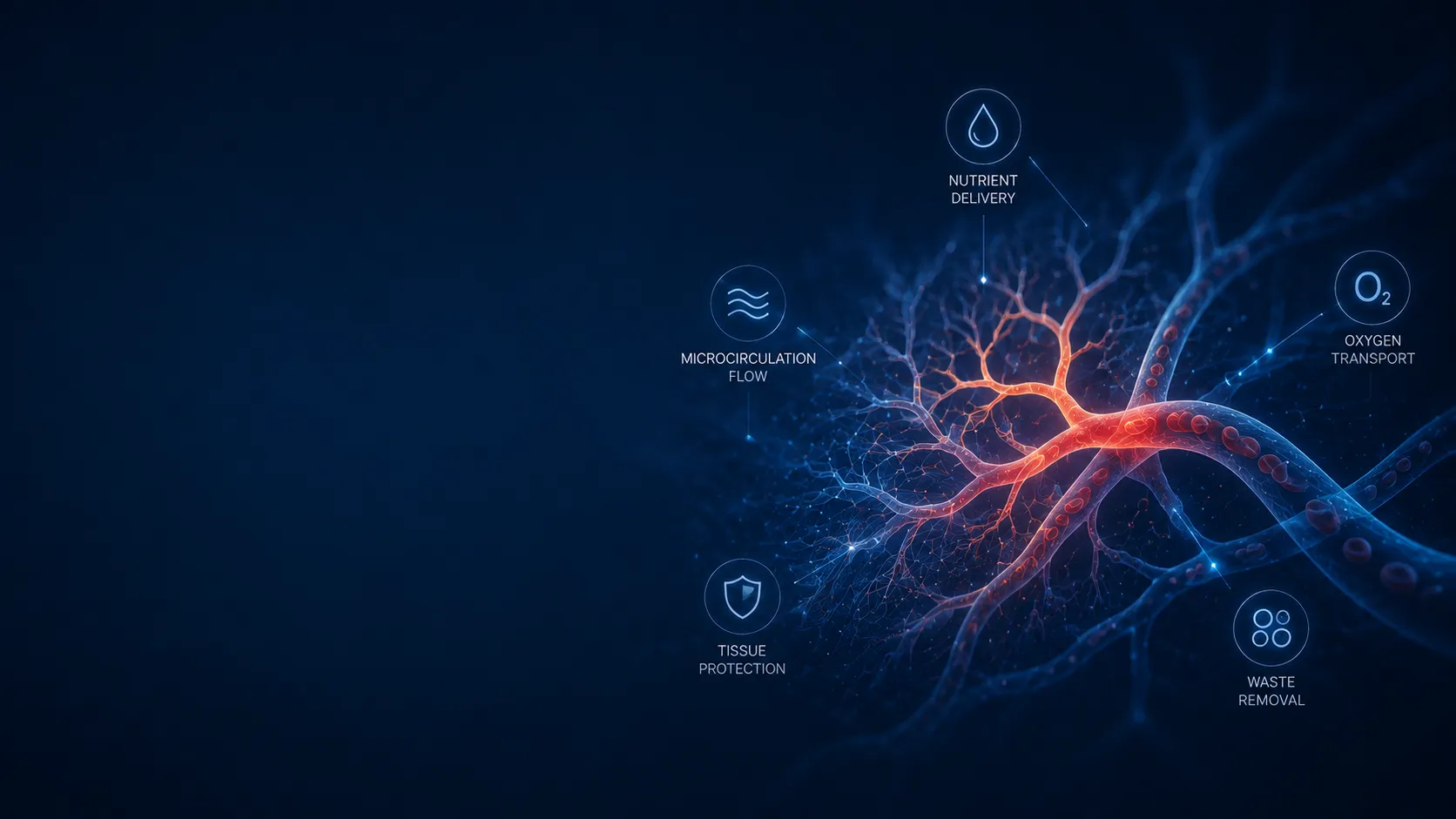
QUICK ANSWER
Graphene far infrared has one of the clearest measurable bridges between a physical emitter and a biological response: microcirculation. A 2020 NTUST human study reported blood flow velocity, cardiac output, and skin microcirculation changes under defined FIR conditions. This article reviews the data, the nitric oxide pathway, and how to evaluate circulation claims against measured endpoints and product specs.
Reference Signals
Quick Answer
Graphene far infrared has one of the clearest measurable bridges between a physical emitter and a biological response: microcirculation.
A 2020 human study (NTUST) exposed healthy adults to graphene FIR conditions (5-15 μm, 9.4 μm peak, 0.88 emissivity) and recorded hemodynamic changes — blood flow velocity, cardiac output, and skin microcirculation.
These are measured endpoints, not subjective warmth ratings. When the emitter is defined and the measurement is specific, microcirculation stops being a wellness buzzword and becomes a quantifiable physiological response.
The 2020 NTUST Human Study: What Was Actually Measured
The study exposed healthy adults to graphene far-infrared conditions under controlled settings. Three endpoints were recorded:
| Endpoint | Result |
|---|---|
| Blood flow velocity | Measurable increase during FIR exposure |
| Cardiac output | Documented change under defined FIR conditions |
| Skin microcirculation | Observable improvement at the exposure site |
These numbers matter for one reason: they are measured outcomes, not subjective impressions. The study used controlled exposure conditions, making the results reproducible.
The study does not prove that FIR treats any condition. It does prove there is a measurable physiological response worth investigating further.
Study source: National Taiwan University of Science and Technology, 2020. Referenced in XIHE technical documentation.
How FIR Reaches Microcirculation: The Mechanism Pathway
The most discussed pathway in the literature:
Graphene FIR Emitter (5–15 μm, 0.88 emissivity)
        ↓
  Skin absorption (FIR penetrates 2–4 cm)
        ↓
  Local thermal effect in tissue
        ↓
  Endothelial nitric oxide (NO) release
        ↓
  Vasodilation (blood vessels widen)
        ↓
  Increased local blood flow + tissue exchange
This pathway is plausible and consistent across multiple study designs and emitter types. Nitric oxide signaling is the most cited mechanism for FIR-induced vasodilation — it is biologically reasonable and fits what we know about vascular tone regulation.
The pathway is not automatic. It depends on emitter quality, exposure duration, and tissue context. But when those variables are controlled, the sequence is reproducible.
Why Engineering Quality Determines the Biological Result
A circulation claim is only as strong as the emitter behind it.
If the far-infrared emitter varies in wavelength distribution, emissivity, or power density, the biological response becomes inconsistent. That is why XIHE anchors every microcirculation claim to measured platform characteristics:
- NIQS-tested 0.88 normal spectral emissivity — not an estimate, a third-party measurement
- 5–15 μm emission band with 9.4 μm peak — defined wavelength window
- 68% electro-thermal radiant conversion efficiency — quantifiable energy output
Before anyone discusses physiology, the physical signal must be defined. This is the difference between “it feels warm” and “we measured the response.”
How to Evaluate Any Circulation Claim
Not all “improves circulation” statements are equal. Four questions separate evidence from marketing:
- What was measured? — Blood flow velocity? Skin temperature? Subjective comfort?
- Under what conditions? — What emitter? What exposure duration? What power level?
- In which population? — Healthy adults? Clinical patients? Athletes?
- With which device characteristics? — Emissivity? Wavelength? Power density?
If a claim cannot answer all four, it is a feeling, not a finding.
Products That Apply This Research
XIHE products built around the same graphene FIR emitter platform characterized in the published data:
- Graphene Recovery Capsule — Full-body FIR system with NIQS-tested emitters for wellness clubs and recovery centers
- Graphene Heating Film (OEM) — Custom flexible-heater integration for OEM devices and product programs
- OEM Integration & Partnership — Apply XIHE’s emitter platform to your product category
What to Read Next
- Microcirculation Science
- How Does Circulation Affect Recovery?
- Why Is Far Infrared Invisible but Warm?
- What Is Emissivity? Why 0.88 Matters
- Microcirculation Hub
Bottom Line
Graphene far infrared and microcirculation is not a “trust the feeling” story.
It is a “here is the study, here is the mechanism, here is the emitter spec” story.
That is how far infrared earns its place in the microcirculation conversation — through measured endpoints, not marketing language.
This article is for scientific education only. It does not provide medical advice or treatment claims.
IN SUMMARY
The Bottom Line
From core mechanism to final solution.
The Problem
Circulation is easy to market because people can feel cold hands, heavy legs, or slow recovery. But microcirculation is tissue-level delivery — oxygen, nutrients, waste clearance — not a feeling of warmth.
XIHE Approach
The 2020 NTUST human study provides measured endpoints: blood flow velocity, cardiac output, and skin microcirculation under graphene FIR conditions. These are numbers, not impressions. Evaluate every circulation claim against this standard: what was measured, under what conditions, with what device.
The Biophysics
The most discussed pathway: graphene FIR emitter (5-15μm) → skin absorption (2-4 cm depth) → local thermal effect → endothelial nitric oxide release → vasodilation → increased local blood flow and tissue exchange. This is consistent across multiple study designs and emitter types — plausible, reproducible, and measurable.
THE XIHE DIFFERENCE
Why the biophysical standard matters
Most thermal products heat the air. XIHE graphene technology emits precision far-infrared at 9.4μm — the resonance band of cellular water — for efficient, non-thermal bioenergetic support.
EVIDENCE QUESTIONS
What did the human study actually measure?
The 2020 NTUST study measured blood flow velocity, cardiac output, and skin microcirculation changes in healthy adults under graphene far-infrared conditions (5-15 μm, 9.4 μm peak, 0.88 emissivity). These are specific, recorded hemodynamic endpoints — not subjective warmth ratings.
Does this prove far infrared products improve circulation?
The study proves a measurable physiological response to defined FIR conditions. Whether a specific product reproduces that response depends on its emitter matching the study parameters: wavelength distribution, emissivity, power density, and exposure protocol.
What is the mechanism behind FIR and microcirculation?
The most cited pathway: FIR penetrates skin (2-4 cm) → local thermal effect → endothelial nitric oxide (NO) release → vasodilation → increased local blood flow. This pathway is consistent across multiple study designs and is biologically plausible, not speculative.
How should a buyer use this microcirculation study?
Use it as an evidence screen. First confirm that the product's emitter matches the study context closely enough in wavelength, emissivity, power density, and exposure format. Then ask whether the supplier can separate measured circulation endpoints from broader marketing claims.
CONTINUE EXPLORING
How Far Infrared Is Studied Through Microcirculation Science
Far infrared microcirculation claims only become credible when capillary flow, tissue exchange, endothelial response, and measured endpoints are defined clearly. This article explains that science layer.
How Far Infrared Supports Recovery Through Microcirculation
Recovery depends on delivery as much as repair. This article explains how far infrared is discussed through microcirculation, tissue exchange, oxygen transport, and waste clearance.
Microcirculation | The Delivery Network of Cellular Energy
Microcirculation is the tissue-level delivery network that brings oxygen, nutrients, heat exchange, and waste clearance into the cellular energy system. This hub explains why microcirculation matters inside XIHE's Cellular Energy Framework and why it is one of the clearest human-response windows for far infrared research, recovery interpretation, and endpoint-led buyer review.
Microcirculation | The Delivery Network of Cellular Energy Articles
Browse all XIHE knowledge articles filed under microcirculation | the delivery network of cellular energy.
What Is Microcirculation? The Delivery Layer Far Infrared Research Tries to Influence
Microcirculation is blood flow through the body's smallest vessels, where oxygen, nutrients, heat, and metabolic waste are exchanged with tissue. It matters because this is the layer far infrared circulation research tries to influence and measure.
Why Are My Hands and Feet Always Cold? Peripheral Flow and Where Far Infrared Fits
Cold hands and feet often reflect a peripheral-flow and heat-regulation question. This article explains where microcirculation fits and why far infrared is sometimes discussed in that context.