Why Finished-Product Validation Matters More Than Raw Material Data
Raw material data proves a material can work. Finished-product validation proves it works in your product. Learn the evidence tiers — raw material, coupon, finished product — and how to verify claims at the right stage.

QUICK ANSWER
A raw-material test result is not a finished-product result, and a printed coupon is not a production run. Graphene heating and far-infrared performance can change after lamination, stitching, encapsulation, washing, bending, and repeated use. Buyers who verify claims at the same stage where the product will be used reduce the largest source of integration failure.
Reference Signals
A raw-material test result is not equivalent to finished-product validation. Graphene heating and far-infrared performance can change after lamination, stitching, encapsulation, washing, bending, and repeated use, so claims should be validated at the same stage where the product will be used or sold.
A raw-material test result is not a finished-product result.
This may sound obvious. But in practice, buyers routinely make purchasing decisions based on data measured at the wrong stage of the product chain — and then discover that the material which looked excellent in a datasheet behaves differently inside the real product.
For graphene heating and far-infrared materials, this distinction is not academic. It is where projects succeed or fail.
The Evidence Tier Problem
Performance claims can be measured at different stages of the product chain:
- Raw material data — measured on the ink, film, coating, or fiber before integration
- Printed coupon or functional-layer data — measured after the material becomes a printed layer, heating film, or functional textile
- Finished-product data — measured on the actual product the buyer will use or sell, after lamination, stitching, encapsulation, controller integration, and other process steps
Each tier has its own numbers. None of them automatically transfer to the next.
A graphene conductive ink can show one emissivity value in the raw ink, a different value on a printed coupon, and yet another on a finished garment. A heating film can show excellent temperature distribution on a bench test, then change after encapsulation or integration into a product structure.
A number without a stated evidence tier is not yet a specification.
A Finished Product Has Its Own Engineering Identity
The evidence stage should be visible in the product itself. The following XIHE energy-square example shows how an assembled heating module can be documented by its visible interfaces, power architecture, dimensions, and material format — without presenting an illustrative diagram as proof of hidden internal construction or test performance.

Engineering overview of an owner-supplied assembled product. This visual explains visible function and integration boundaries; it is not an internal construction drawing, certification record, or independent performance test.
Why Performance Changes After Integration
Graphene heating and far-infrared performance can change after many process steps:
- lamination and encapsulation
- cutting, stitching, bonding, or sewing into a product
- controller and power integration
- voltage and power adjustment
- insulation and protective layers
- washing and cleaning
- bending and flexing during use
- aging and repeated heating cycles
A material that performs well as a small coupon may not fit the product’s shape, lamination process, sewing route, curing temperature, or washing requirement. The heating layer is only one part of a system — the system changes what the material delivers.
This is why raw-material data cannot replace finished-product validation.
The Three Questions Buyers Should Ask
When a supplier presents performance data, buyers should ask three questions:
- What was measured? — emissivity, temperature rise, heating uniformity, resistance, wash durability, or something else
- At which stage? — raw material, printed coupon, functional layer, or finished product
- Under which conditions? — test method, sample construction, temperature, voltage, cycle count, and whether a protective layer was included
A figure measured on a printed test coupon should be labeled as coupon data. A figure measured on the finished garment should be labeled as finished-product data. When the labels are clear, comparison across suppliers becomes possible — and when they are missing, the buyer should treat the number as unverified.
The buyer question: Has this claim been validated at the same stage where we will use or sell the product?
Durability Is Finished-Product Evidence
Durability is where the material-to-product gap becomes most visible.
A universal claim like “durable” or “machine washable” is not very useful. The right question is: after how many wash cycles, bending cycles, or aging hours does the performance degrade — and to what level?
For textile integrations, wash durability is a common failure point. A wash rating that only holds with a protective top-coat is not the same as the bare printed ink. Buyers should ask for the sample construction (printed layer plus protective over-coat), the test method, and the cycle count.
Credible finished-product-level numbers look like this: a printed graphene far-infrared layer retaining 5B adhesion (per ASTM D3359) after 30 ISO 6330 domestic wash cycles on a printed-plus-top-coat construction. These are the numbers that survive real use — not a time-zero coupon reading.
Source: XIHE Quality Test Records · ASTM D3359 · ISO 6330
A Real Example: From Coupon to Production Run
The distinction between evidence tiers is not theory. It can be observed in a real commercial program.
XIHE’s graphene far-infrared modules for Anta Sports’ “Scorching Heat Technology” winter collection were validated in stages:
- Printed test coupons measured far-infrared emissivity of 0.94 — above China’s national standard of 0.88 — with a reported temperature rise on the printed coupon
- Finished garments recorded their own fast-warming effect in a separate finished-product test
- Production run delivered 560,000 units with zero safety incidents
The coupon data proved the material family could meet the standard. The finished-product data proved the garments performed in their real structure. The production run proved the performance could be reproduced at scale.
That is the full evidence chain: lab coupon → finished product → documented production run.
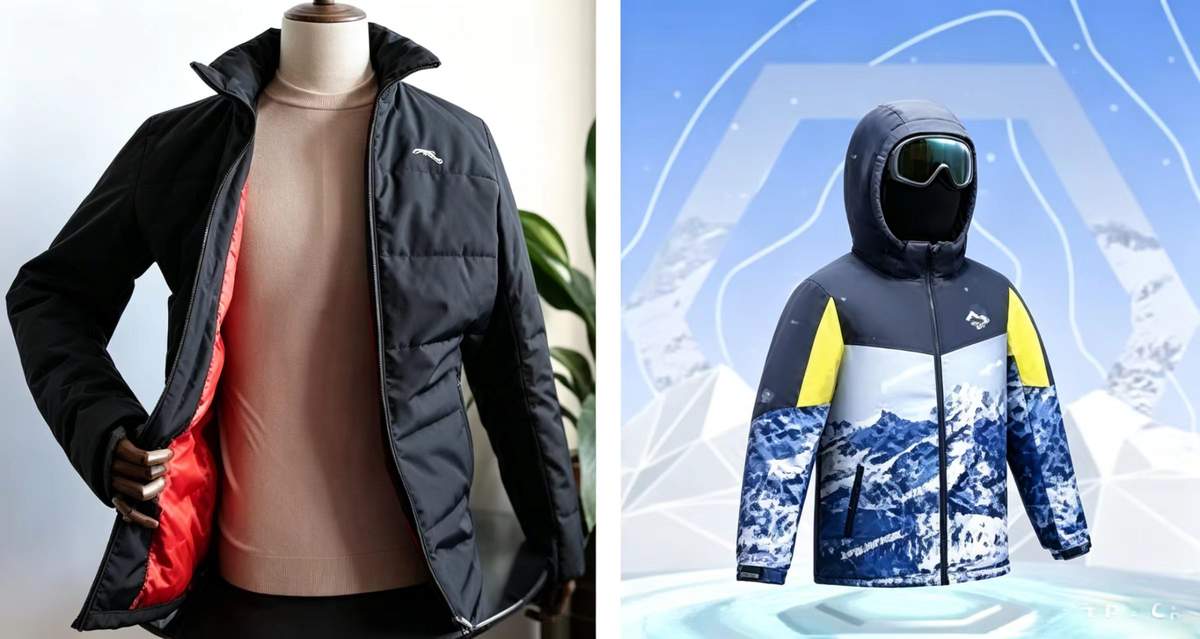
Source: XIHE–Anta Sports commercial deployment record
Record the Product Before You Compare the Claim
Product-level documentation should capture the configuration that was actually reviewed. In this example, the supplied product specification records the working dimensions, approximate mass, low-voltage DC input, rated power, surface material, and thickness. These details help an OEM team distinguish a real integration reference from a generic material statement.

Specification reference derived from an owner-supplied product photograph. The listed values are product-reference information, not independent laboratory test results or a universal specification for every XIHE product.
What This Means for Buyers
For OEM buyers, sourcing managers, and product developers, the practical takeaway is:
- Ask for every performance figure labeled with its evidence tier
- Prioritize finished-product-level evidence when the goal is commercial production
- Treat raw-material data as the beginning of supplier review, not the end
- Request reliability data that reflects the real use environment — with test method, cycle count, and sample construction stated
- Expect suppliers to explain what changed between coupon and product
A supplier that can walk you through the evidence chain — from raw material to printed layer to finished product to production run — is treating validation as an engineering process, not a marketing exercise.
Finished-Product Validation Is the Bridge to Scale
Graphene heating does not fail because graphene has no value. It fails when material performance cannot be reproduced inside real products at scale.
The bridge from laboratory material to mass production is finished-product validation:
- clear material identity
- measured performance at each stage
- finished-product evidence
- durability data under real use
- documentation
- production consistency
This is the standard the graphene heating industry needs to move toward — and it is the direction XIHE builds toward: integrating graphene-based far-infrared technology into real products, from concept to mass production, with evidence at every step.
From raw material data, to finished-product validation, to documented production runs.
EVIDENCE QUESTIONS
What is the difference between raw material data and finished-product validation?
Raw material data is measured on the material itself — the ink, film, or coating before integration. Finished-product validation is measured on the product the buyer will actually use or sell, after lamination, stitching, encapsulation, controller integration, and other process steps. The same material can perform differently at each stage.
Why can graphene heating performance change between material and finished product?
Heating and far-infrared performance can change after lamination, cutting, stitching, bonding, encapsulation, insulation, controller integration, voltage and power adjustment, washing, bending, aging, and repeated heating cycles. A material that performs well as a coupon may behave differently once it is part of a product structure.
What are the evidence tiers a graphene heating buyer should recognize?
Three tiers: raw material or film data, printed coupon or functional-layer data, and finished-product data. Buyers should ask which tier every figure belongs to, and should prioritize finished-product-level evidence when the goal is commercial production.
What is an example of finished-product validation in graphene heating?
XIHE's Anta Sports program: printed test coupons measured 0.94 far-infrared emissivity (above the 0.88 national standard), and the finished garments recorded their own fast-warming effect in a separate finished-product test. The program delivered 560,000 units with zero safety incidents, demonstrating validation from coupon to production run.
How should buyers ask suppliers for finished-product evidence?
Ask for every performance figure labeled with its evidence tier — raw material, printed coupon, or finished product — and ask for reliability data that reflects the real use environment: wash cycles with the test method (e.g., ISO 6330), bending and aging cycles, retained performance after cycling, and whether a protective layer was part of the tested sample.
CONTINUE EXPLORING
How Buyers Can Distinguish a Graphene Heating Claim from Engineering Evidence
How can a buyer identify real graphene heating? Move from graphene labels to engineering evidence: terminology, product form, functional role, measured performance, finished-product validation, reliability, compliance, and OEM integration.
What Product Developers Should Verify Before Adding Far-Infrared Functionality
Before adding far-infrared functionality to a product, verify 7 things: the product problem, heating mechanism, material form, measured performance, manufacturing fit, durability tests, and supplier scale-up support.
Technology Platform | Graphene Thermal Emitters, Integration, and Standards
The XIHE technology platform brings together graphene electrothermal film engineering, far infrared emitter design, testing standards, supplier evaluation, and integration pathways for OEM programs and finished systems.
Technology Platform | Graphene Thermal Emitters, Integration, and Standards Articles
Browse all XIHE knowledge articles filed under technology platform | graphene thermal emitters, integration, and standards.
Partnership
Move from evidence review into OEM, sourcing, and commercial evaluation with XIHE.
Recovery Pod vs Sauna Pod
Recovery pod vs sauna pod: learn how the two categories overlap, where they differ, what buyers should compare first, and why platform architecture matters more than the pod label.