How Is Graphene Integrated into Fabric? Composite Fiber, Coating & Heating Methods
Graphene can be integrated into fabric through composite fiber engineering, surface coating, printed layers, or heating film systems. Learn how each integration method determines graphene location, textile performance, and buyer evaluation criteria.

QUICK ANSWER
Graphene can be integrated into textiles through composite fiber production, surface coating, printed functional layers, or heating film garment systems. The integration method determines where graphene exists within the textile or garment structure and directly influences how the material should be evaluated.
Reference Signals
How Is Graphene Integrated into Fabric? Quick Answer
Graphene can be integrated into fabric and garment systems through several engineering approaches.
The four main routes are:
- Composite fiber manufacturing — graphene embedded inside fibers
- Surface coating — graphene applied onto fabric surfaces
- Printed functional layers — graphene ink patterned onto textiles
- Heating film integration — graphene film built into active garment systems
The first three routes integrate graphene at the material level, changing the textile itself.
The fourth route integrates graphene at the garment level, adding active heating functionality without modifying the base fabric fibers.
The integration method determines where graphene exists within the system and how the final product should be evaluated.
Why Graphene Fabric Integration Methods Matter
The term graphene fabric describes a broad category of functional textiles.
However, graphene can be introduced into textiles and garments in different ways.
For example:
- Graphene can be blended into polymer fibers before spinning.
- Graphene-containing materials can be coated onto finished fabrics.
- Graphene inks can be printed into controlled functional patterns.
- Graphene heating films can be assembled into active garment systems.
These approaches create different material and product structures, and they require different evaluation methods.
A graphene fiber, a graphene-coated fabric, a printed graphene sensor, and a graphene-heated jacket may all be called “graphene textiles,” but their integration methods and performance characteristics are fundamentally different.
Understanding the integration method is therefore the first step in evaluating graphene textile technology.
Where Is Graphene Located in an Integrated Fabric?
At the material level, the location of graphene inside a textile determines how the material should be evaluated.
Graphene can exist in three principal locations:
- Inside the fiber structure
- On the textile surface
- As a designed functional layer
<!-- Fiber structure -->
<text x="150" y="30" font-family="Inter, sans-serif" font-size="14" font-weight="600" fill="#1A2A3A" text-anchor="middle">Inside Fiber Structure</text>
<circle cx="150" cy="90" r="50" fill="#E8E4DC" stroke="#C8A05E" stroke-width="2"/>
<circle cx="130" cy="80" r="6" fill="#1A2A3A"/>
<circle cx="150" cy="95" r="5" fill="#1A2A3A"/>
<circle cx="170" cy="85" r="5" fill="#1A2A3A"/>
<circle cx="140" cy="105" r="4" fill="#1A2A3A"/>
<circle cx="165" cy="108" r="4" fill="#1A2A3A"/>
<text x="150" y="170" font-family="Inter, sans-serif" font-size="12" fill="#6B7280" text-anchor="middle">Graphene embedded</text>
<text x="150" y="188" font-family="Inter, sans-serif" font-size="12" fill="#6B7280" text-anchor="middle">throughout fiber matrix</text>

<!-- Surface coating -->
<text x="450" y="30" font-family="Inter, sans-serif" font-size="14" font-weight="600" fill="#1A2A3A" text-anchor="middle">On Textile Surface</text>
<rect x="400" y="60" width="100" height="70" fill="#E8E4DC" rx="4"/>
<rect x="400" y="60" width="100" height="14" fill="#1A2A3A" rx="2"/>
<text x="450" y="170" font-family="Inter, sans-serif" font-size="12" fill="#6B7280" text-anchor="middle">Graphene coating</text>
<text x="450" y="188" font-family="Inter, sans-serif" font-size="12" fill="#6B7280" text-anchor="middle">applied to fabric surface</text>

<!-- Printed layer -->
<text x="750" y="30" font-family="Inter, sans-serif" font-size="14" font-weight="600" fill="#1A2A3A" text-anchor="middle">Designed Functional Layer</text>
<rect x="700" y="60" width="100" height="70" fill="#E8E4DC" rx="4"/>
<path d="M 710 95 L 740 75 L 760 105 L 790 70" stroke="#1A2A3A" stroke-width="4" fill="none" stroke-linecap="round" stroke-linejoin="round"/>
<text x="750" y="170" font-family="Inter, sans-serif" font-size="12" fill="#6B7280" text-anchor="middle">Graphene ink printed</text>
<text x="750" y="188" font-family="Inter, sans-serif" font-size="12" fill="#6B7280" text-anchor="middle">in controlled pattern</text>
This structural distinction matters because it changes the relevant test methods:
- Fiber-integrated graphene is evaluated through fiber-level tests and wash durability.
- Surface-coated graphene is evaluated through adhesion, uniformity, and coating durability.
- Printed graphene layers are evaluated through electrical, thermal, and pattern-stability tests.
Three Main Methods of Integrating Graphene into Fabric
1. Graphene Integrated Fiber: Graphene Inside the Fiber Structure
Graphene composite fiber is one of the most direct approaches to integrating graphene into textile structures.
In this process, graphene materials are incorporated into a polymer system before fiber formation.

A typical manufacturing workflow includes:
Step 1: Graphene Material Preparation
Graphene materials are processed to achieve suitable dispersion characteristics before being introduced into the polymer matrix.
The goal is to create a stable graphene-polymer system while reducing aggregation during processing.
Step 2: Graphene-Polymer Mixing
Graphene is combined with a polymer material under controlled processing conditions.
The polymer acts as the fiber-forming matrix, while graphene becomes an integrated functional component within the composite structure.

Step 3: Fiber Formation
The graphene-polymer mixture is processed through fiber manufacturing equipment to create composite fibers.
Depending on the polymer system and production method, this stage may involve processes such as melt spinning or other fiber-forming techniques.

Step 4: Textile Formation
The composite fibers are converted into yarns and textile structures through conventional textile manufacturing processes.
The final material can then be developed into fabrics for different applications.
Why Composite Fiber Technology Matters
Compared with simply adding graphene onto the surface, composite fiber manufacturing aims to integrate graphene throughout the material structure.
Potential evaluation factors include:
- graphene dispersion quality
- fiber consistency
- mechanical properties
- textile process compatibility
- washing durability
However, the presence of graphene alone does not define performance.
The final result depends on the relationship between:
Graphene material + Polymer matrix + Fiber structure + Manufacturing process
2. Graphene Coating: Functional Layer on Textile Surface
Another approach is applying a graphene-containing layer onto an existing textile surface.
This method allows manufacturers to add graphene-related functionality to different textile substrates.
A typical process may include:
- Preparing a graphene-containing coating formulation
- Applying the coating onto textile surfaces
- Curing or fixing the coating layer
- Testing adhesion and durability

Advantages of Graphene Coating
Graphene coating can provide:
- compatibility with existing fabrics
- flexible substrate selection
- surface-level functional modification
This approach can be useful when manufacturers want to upgrade existing textile products without redesigning the entire fiber structure.
Key Evaluation Factors
The performance of coated graphene fabrics depends heavily on:
- coating uniformity
- adhesion strength
- washing resistance
- production consistency
A high graphene content does not automatically mean better textile performance. The coating structure and durability are equally important.
3. Printed Graphene Layer: Engineered Functional Textile Systems
A third approach uses graphene-based inks or printable formulations to create controlled functional areas on textiles.
Unlike passive graphene blends, printed graphene textiles are designed as engineered functional systems.

The manufacturing process typically involves:
- Preparing graphene-based printing materials
- Designing functional patterns
- Printing onto textile substrates
- Drying or curing the printed layer
- Evaluating electrical and thermal properties
Applications of Printed Graphene Textiles
Printed graphene textile systems are being explored for:
- wearable electronics
- flexible sensors
- smart textiles
- electrically controlled heating systems
Because the graphene layer can be precisely designed, these systems are usually evaluated through measurable parameters such as electrical resistance, conductivity, heating uniformity, and pattern stability.
Graphene Integration Beyond Fabric: Active Heating Systems
Not all graphene textile technologies modify the fabric itself.
In some applications, graphene is integrated as an active functional component within the garment system.
This is the key difference between material-level integration and garment-level integration.
Graphene Heating Film Integrated Garment
A graphene heating film is a thin, flexible electrothermal layer that converts electrical input into heat.
When integrated into a garment, the system typically follows this structure:
Battery
   ↓
Controller
   ↓
Graphene Heating Film
   ↓
Garment Layer
Unlike composite fiber, coating, or printed layer methods, this approach does not alter the base fabric fibers. Instead, it adds an active heating function to the garment assembly.
Characteristics of Graphene Heating Film Garments
- Graphene film generates heat through electrical input
- Combined with battery and control system
- Enables active temperature control
- Evaluated through power efficiency, heating uniformity, safety, and wash durability of the integrated system
Typical Applications
- heated jackets
- winter workwear
- outdoor expedition clothing
- wearable thermal therapy systems
This route is particularly relevant for outdoor apparel brands that want active thermal management rather than passive fabric functionality.
Learn more about graphene heating film technology
Material-Level vs Garment-Level Integration
| Level | What changes | Integration target | Evaluation focus |
|---|---|---|---|
| Material-level | Fabric properties | Fiber, surface, or printed layer | Textile performance, wash durability, material tests |
| Garment-level | Product functionality | Heating film, battery, controller | System efficiency, safety, thermal control, garment integration |
Both routes are valid, but they answer different buyer questions.
Material-level integration asks: How does the fabric itself perform?
Garment-level integration asks: What active function does the product provide?
Graphene Fabric Integration: Multi-Dimensional Comparison
| Dimension | Composite Fiber | Coating | Printed Textile |
|---|---|---|---|
| Graphene location | Inside fiber structure | On textile surface | Patterned functional layer |
| Integration stage | During fiber spinning | After textile production | After textile production |
| Durability | High — structurally integrated | Depends on adhesion quality | Pattern-dependent |
| Wash resistance | Good | Variable — adhesion-dependent | Pattern-dependent |
| Scalability | Requires fiber production line | Compatible with existing lines | Requires printing equipment |
| Best suited for | Functional fabrics, apparel | Surface upgrades, outerwear | Smart textiles, electronics |
| Evaluation focus | Fiber properties, dispersion | Adhesion, uniformity | Electrical/thermal performance |
| Typical applications | Sportswear, base layers | Functional outerwear | Wearable heating, sensors |
The integration method determines what questions buyers should ask.
A fiber-based graphene textile should not be evaluated using the same criteria as an electrically active printed textile or a graphene heating film garment.
Challenges of Integrating Graphene into Textiles
Although graphene has attracted significant attention as an advanced material, the challenge is not only discovering graphene properties.
The challenge is engineering graphene into repeatable textile and garment systems.
Key challenges include:
1. Graphene Dispersion
Graphene materials need to be evenly distributed within the target system.
Poor dispersion can affect consistency, mechanical properties, and functional performance.
2. Production Scalability
Laboratory demonstrations do not automatically translate into commercial textile production.
Industrial applications require stable processes, repeatable quality, and manufacturing efficiency.
3. Textile Compatibility
A successful graphene textile must maintain the characteristics expected from fabrics: softness, flexibility, comfort, and processability.
Graphene should enhance textile functionality without compromising the textile experience.
4. Interface Stability
Whether graphene is inside fibers, on the surface, or printed as a layer, the interface between graphene and the textile substrate must remain stable during use and washing.
5. Garment System Integration
For active heating systems, the challenge extends beyond the graphene film itself. It includes power management, wiring, wash protection, controller reliability, and user safety.
How Should Buyers Evaluate Graphene Fabric Integration?
For OEM buyers, several questions are more important than graphene content alone.
1. What Integration Method Is Used?
Ask whether graphene is:
- integrated into fibers?
- coated onto fabric?
- printed as a functional layer?
- assembled as a heating film system?
2. What Evidence Supports the Performance?
Reliable evaluation should include testing methods, measurement conditions, durability data, and production information.
3. Can the Process Be Repeated at Scale?
A promising graphene textile technology needs more than laboratory results.
Commercial readiness depends on manufacturing consistency, quality control, and application validation.
How XIHE Approaches Graphene Textile Integration
XIHE focuses on graphene-based material engineering rather than simply adding graphene as a marketing label.
The approach covers both passive textile integration and active garment systems:
- Passive textile route: graphene-enhanced fabrics for far infrared thermal management
- Active garment route: graphene heating film systems for electrical heating and temperature control
This dual capability matters because many suppliers offer only one route. XIHE can support buyers across the full technology map, from material-level integration to finished active garments.
The approach emphasizes:
- controlled graphene integration
- measurable material characteristics
- textile application validation
- manufacturing repeatability
- system-level safety and performance
The goal is not only to use graphene, but to engineer graphene into functional material and product systems.
Performance Comparison: Composite Fiber vs Coating vs Printing
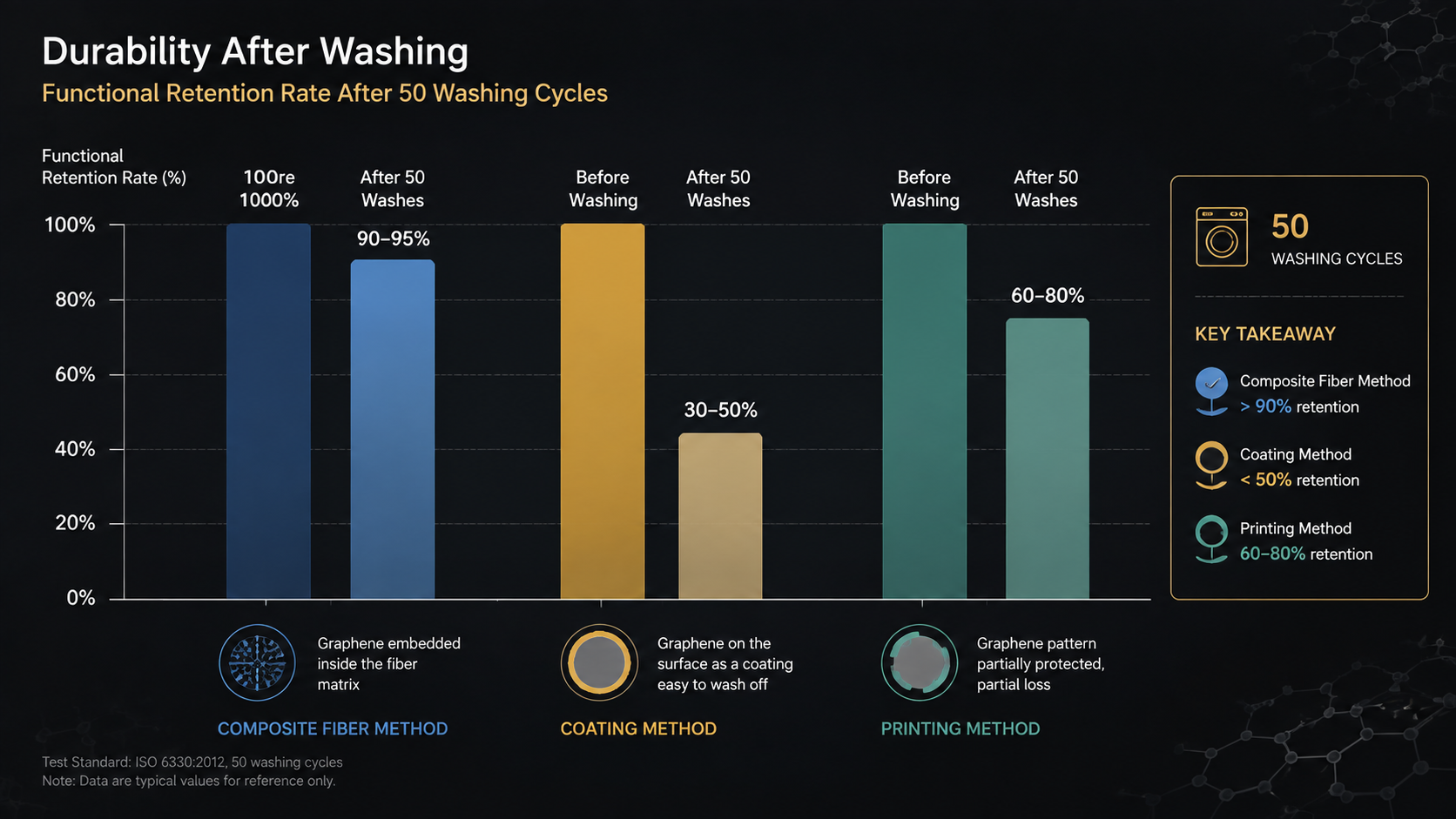
Conclusion: Integration Defines Graphene Fabric Performance
Graphene fabric is not created by adding a graphene label to a textile.
Its performance depends on how graphene is integrated into the material structure.
Whether through graphene composite fibers, graphene coatings, printed graphene functional layers, or graphene heating film garment systems — the integration method determines how the textile or product should be evaluated.
For the future of graphene textiles, the key transition is not from graphene discovery to graphene products.
It is from:
Graphene material → Engineered textile structure → Scalable manufacturing → Real-world application
After understanding how graphene is integrated into textiles, the next question is how the resulting performance should be measured.
Read next: How Is Far Infrared Performance Measured in Graphene Fabric?
Related Articles
- What Is Graphene Fabric?
- How Is Far Infrared Performance Measured in Graphene Fabric?
- Graphene Heated Jacket vs Graphene Fabric
- Graphene-Enhanced Textiles
- Graphene Heating Film
Scientific Disclaimer
This article is intended for material science, textile engineering, and OEM evaluation purposes.
Graphene textile performance varies depending on graphene type, integration method, manufacturing process, textile structure, and testing conditions.
EVIDENCE QUESTIONS
How is graphene integrated into fabric?
Graphene can be integrated into fabric through four main approaches: composite fiber production (graphene embedded inside fibers), surface coating (graphene layer applied to fabric), printed functional layers (graphene ink in controlled patterns), and heating film systems (graphene film integrated into garments with power and control). The first three are material-level integrations; the fourth is a garment-level active system.
What is graphene composite fiber manufacturing?
Graphene composite fiber manufacturing integrates graphene materials into a polymer matrix before fiber spinning. The process involves graphene dispersion, graphene-polymer mixing, fiber formation through melt spinning or similar methods, and conversion into yarn and textile structures. The graphene becomes part of the fiber itself, not a surface additive.
Is graphene heating film the same as graphene fabric?
No. Graphene heating film is an active functional component integrated into garment systems, usually with a battery and controller. It does not modify the fabric fibers themselves. Graphene fabric refers to textiles where graphene is embedded into fibers, coatings, or printed layers to change material properties.
CONTINUE EXPLORING
What Is Graphene Fabric? Next-Generation Textile Technology for Heated Jackets and Outdoor Apparel
Graphene fabric is a functional textile category — not one single material. Learn the engineering difference between passive graphene textiles and active graphene heating-film apparel for heated jackets, wearable eye masks, and OEM wearables, with edge-compensated thermal distribution and emissivity context.
Graphene Fabric Far Infrared Performance: Emissivity and Testing Standards
Graphene fabric far infrared performance is measured through standardized testing. Learn how GB/T 30127 evaluates emissivity (≥0.88), temperature rise (≥1.4°C), and why wavelength (~9.4 μm) matters for textile evaluation.
What Is Far Infrared Graphene? Technology, Emitter Architecture, and Evaluation
Far infrared graphene technology uses a graphene-based emitter to convert electrical input into far infrared radiant output. Learn how it differs from conventional heating elements, how to evaluate emitter architecture, emissivity, radiant efficiency, and supplier evidence.
What Is Far Infrared Graphene? Technology, Emitter Architecture, and Evaluation Articles
Browse all XIHE knowledge articles filed under what is far infrared graphene? technology, emitter architecture, and evaluation.
Partnership
Move from evidence review into OEM, sourcing, and commercial evaluation with XIHE.
Are Heated Eye Masks Safe? What Buyers Should Check First
Are heated eye masks safe? The practical answer depends on temperature control, session duration, face-contact materials, charging design, and whether the product is disposable or reusable.