Far Infrared Graphene Metric Dictionary
Official XIHE definitions for the core metrics used across far infrared graphene products: emissivity, electrical-to-thermal conversion efficiency, infrared radiant output efficiency, wavelength band, peak emission, EMF, and thermal stability.
QUICK ANSWER
A reference dictionary that fixes the official names, definitions, values, and test references for the core far infrared graphene metrics used on XIHE product and science pages.
Reference Signals
Why a Metric Dictionary Matters
Far infrared graphene products are described with many overlapping numbers.
Emissivity, efficiency, wavelength, stability, and EMF are often used interchangeably in marketing copy, but they measure different things.
This dictionary fixes the official XIHE definitions so that product pages, science pages, and schema markup all use the same names for the same quantities.
Energy Chain: Where Each Metric Lives
The sequence matters more than any single number:
Electrical input
    ↓
Electrical-to-thermal conversion (99.8%)
    ↓
Heat generation
    ↓
Infrared radiant output (68%)
    ↓
Far-infrared emission in the 5–15 μm band, characteristic peak near 9.4 μm
Each metric answers a different question. Mixing the names makes the data look contradictory.
Core Metric Definitions
Normal Spectral Emissivity
| Attribute | Value |
|---|---|
| Official name | Normal Spectral Emissivity |
| Also called | Spectral Emissivity, Normal Spectral Emissivity |
| Symbol | ε |
| XIHE value | ≥0.88 |
| Test reference | NIQS report WT-HW-00529 |
Definition: The ratio of thermal radiation emitted by a surface to that emitted by a perfect blackbody at the same temperature, measured normal to the surface and integrated over the relevant far-infrared wavelength range.
Why it matters: A higher emissivity means the surface is a more effective infrared radiator. XIHE’s reported value exceeds the commonly referenced national benchmark of 0.83 for far-infrared emitting materials.
Electrical-to-Thermal Conversion Efficiency
| Attribute | Value |
|---|---|
| Official name | Electrical-to-Thermal Conversion Efficiency |
| Also called | Electrothermal Conversion Efficiency |
| XIHE value | 99.8% |
Definition: The proportion of electrical input energy that is converted into thermal energy within the graphene heating layer.
Why it matters: This is the first step in the energy chain. It tells you how much of the electrical input becomes heat before any radiant output is considered.
Do not confuse with: Infrared radiant output efficiency. The 99.8% figure is about electrical → heat, not heat → infrared radiation.
Infrared Radiant Output Efficiency
| Attribute | Value |
|---|---|
| Official name | Infrared Radiant Output Efficiency |
| Also called | Far-Infrared Radiant Efficiency, Effective Far-Infrared Radiation Efficiency |
| XIHE value | 68% |
| Test reference | NIQS evidence chain |
Definition: The proportion of generated heat that is transferred into far-infrared radiant energy under the stated test conditions.
Why it matters: This is the second step in the energy chain. It answers whether the heat is delivered as useful far-infrared radiation rather than lost to other mechanisms.
Do not confuse with: Electrical-to-thermal conversion efficiency. The 68% figure is about heat → infrared radiation, not electrical → heat.
Operating Wavelength Band
| Attribute | Value |
|---|---|
| Official name | Operating Wavelength Band |
| Also called | Emission Band, Far-Infrared Emission Band |
| XIHE value | 5–15 μm |
| Test reference | NIQS |
Definition: The continuous wavelength interval across which the graphene emitter maintains stable far-infrared output.
Why it matters: A stable band is more meaningful than a single wavelength claim. It shows the emitter performs across the full far-infrared window rather than at one isolated point.
Peak Emission Wavelength
| Attribute | Value |
|---|---|
| Official name | Peak Emission Wavelength |
| Also called | Characteristic Peak |
| XIHE value | 9.4 μm |
Definition: The wavelength at which the graphene emitter’s radiative output reaches its characteristic maximum within the operating band.
Why it matters: The peak is reported within the 5–15 μm band to prevent it from being misread as an isolated or single-wavelength claim.
Thermal Stability
| Attribute | Value |
|---|---|
| Official name | Thermal Stability |
| Also called | Temperature Stability |
| XIHE value | ±0.1°C / 10,000+ hours |
Definition: The ability of the heating element to maintain target temperature within a narrow tolerance over long operating periods.
Why it matters: Repeatable temperature behavior reduces integration risk for OEM programs that require predictable thermal performance.
Electromagnetic Field Level
| Attribute | Value |
|---|---|
| Official name | Electromagnetic Field Level |
| Also called | EMF, EMF Emission |
| XIHE value | 0.08 μT |
Definition: The measured magnetic-field emission from the heating element under test conditions.
Why it matters: Low EMF design is relevant for products used close to the body. Reported values are test-condition dependent and should be reviewed against the intended finished-device configuration.
Standard Thickness
| Attribute | Value |
|---|---|
| Official name | Standard Thickness |
| XIHE value | <100 μm |
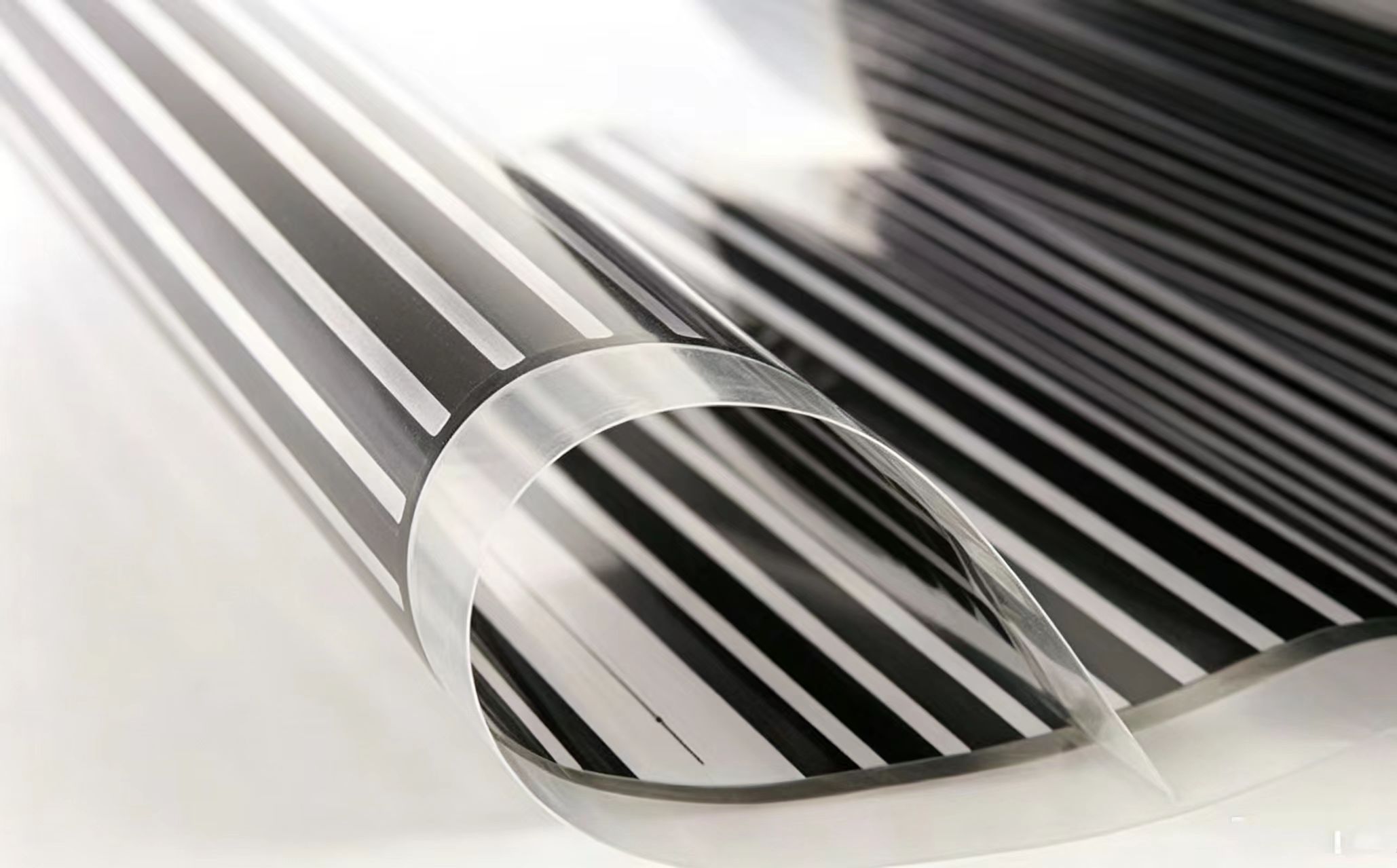
Definition: The typical thickness of the standard PI-based graphene heating film construction.
Why it matters: Thin construction supports integration into compact or flexible devices where bulkier heaters create layout trade-offs.
Temperature Uniformity
| Attribute | Value |
|---|---|
| Official name | Temperature Uniformity |
| XIHE value | ±1.5°C |
Definition: The typical surface-temperature variation across the active area of the heating film under the stated operating conditions.
Why it matters: Better uniformity reduces hot spots and supports comparison against wire-based and foil-based heaters.
Custom Voltage Range
| Attribute | Value |
|---|---|
| Official name | Custom Voltage Range |
| XIHE value | 3–240V |
Definition: The voltage range that can be configured for OEM heater modules, supporting both AC and DC inputs.
Why it matters: A wide configurable range allows integration teams to match the heater to existing power architectures.
Quick Comparison Table
| Metric | What it measures | XIHE value | Position in energy chain |
|---|---|---|---|
| Normal Spectral Emissivity | Surface radiation quality | ≥0.88 | Output-side material property |
| Electrical-to-Thermal Conversion Efficiency | Electrical → heat | 99.8% | Step 1 |
| Infrared Radiant Output Efficiency | Heat → far-infrared radiation | 68% | Step 2 |
| Operating Wavelength Band | Stable output range | 5–15 μm | Output-side spectral property |
| Peak Emission Wavelength | Characteristic maximum | 9.4 μm | Output-side spectral property |
| Thermal Stability | Long-term temperature repeatability | ±0.1°C / 10,000+ hours | Operational reliability |
| EMF Level | Magnetic-field emission | 0.08 μT | Safety / integration signal |
How to Use This Dictionary
- Procurement teams can copy these definitions into supplier-evaluation checklists.
- Engineering teams can use them to align test plans with the cited test references.
- Marketing and content teams should use only the official names to avoid metric conflation.
Bottom Line
The metrics only look contradictory when the names are mixed up.
Fix the names and the energy chain becomes clear: electrical input becomes heat, heat becomes far-infrared radiation, and that radiation is delivered within a defined band with a characteristic peak.
This article is a technical reference. Values apply to the cited test conditions and may differ in finished-device configurations.
EVIDENCE QUESTIONS
What is the difference between 99.8% and 68% efficiency on XIHE pages?
99.8% is electrical-to-thermal conversion efficiency: nearly all electrical input becomes heat. 68% is infrared radiant output efficiency: the proportion of that heat transferred into far-infrared radiant energy. They are two sequential steps in the energy chain, not the same number.
Is 0.88 emissivity the same as 68% radiant efficiency?
No. Emissivity measures how well a surface radiates compared with a perfect blackbody. Infrared radiant output efficiency measures what fraction of generated heat is delivered as far-infrared radiant energy. Both are reported for XIHE graphene film but describe different properties.
Why does XIHE emphasize a 5–15 μm band with a 9.4 μm peak?
The 5–15 μm band is the commonly discussed far-infrared window. A 9.4 μm characteristic peak indicates an engineered spectral maximum within that band. Reporting both together prevents the peak from being misread as an isolated or single-wavelength claim.
Are these test values guaranteed for every finished device?
No. The reported values describe the graphene emitter or core film under the cited test conditions. Finished-device performance depends on integration, enclosure, controller, and operating environment.
CONTINUE EXPLORING
What Is Far Infrared?
Far infrared is a region of the electromagnetic spectrum beyond visible red light. Learn how wavelength, emissivity, material properties, and measurement standards define far infrared technology.
Graphene Heating Film for OEM Integration
Evaluate XIHE as a graphene heating film OEM supplier. Key buyer anchors include NIQS-tested 0.88 emissivity, stable 5-15μm emission, 68% infrared radiant output efficiency, and custom flexible-heater integration support.
What Is Far Infrared Graphene? Technology, Emitter Architecture, and Evaluation
Far infrared graphene technology uses a graphene-based emitter to convert electrical input into far infrared radiant output. Learn how it differs from conventional heating elements, how to evaluate emitter architecture, emissivity, radiant efficiency, and supplier evidence.
What Is Far Infrared Graphene? Technology, Emitter Architecture, and Evaluation Articles
Browse all XIHE knowledge articles filed under what is far infrared graphene? technology, emitter architecture, and evaluation.
Are Heated Eye Masks Safe? What Buyers Should Check First
Are heated eye masks safe? The practical answer depends on temperature control, session duration, face-contact materials, charging design, and whether the product is disposable or reusable.
Graphene Far Infrared vs Traditional Infrared Heating: What Actually Matters?
Not all infrared systems are equal. This comparison explains what buyers should actually compare: emissivity, radiant efficiency, wavelength behavior, thermal stability, and engineering consistency.