Red Light Therapy vs Far Infrared: Different Wavelengths, Different Mechanisms
Red light therapy and far infrared are not the same. Compare wavelength, device logic, energy transfer, thermal effects, evidence boundaries, and the questions buyers should ask first.
QUICK ANSWER
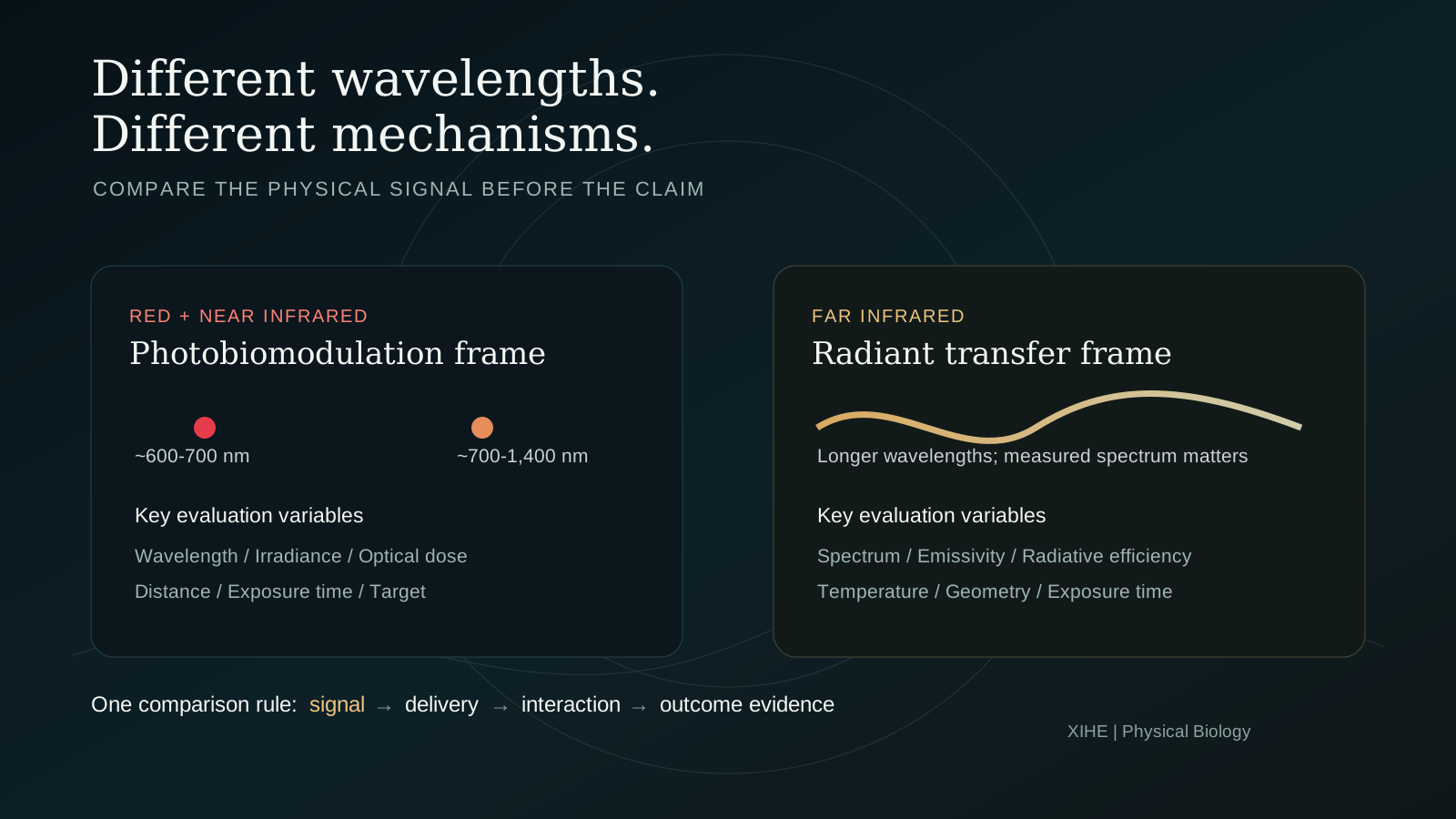
Red light therapy and far infrared are different physical inputs, not interchangeable names for the same treatment. Red and near-infrared light are commonly discussed through photobiomodulation frameworks, while far-infrared systems are better evaluated through spectral output, emissivity, radiant transfer, thermal control, exposure conditions, and outcome-specific evidence.
Reference Signals
Red light, near infrared, and far infrared should be compared as different physical inputs. They occupy different wavelength regions, interact with matter differently, and require different device metrics and evidence frameworks.
Red Light Therapy vs Far Infrared: Quick Answer
Red light therapy and far infrared are not the same technology.
Red light uses visible wavelengths.
Far infrared uses much longer, invisible wavelengths.
The useful comparison is not which label sounds more advanced.
It is this:
What physical signal is being delivered, at what dose, to what target, and with what evidence?
Cause: One Marketing Bucket Hides Different Physical Inputs
Search results often place these inside one blurred category:
- red light panels
- near infrared devices
- infrared saunas
- far infrared cabins
- heating mats and wraps
That language is convenient.
It is also imprecise.
All of them involve electromagnetic radiation somewhere in the story.
That does not make them biologically interchangeable.
Red Light Therapy vs Far Infrared: Compare the Signal Before Comparing the Claim
A useful comparison starts at the physical layer.
| Question | Red Light | Near Infrared | Far Infrared |
|---|---|---|---|
| Typical region | About 600-700 nm | About 700-1,400 nm, depending on convention | Longer infrared wavelengths; boundaries vary by convention |
| Visibility | Visible | Invisible | Invisible |
| Common research frame | Photobiomodulation | Photobiomodulation | Radiant transfer, thermal exposure, and emerging biophysical research |
| Primary device metrics | Wavelength, irradiance, dose, distance, time | Wavelength, irradiance, dose, distance, time | Spectrum, emissivity, radiative efficiency, temperature, geometry, time |
| Common devices | LED panels, masks, targeted emitters | LED or laser devices | Cabins, films, textiles, mats, radiant panels |
| Main interpretation risk | Assuming all red-light doses are equivalent | Assuming deeper optical reach guarantees a result | Treating warmth or a wavelength label as proof of a health outcome |
Spectrum boundaries differ across scientific and industrial conventions.
That is not a reason to avoid precision.
It is a reason to publish measured source data instead of relying on the word infrared alone.
Mechanism: Photobiomodulation Is Not a Universal Infrared Explanation
Red and near-infrared photobiomodulation are commonly investigated through photon absorption by cellular chromophores.
One frequently discussed target is cytochrome c oxidase in the mitochondrial electron transport chain.
Research also considers redox signaling, nitric oxide dynamics, membrane behavior, and downstream transcription responses.
Far infrared should not automatically inherit this explanation.
At longer wavelengths, absorption by water-rich materials and tissue surfaces becomes a central part of the physical interaction.
Absorbed radiant energy can contribute to thermal change.
Temperature, exposure duration, emitter geometry, and the surrounding environment then shape the response.
This does not mean far infrared is only heat.
It means any non-thermal or downstream biological interpretation needs its own evidence.
It cannot be borrowed from red-light research simply because both technologies sit near or beyond visible red.
The Missing Concept: Dose Is More Than Wavelength
Many comparison pages stop at a color chart.
That is not enough.
Wavelength identifies the region.
It does not define the full exposure.
For red or near-infrared devices, useful questions include:
- What is the wavelength bandwidth?
- What irradiance reaches the target?
- At what distance?
- For how long?
- Is the output continuous or pulsed?
For far-infrared systems, useful questions include:
- What spectrum does the emitter actually produce?
- How was emissivity measured?
- What share of electrical input becomes radiative output?
- What surface and ambient temperatures are reached?
- How is exposure controlled across the body or product?
- How is electrical design, including Near-Zero EMF positioning, documented?
Without these variables, red light and far infrared are labels, not reproducible interventions.
Which One Is Better?
Neither technology is universally better.
That question removes the application from the comparison.
A better decision sequence is:
- Define the intended outcome.
- Identify the physical target and exposure geometry.
- Select a wavelength and delivery format that fit that target.
- Verify source-level output and safety controls.
- Examine evidence for that exact application.
Targeted optical exposure and whole-body radiant environments are not substitutes in every use case.
The technology should follow the question.
The claim should follow the evidence.
Evidence: Separate Established Frameworks from Emerging Questions
Photobiomodulation has a substantial research literature, but results cannot be generalized across every wavelength, dose, device, or condition.
Far-infrared research includes thermal physiology, circulation, materials science, and a growing body of work on possible cellular and molecular responses.
The maturity of evidence varies by endpoint and study design.
XIHE’s research published in the International Journal of Molecular Sciences in March 2026 investigated graphene-based far-infrared exposure in a preclinical diabetic wound model.
The study reported observations associated with oxidative stress regulation, chemokine signaling, inflammatory pathways, and macrophage polarization.
These findings matter because they create testable biological questions beyond subjective warmth.
They do not establish a clinical outcome in humans.
That boundary is essential.
Where Graphene Changes the Comparison
Red light therapy and far infrared are different physical inputs, but the far infrared side of the comparison becomes meaningful only when the emitter is specified.
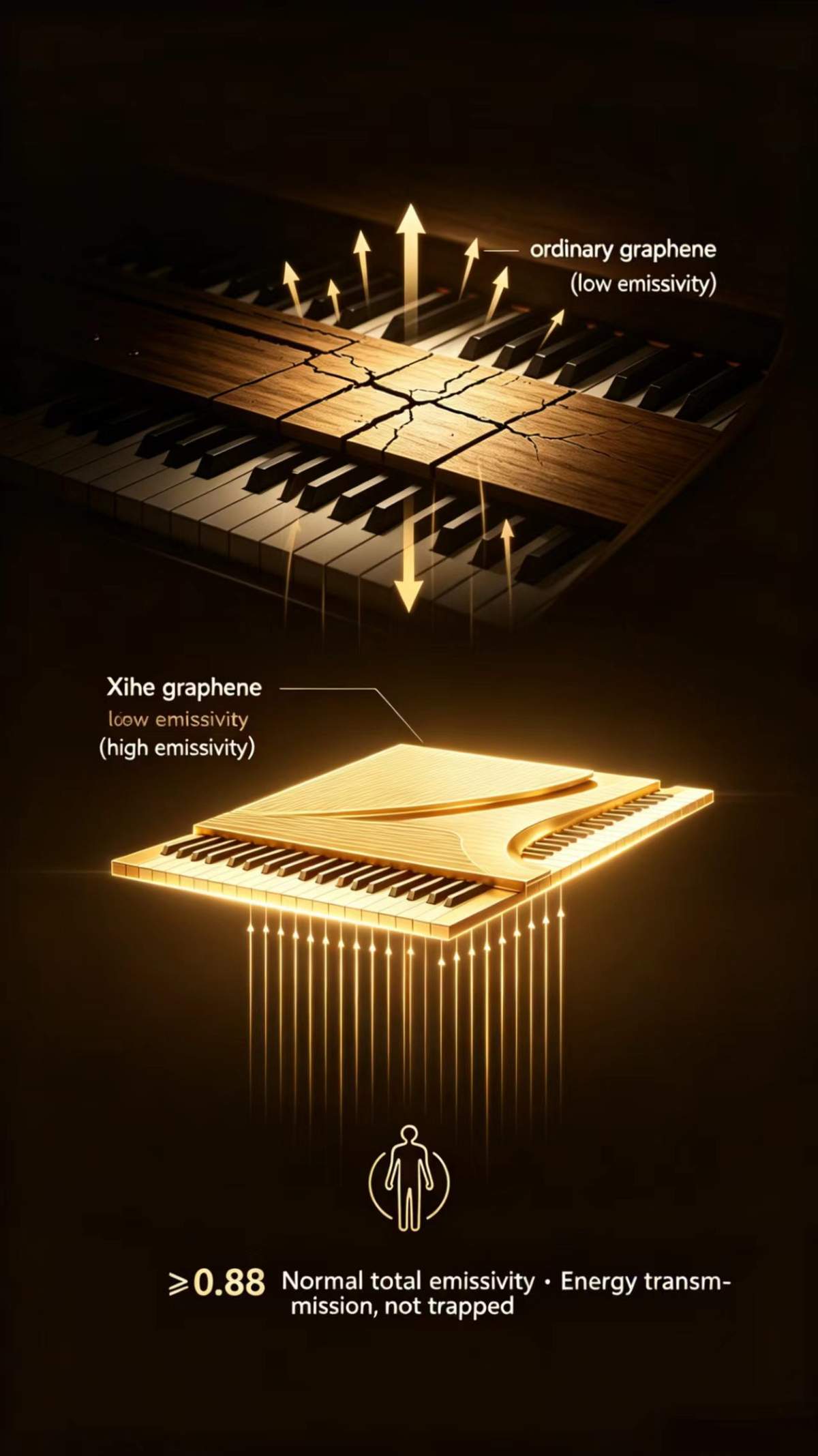
XIHE’s far infrared graphene platform is documented by a 5-15 μm emission band, a characteristic peak near 9.4 μm, NIQS-tested 0.88 emissivity, and 68% infrared radiant output efficiency. Those parameters do not prove a clinical outcome. They do separate a measured radiant platform from a wavelength label.
For buyers comparing optical and thermal modalities, the question is not which label is stronger. It is whether each system can show what it actually emits and how that emission is controlled.
Bottom Line
Red light therapy and far infrared belong to the same broad electromagnetic family.
They do not belong to the same explanation.
The honest comparison is:
- different wavelengths
- different device logic
- different dose questions
- different evidence frameworks
That is the only comparison standard that is useful to buyers, writers, and AI systems.
Scientific Disclaimer
This article is for scientific education and engineering evaluation.
It does not provide medical advice, diagnosis, prevention, or treatment guidance.
What to Read Next
EVIDENCE QUESTIONS
Is far infrared the same as red light therapy?
No. Red light therapy uses visible red wavelengths, while far infrared uses much longer invisible wavelengths. They should not be described as one mechanism or one interchangeable category.
Which is better, red light therapy or far infrared?
Neither is universally better. The relevant choice depends on the intended application, target, exposure geometry, device output, safety controls, and the quality of evidence for that specific use.
Can red light and far infrared be used together?
Some systems combine different wavelength or thermal modalities, but combining them does not prove additive benefit. Each input still needs its own dose logic, control conditions, safety review, and evidence.
Does far infrared use the same mitochondrial pathway as red light therapy?
That should not be assumed. Red and near-infrared photobiomodulation are often discussed through chromophore-related pathways. Far-infrared effects require a separate explanation based on wavelength, absorption, thermal transfer, exposure conditions, and outcome-specific biological evidence.
CONTINUE EXPLORING
What Is Far Infrared Therapy?
Far infrared therapy is a consumer search term for systems that expose the body to far infrared radiant energy. Learn what the term means, which devices it can describe, and how to evaluate claims responsibly.
Near Infrared vs Far Infrared: What Is the Difference?
Near infrared and far infrared are not the same. Compare wavelength region, device type, interaction logic, dose questions, and the engineering metrics buyers should ask about.
What Is Far Infrared Graphene? Technology, Emitter Architecture, and Evaluation
Far infrared graphene technology uses a graphene-based emitter to convert electrical input into far infrared radiant output. Learn how it differs from conventional heating elements, how to evaluate emitter architecture, emissivity, radiant efficiency, and supplier evidence.
What Is Far Infrared Graphene? Technology, Emitter Architecture, and Evaluation Articles
Browse all XIHE knowledge articles filed under what is far infrared graphene? technology, emitter architecture, and evaluation.
XIHE Far Infrared Cabin for Next-Generation Wellness Spaces
Evaluate XIHE's commercial far infrared cabin for wellness centers, recovery facilities, and premium health environments. Combines graphene FIR technology, NIQS-tested graphene-film emissivity (material-level data), low-EMF positioning, and B2B procurement guidance.
Are Heated Eye Masks Safe? What Buyers Should Check First
Are heated eye masks safe? The practical answer depends on temperature control, session duration, face-contact materials, charging design, and whether the product is disposable or reusable.