Why Does Aging Drain Your Energy? The Rising Biological Cost of Daily Life
Aging does not simply remove energy. It can raise the biological cost of everyday work across mitochondria, circulation, sleep, inflammation, and repair, creating a new healthy-aging framework connected to measurable far infrared graphene inputs.

QUICK ANSWER
Aging can feel like an energy problem because the same biological work may require more ATP, oxygen delivery, recovery time, and inflammatory resolution. This article uses Biological Cost as a framework for healthy aging: not age reversal, but understanding how mitochondria, circulation, sleep, repair, and the physical environment influence the cost of daily function. XIHE connects that framework to measurable far infrared graphene engineering without making a longevity or treatment claim.
Reference Signals
Quick Answer
Aging is not a disease. It is the rising cost of biological work.
Aging does not necessarily mean that the body has suddenly run out of energy. It can mean that the body pays more to produce, distribute, and recover from the same amount of daily work.
That higher Biological Cost may appear as:
- more ATP required for the same workload
- less efficient oxygen and nutrient delivery
- longer recovery after physical or cognitive load
- more time needed to resolve inflammatory activity
- less reserve when sleep or circulation is disrupted
This is a systems framework for understanding healthy aging, not a diagnosis or a claim that one intervention reverses aging.

The Core Idea: Biological Cost
Everyday work has a biological cost.
At one stage of life, a walk, a demanding workday, or a poor night’s sleep may consume relatively little reserve. Later, the same event may require more ATP, more oxygen delivery, more repair activity, or more recovery time.
Nothing magical has to happen for the experience to change. The cost of completing the work has increased.
This is why “less energy” is often an incomplete description. The more useful question is:
How much biological work is required to produce the same daily function?
Why the Cost Rises
Mitochondria: the conversion cost
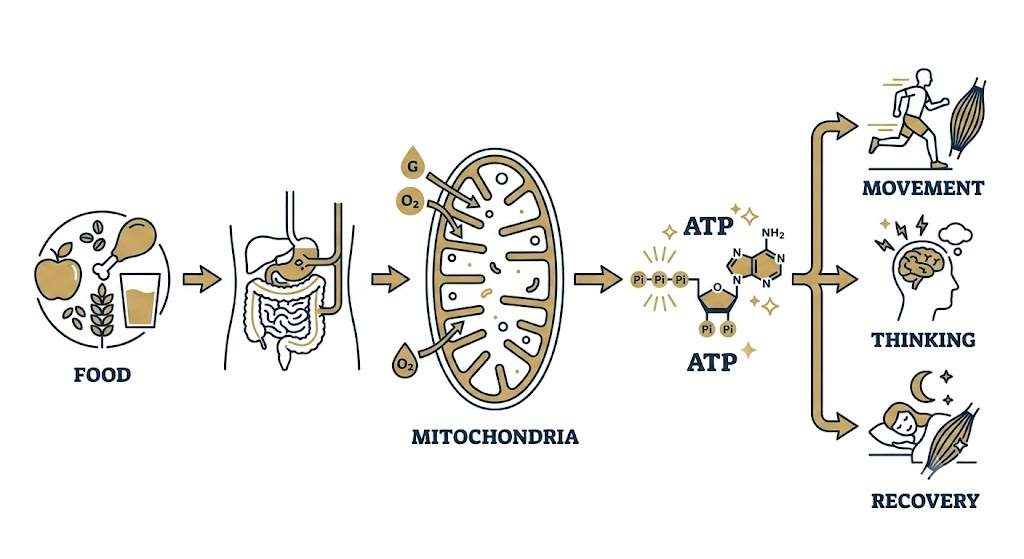
Mitochondria convert nutrients and oxygen into ATP, the usable energy currency of cells. When mitochondrial efficiency becomes less adaptable, the same output may require more input or leave less reserve for the next task.
Read the supporting explanation in What Is Mitochondrial Health?.
Circulation: the delivery cost
Energy is useful only when oxygen, nutrients, heat, and metabolic byproducts can move through tissue. Changes in vascular adaptability and microcirculation can make delivery and clearance more demanding.
See How Does Circulation Affect Recovery? for the delivery layer.
Sleep: the repair budget
Sleep is not just time away from activity. It is a recurring window for neural recalibration, metabolic regulation, and repair. When sleep becomes fragmented, the next day may begin with a larger recovery deficit.
The Sleep Hub examines that recovery window in more detail.
Inflammation: the background expense
Inflammatory signaling is necessary for defense and repair. The problem is not inflammation as a category; the question is how long the system remains activated and how much energy is spent managing unresolved load.
This is why healthy aging must connect energy, recovery, and inflammatory regulation rather than treating them as separate topics.
The Flow of Biological Cost
The framework can be summarized as a flow:
Age-related stressors
-> mitochondrial conversion becomes less adaptable
-> delivery and clearance become more demanding
-> sleep and repair windows become more valuable
-> inflammatory load consumes more reserve
-> the biological cost of ordinary life rises
Healthy Aging Means Reducing Waste, Not Chasing Youth
Healthy aging is not about promising more years or pretending that time can be stopped. A more useful objective is preserving cellular healthspan: keeping energy conversion, distribution, repair, and adaptation as efficient and measurable as possible.
That shifts the question from:
Can the body become young again?
to:
Can the body reduce the biological cost of each day?
Sleep, movement, nutrition, circulation, recovery structure, and clinical care all belong in this conversation. None should be reduced to a single technology.
Where the Physical Environment Enters
Healthy aging is often discussed through biology alone. XIHE approaches it from another angle: every biological system exists inside a physical environment.
That environment includes temperature, light, movement, radiation, sleep conditions, and recovery context. Far infrared graphene belongs to this physical layer.
Its role in the XIHE framework is to make one part of the recovery environment more measurable through engineering parameters such as wavelength, emissivity, radiant conversion, and source control. Those parameters describe the input. They do not by themselves prove longevity, treatment efficacy, or a reduction in biological age.
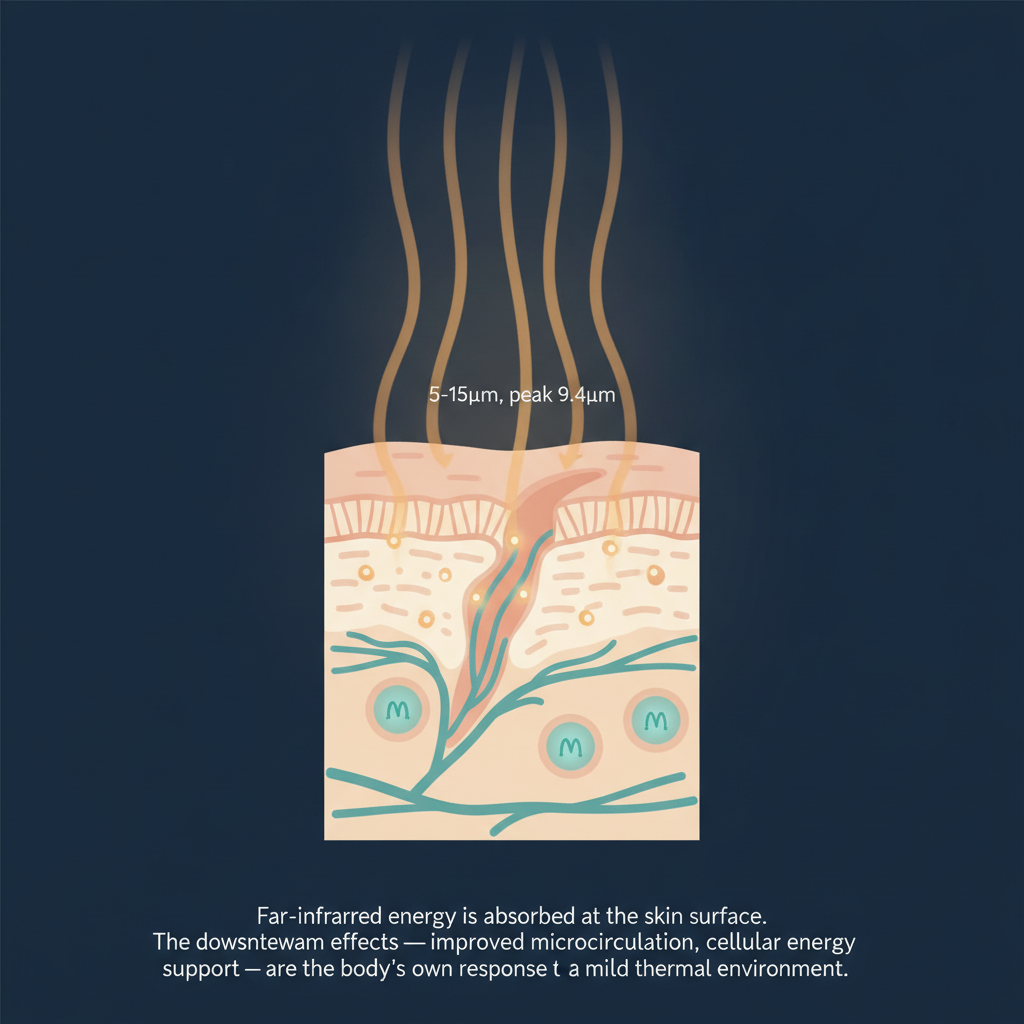
For the engineering platform definition, see the Far Infrared Graphene hub.
The Signature Takeaway
The goal is not to produce more energy at any cost.
The goal is to waste less of the energy already available.
Healthy aging may ultimately be less about slowing the clock, and more about reducing the biological cost of living inside it.
What to Read Next
- Why Is My Recovery Slow?
- What Is Mitochondrial Health?
- How Does Sleep Affect Cellular Recovery?
- How Does Circulation Affect Recovery?
- Healthy Aging Hub
- Far Infrared Graphene Hub
Key Takeaways
- Aging does not simply remove energy; it can raise the biological cost of everyday work.
- Biological Cost connects ATP conversion, circulation, sleep, inflammation, repair, and daily reserve in one framework.
- Healthy aging is better framed as preserving cellular healthspan than promising age reversal.
- Far infrared graphene belongs to the measurable physical environment layer of the discussion.
- Engineering parameters describe the input environment and must remain separate from clinical outcome claims.
EVIDENCE QUESTIONS
Why do I feel less energetic as I get older?
The body may be paying a higher biological cost for the same daily work. Mitochondrial efficiency, oxygen delivery, sleep quality, inflammatory resolution, and repair timing can all influence how much reserve remains after ordinary activity.
What does biological cost mean in healthy aging?
Biological Cost is a useful systems framework, not a clinical diagnosis. It describes the energy, oxygen delivery, recovery time, and repair activity required to complete everyday work. With age, the same task can require more of these resources.
Is aging only about mitochondria?
No. Mitochondria convert energy, but circulation distributes resources, sleep creates a repair window, and inflammatory control affects how much energy remains available for new work.
Can the physical environment change the biological cost of aging?
That is an open physical-biology question. Temperature, light, movement, and other controlled inputs may shape the recovery environment, but each input needs to be measured and studied separately. XIHE treats far infrared graphene as an engineered physical layer, not as an age-reversal claim.
How does XIHE connect this topic to far infrared graphene?
XIHE connects healthy aging to the measurable physical layer of far infrared graphene: wavelength, emissivity, radiant conversion, and source control. Those engineering parameters define the input environment; they do not by themselves establish a clinical or longevity outcome.
CONTINUE EXPLORING
Healthy Aging | Resilience, Recovery, and Long-Term Function
Healthy aging is best understood as maintaining function, adaptability, and daily resilience over time. This hub organizes sleep, movement, recovery, and environment-level support without hype.
What Is Far Infrared Graphene? Technology, Emitter Architecture, and Evaluation
Far infrared graphene technology uses a graphene-based emitter to convert electrical input into far infrared radiant output. Learn how it differs from conventional heating elements, how to evaluate emitter architecture, emissivity, radiant efficiency, and supplier evidence.
Healthy Aging | Resilience, Recovery, and Long-Term Function Articles
Browse all XIHE knowledge articles filed under healthy aging | resilience, recovery, and long-term function.
XIHE Far Infrared Cabin for Next-Generation Wellness Spaces
Evaluate XIHE's commercial far infrared cabin for wellness centers, recovery facilities, and premium health environments. Combines graphene FIR technology, NIQS-tested graphene-film emissivity (material-level data), low-EMF positioning, and B2B procurement guidance.
How Can We Support Healthy Aging?
Healthy aging is best supported by lowering the biological cost of daily life through better sleep, movement, metabolic stability, recovery structure, and a measurable physical environment.
XIHE Far Infrared Graphene Abdominal Wearable
Evaluate the XIHE far infrared graphene abdominal wearable for warm comfort, portability, and everyday use. This page focuses on wearable format, documented emitter performance, near-zero EMF positioning, and buyer comparison rather than medical claims.