How Does Sleep Affect Cellular Recovery?
Sleep is not only rest. It is a regulated recovery period when the body shifts attention toward repair, energy restoration, immune balance, and nervous system recalibration.
QUICK ANSWER
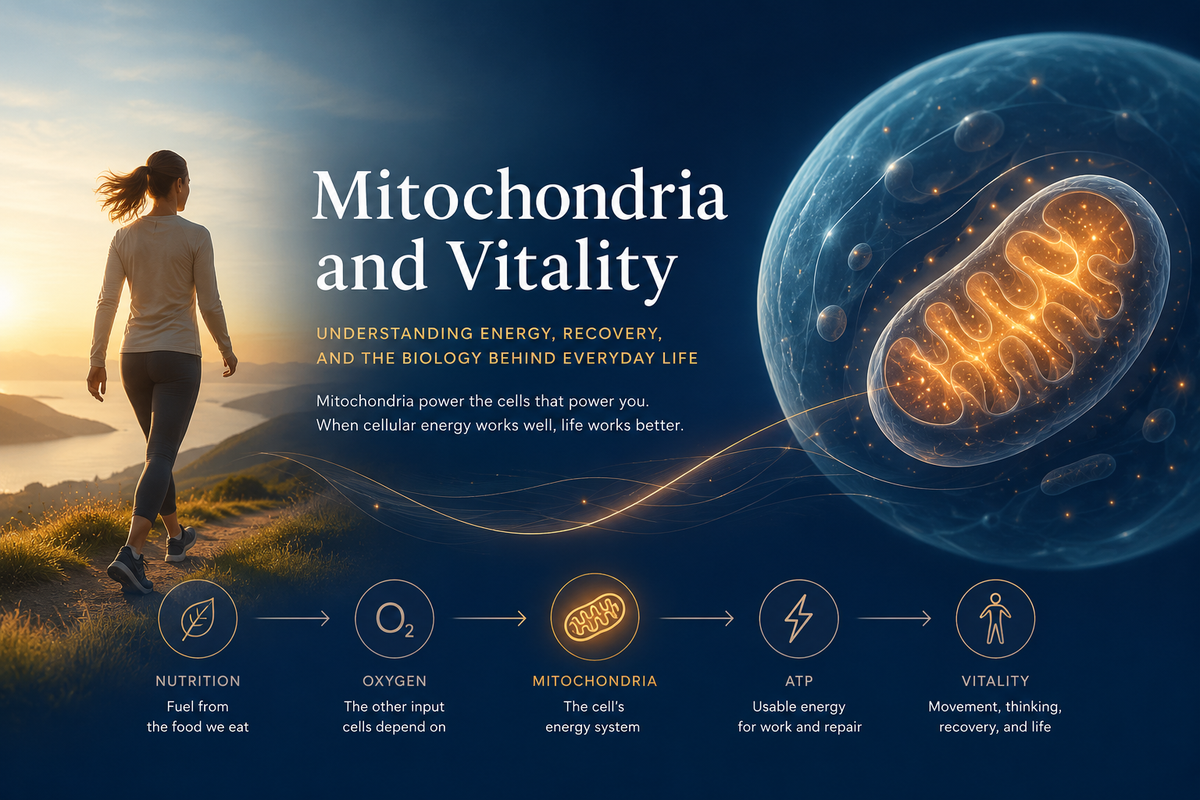
Deep sleep is a primary biological phase for cellular recovery, during which mitochondria shift toward repair functions, ATP reserves are replenished, and metabolic waste clearance is activated.
Reference Signals
Why This Matters
Sleep and recovery are related, but they are not identical.
A person can spend enough time asleep and still wake up feeling unrecovered if the deeper repair stages were shortened, fragmented, or poorly timed. Understanding what each sleep stage contributes helps explain why sleep quality matters as much as sleep quantity.
Deep Sleep: The Physical Repair Window
Deep sleep — particularly slow-wave sleep — is the body’s primary physical restoration period. Growth hormone pulses occur largely during this stage. Protein synthesis, immune renewal, and cellular maintenance become more active.
- ATP energy stores are rebuilt during this window.
- Mitochondrial repair shifts into active mode.
- Metabolic waste accumulated during the day is cleared from tissue.
If deep sleep is repeatedly reduced — by stress, environmental disruption, or poor sleep timing — the body may receive sleep time without the full benefit of sleep-based repair. This is one reason people can technically “sleep enough” but still feel unrefreshed in the morning.
REM Sleep: Neural and Emotional Recalibration
REM sleep supports a different layer of recovery from deep sleep. It is involved in memory consolidation, emotional processing, and nervous system recalibration. Poor REM quality can affect mood, learning, and cognitive stability — distinct from the physical fatigue that comes from shortened deep sleep.
Together, deep sleep and REM sleep form a two-part recovery system: one handles physical restoration, the other handles neural and emotional processing. When either is disrupted, recovery feels incomplete — but the reasons can be quite different.
Body Temperature: The Overlooked Sleep Signal
One often overlooked factor in sleep quality is body temperature. To enter sleep efficiently, core body temperature usually needs to fall. Peripheral blood flow helps the body release heat through the skin.
If that heat-release process is delayed, sleep onset and deep sleep quality may be affected.
This is where microcirculation enters the sleep conversation. Better peripheral circulation may support thermoregulation, which in turn may help the body move into deeper sleep more efficiently. A simple observation: if your hands and feet stay cold for a long time at bedtime, peripheral heat release may not be happening smoothly.
Sleep is not passive downtime. It is one of the body’s most important recovery programs.
Where Far Infrared Fits
This is the layer where far infrared becomes relevant.
XIHE does not position far infrared graphene as proof of better sleep in every context. The more precise question is whether a defined far infrared environment may support some of the physical conditions that help sleep-driven recovery happen more smoothly.
Those conditions may include:
- peripheral warmth before bed
- heat-release support through microcirculation
- reduced sleep-onset friction
- a more repeatable recovery environment for evening use
That is why XIHE keeps sleep content connected to the Far Infrared Graphene Hub: the sleep story is not only about behavior. It is also about the physical environment in which recovery begins.
What to Read Next
- Why Do I Wake Up Tired?
- What Is Mitochondrial Health?
- What Is Microcirculation?
- Far Infrared Graphene Hub
- Neural Resilience Eye Mask
Key Takeaways
- Sleep is an active maintenance window, not passive downtime.
- Deep sleep drives physical repair: ATP rebuilding, mitochondrial repair, and waste clearance.
- REM sleep drives neural and emotional recalibration.
- Body temperature decline is a key sleep-entry signal, supported by peripheral circulation.
- Sleep quality depends on biological timing, circulation, and nervous system regulation.
EVIDENCE QUESTIONS
What happens during deep sleep that supports recovery?
During deep slow-wave sleep, growth hormone pulses trigger protein synthesis and cellular maintenance. ATP stores are rebuilt, metabolic waste is cleared, and mitochondria shift toward repair-oriented states. If deep sleep is repeatedly shortened, the body may get sleep time without receiving the full benefit of sleep-based repair.
How does REM sleep differ from deep sleep in recovery?
REM sleep supports a different layer of recovery: memory consolidation, emotional processing, and nervous system recalibration. Poor REM quality can affect mood, learning, and cognitive stability -- distinct from the physical restoration driven by deep sleep.
How does body temperature affect sleep quality?
To enter sleep efficiently, core body temperature needs to fall. Peripheral blood flow helps the body release heat through the skin via microcirculation. If heat release is delayed, sleep onset and deep sleep quality may be affected. Cold hands and feet at bedtime can be a sign this process is not happening smoothly.
CONTINUE EXPLORING
Sleep | How Far Infrared May Support Restoration, Recovery, and Energy Reset
Sleep is a biological restoration process tied to ATP recovery, circadian rhythm, glymphatic clearance, and metabolic reset. This hub explains where far infrared may support the sleep environment without turning it into a sleep-treatment claim.
What Is Far Infrared Graphene? Technology, Emitter Architecture, and Evaluation
Far infrared graphene technology uses a graphene-based emitter to convert electrical input into far infrared radiant output. Learn how it differs from conventional heating elements, how to evaluate emitter architecture, emissivity, radiant efficiency, and supplier evidence.
Sleep | How Far Infrared May Support Restoration, Recovery, and Energy Reset Articles
Browse all XIHE knowledge articles filed under sleep | how far infrared may support restoration, recovery, and energy reset.
Neural Resilience Eye Mask
Evaluate the XIHE Neural Resilience Eye Mask as a graphene sleep mask for light blocking, gentle warmth, and near-zero EMF overnight comfort. The page focuses on documented emitter performance, design format, and buyer evaluation rather than medical claims.
How Far Infrared May Support Sleep Architecture
Sleep architecture is shaped by timing, nervous-system state, and thermal transition. This article explains where far infrared may matter as an environmental factor and where the limits still are.
Why Can't I Fall Asleep at Night, and Where Far Infrared Fits
Difficulty falling asleep is often a sleep-onset transition problem involving thermoregulation, nervous-system downshifting, and circadian timing. Learn where far infrared fits as a physical-layer support.