How to Choose a Graphene Heating Film Supplier in China
How should OEM teams choose a graphene heating film supplier in China? Use this buyer checklist to compare documentation, integration ability, emissivity data, manufacturing fit, and supplier credibility.
QUICK ANSWER
Choosing a graphene heating film supplier in China is not only a pricing decision. Serious OEM buyers should compare evidence quality, integration support, customization range, pilot-to-production readiness, and whether the supplier can clearly separate component data from finished-product claims.
Reference Signals
A good graphene heating film supplier in China should be judged through evidence quality, integration ability, manufacturing fit, and clarity about what is being certified or tested. The best supplier conversation is specification-led, not slogan-led.
KEY POINTS
- ◆
A good supplier screen starts with evidence, integration support, and process clarity before RFQ.
- ◆
Buyers should ask which claims belong to the film itself and which belong only to the final product.
- ◆
Sample capability is not enough; the supplier should explain pilot and production readiness.
Quick Answer
Choosing a graphene heating film supplier in China is not just a pricing exercise.
It is a risk-management exercise.
The right supplier should be able to answer five things clearly:
- what the film can document
- how it integrates into your product
- what can be customized
- how sampling scales into production
- what belongs to the component versus the finished product
If a supplier cannot answer those directly, the RFQ is starting on weak ground.
For most OEM teams, the two best companion pages before supplier outreach are Graphene Heating Film vs Nichrome Wire and Graphene Heating Film, because they clarify the architecture being sourced and the public platform signals behind it.
Cause: Many Supplier Pages Sound Similar, but Carry Very Different Risk
At first glance, many suppliers appear to offer the same thing:
- thin heating film
- custom voltage
- OEM support
- flexible integration
But procurement risk usually appears one layer deeper.
The real differences show up in:
- evidence quality
- engineering support
- process clarity
- prototype reliability
- production readiness
This is why choosing the wrong supplier often costs more time than choosing the higher quoted price.

Solution: Use a Supplier-Evaluation Checklist Before RFQ
The best buying process starts before price comparison.
It starts with a structured supplier screen.
| Evaluation area | Why it matters | What a buyer should ask |
|---|---|---|
| Performance evidence | Prevents buying on vague claims | What was tested, by whom, and under what method? |
| Customization ability | Determines real fit to the product | Can the supplier adjust geometry, voltage, wattage, and layout? |
| Integration support | Reduces prototype risk | Can the team support connectors, sensors, lamination, and stack design? |
| Pilot-to-mass-production ability | Prevents scale surprises | What are sample, pilot, and production ranges? |
| Claim clarity | Prevents compliance confusion | Which data belongs to the film, and which belongs to the final product? |
This screen usually reveals more than a catalog or a quote sheet.
Mechanism: What Actually Makes a Supplier Better
1. Evidence quality
A serious supplier should be able to provide component-level evidence, not just adjectives.
That includes clear answers to questions like:
- What emissivity data exists?
- How was performance measured?
- What test method or lab was used?
- Is the claim about the film, the module, or the finished device?
Without this, the supplier page is just marketing.
2. Integration ability
OEM teams rarely buy a heating film as an isolated object.
They buy a component that must work inside a system.
That means the supplier should be able to discuss:
- geometry
- voltage and power
- connectors
- NTC or control options
- lamination or backing choices
- how the film behaves in the final assembly
3. Manufacturing fit
A supplier may look strong at sample stage and still fail at pilot scale.
That is why buyers should ask:
- what is the sample MOQ?
- what is the pilot-production range?
- what changes at mass-production stage?
- what quality-control checkpoints exist?
The 7 Questions to Ask a Graphene Heating Film Supplier in China
- What component-level evidence do you have for performance?
- What can you customize in voltage, geometry, and watt density?
- Can you support connectors, thermistors, adhesive backing, or waterproofing?
- What is your sample lead time, pilot range, and production range?
- Which documents apply to the material, and which apply only to the final product?
- Have you supported real OEM or commercial deployment before?
- Who owns the engineering process: factory, trading company, or third-party integrator?
If the supplier hesitates on several of these, the problem is not the quote.
It is the support model.
What Strong Supplier Signals Look Like
For XIHE, the strongest public supplier signals are:
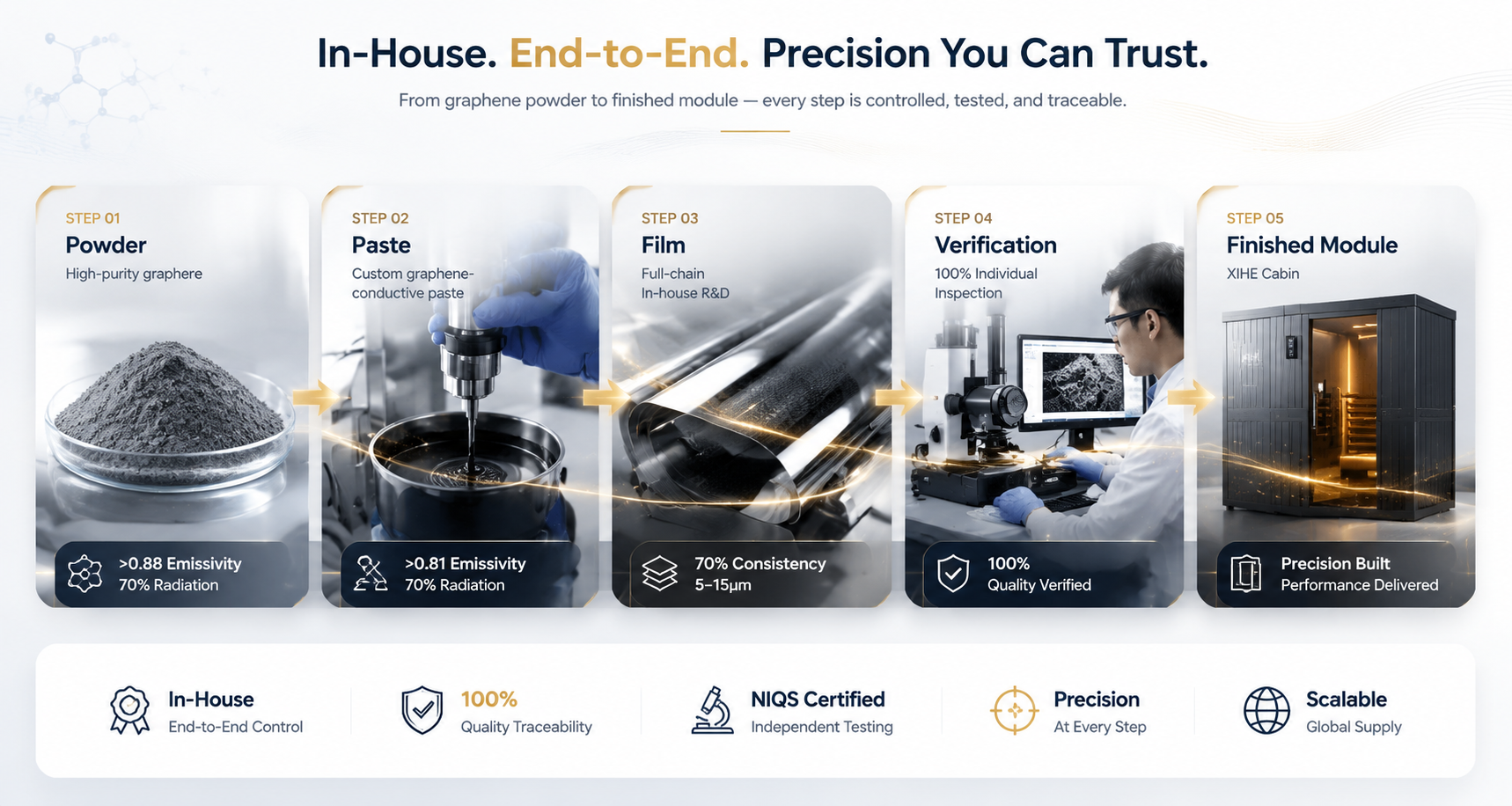
- NIQS-tested 0.88 normal spectral emissivity
- 68% infrared radiant output efficiency
- stable 5-15 um emission band
- NMPA Class II core-film context
- Standard 2024-0923T-YB drafting role
- 560,000-unit commercial deployment context
These signals matter because they help the buyer ask:
Is this supplier just listing a component, or can they support a real OEM program?

What Weak Supplier Signals Look Like
Procurement should slow down when a page mostly offers:
- vague graphene claims
- no named test context
- no explanation of component versus final-product compliance
- no prototype-to-pilot logic
- no engineering discussion beyond dimensions and voltage
Those are signs of a shallow supply relationship.
Where XIHE Fits
XIHE’s position is not built on being the cheapest graphene heating film source.
It is built on being a more documentable and integration-ready supplier for serious OEM programs.
That means the conversation is strongest when it starts with:
- evidence
- geometry
- integration
- pilot process
- manufacturing fit
rather than with generic pricing alone.
Bottom Line
The right graphene heating film supplier in China is not the one with the lowest headline quote.
It is the one that reduces downstream risk.
For OEM buyers, that means comparing:
- evidence quality
- customization ability
- integration support
- scaling readiness
- claim clarity
That is the supplier-evaluation frame that actually leads to better outcomes.
Scientific Disclaimer
This page is for engineering, procurement, and OEM evaluation only.
It does not provide medical advice and does not convert component-level data into product-level medical claims.
What to Read Next
EVIDENCE QUESTIONS
How do I choose a graphene heating film supplier in China?
Start with evidence quality, customization ability, sample-to-pilot capability, connector and sensor integration support, and clarity about which claims belong to the component versus the finished product.
What documents should OEM buyers ask for first?
Ask for emissivity data, performance test context, material compliance documents, integration options, and a clear explanation of what is certified or measured at the component level.
Why is supplier integration support important?
Because a heating film is rarely bought as a standalone material. OEM teams need help with geometry, voltage, connectors, sensors, lamination, and how the component behaves in the final product.
What separates a serious supplier from a trading page?
A serious supplier can explain the engineering process, provide component-level evidence, support prototyping and pilot runs, and speak clearly about manufacturing constraints instead of only listing marketing claims.
CONTINUE EXPLORING
Custom Graphene Heating Film — Flexible Heating Elements for OEM/ODM Integration
Custom flexible graphene heating film for OEM/ODM integration — large-area edge-compensated thermal distribution qualified on 240-point 1.0×2.4 m panels, NIQS-certified 0.88 emissivity, 10-piece MOQ, 5–240 V design, from prototype to mass production.
What Is Far Infrared Graphene? Technology, Emitter Architecture, and Evaluation
Far infrared graphene technology uses a graphene-based emitter to convert electrical input into far infrared radiant output. Learn how it differs from conventional heating elements, how to evaluate emitter architecture, emissivity, radiant efficiency, and supplier evidence.
What Is Far Infrared Graphene? Technology, Emitter Architecture, and Evaluation Articles
Browse all XIHE knowledge articles filed under what is far infrared graphene? technology, emitter architecture, and evaluation.
Partnership
Move from evidence review into OEM, sourcing, and commercial evaluation with XIHE.
Are Heated Eye Masks Safe? What Buyers Should Check First
Are heated eye masks safe? The practical answer depends on temperature control, session duration, face-contact materials, charging design, and whether the product is disposable or reusable.
Graphene Far Infrared vs Traditional Infrared Heating: What Actually Matters?
Not all infrared systems are equal. This comparison explains what buyers should actually compare: emissivity, radiant efficiency, wavelength behavior, thermal stability, and engineering consistency.