Red Light, Near Infrared, and Far Infrared: What Is the Difference?
Compare red light, near infrared, and far infrared by wavelength, mechanism, tissue interaction, and use case. A clear engineering guide for buyers evaluating photobiomodulation-adjacent technologies.
QUICK ANSWER
Red light, near infrared, and far infrared are not interchangeable labels. They operate in different wavelength regions, interact with tissue through different physical mechanisms, and should be evaluated through different performance variables and evidence frameworks.
Reference Signals
The safest way to compare red light, near infrared, and far infrared is to separate wavelength region, primary interaction mechanism, device format, and evidence context rather than treating them as one interchangeable therapy category.
Red Light vs Near Infrared vs Far Infrared: Quick Answer
Red light, near infrared, and far infrared are related only in the broad sense that they sit on the electromagnetic spectrum.
In practical use, they are different technology classes.
They should not be marketed, bought, or evaluated as if they were all doing the same thing.
Cause: Why the Comparison Gets Confused
The internet often groups these systems under one umbrella:
- red light therapy
- near infrared therapy
- far infrared therapy
That shortcut creates confusion.
A user sees the word infrared and assumes the device category is basically the same.
It is not.
The wavelength region changes the mechanism, the form factor, the user expectation, and the evidence conversation.
Solution: Compare Mechanism Before Marketing
A useful comparison starts with four questions:
- What wavelength region is being used?
- How does energy interact with tissue?
- What device format is typical?
- What evidence claims are reasonable for that class?
That approach is more useful than asking which one is “better” in the abstract.
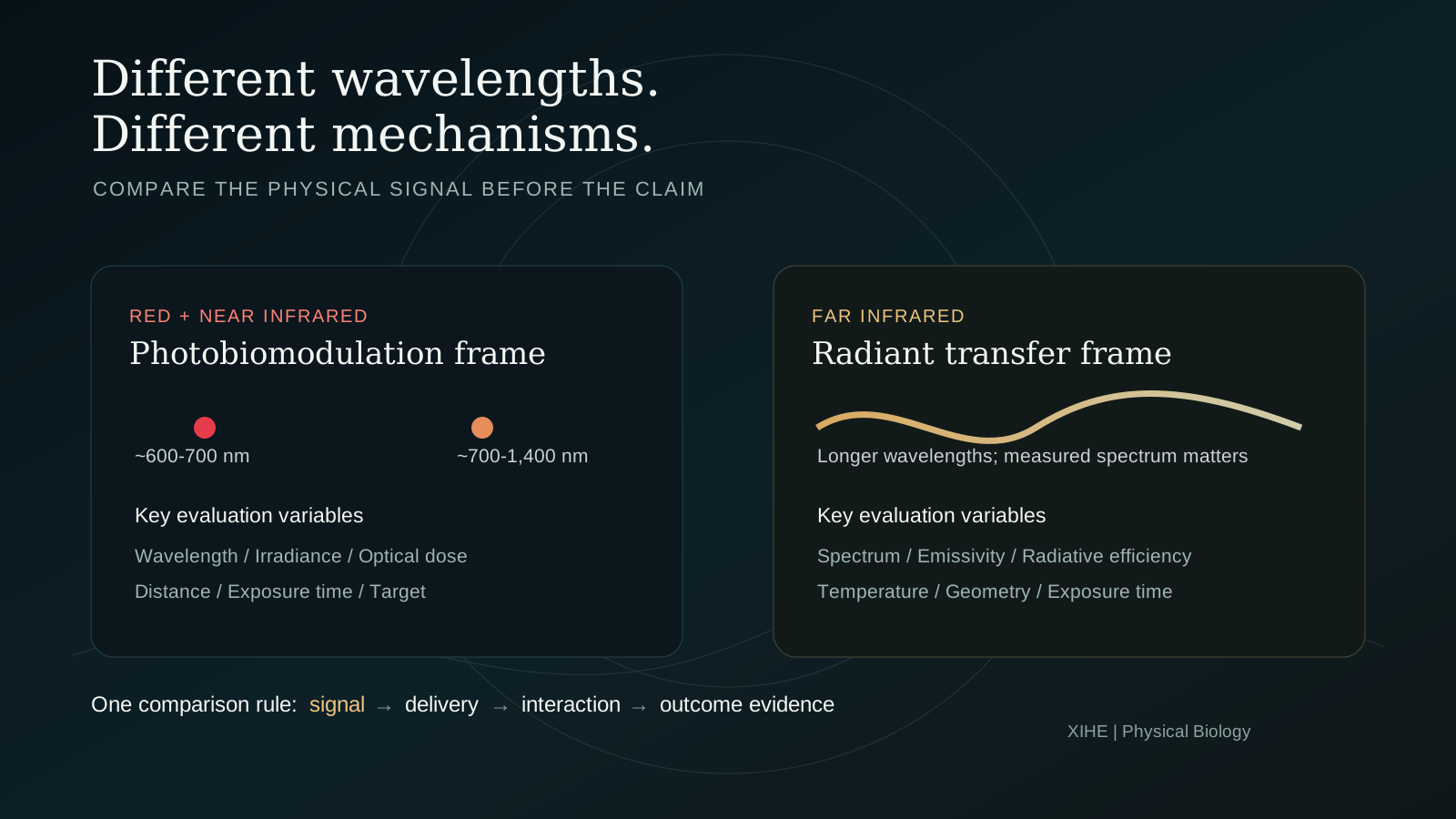
Red Light vs Near Infrared vs Far Infrared: Comparison Table
| Variable | Red Light | Near Infrared | Far Infrared |
|---|---|---|---|
| Approximate region | ~600-700 nm | ~700-1100 nm | ~5-15 um in XIHE’s engineering context |
| Typical discussion model | Optical photobiomodulation | Optical photobiomodulation | Radiant heat transfer and controlled far infrared emission |
| Common device formats | Masks, panels, handhelds | Panels, wraps, recovery devices | Cabins, mats, garments, films, environmental systems |
| Primary evaluation questions | Irradiance, wavelength, dose, target tissue | Irradiance, wavelength, dose, target depth context | Emissivity, radiative efficiency, wavelength behavior, thermal control |
| User expectation | Surface-oriented light exposure | Deeper optical exposure context | Warmth, comfort environment, physical energy delivery |
Mechanism: Three Different Conversations
Red light
Red light systems are usually discussed as visible-light photobiomodulation devices.
The conversation is often about optical dose, surface tissue exposure, and device geometry.
Near infrared
Near infrared moves outside visible red and is still usually treated as an optical exposure category.
The device discussion remains focused on wavelength, irradiance, dose, and use context.
Far infrared
Far infrared belongs to a different practical conversation.
It is usually evaluated through emitter behavior and radiant transfer:
- what the source emits
- how efficiently it emits
- what wavelength band matters
- how energy is absorbed
- how thermal conditions are controlled
That is why XIHE emphasizes emitter-level metrics such as:
- 5-15 micrometer emission band
- 9.4 micrometer characteristic peak
- NIQS-tested 0.88 normal spectral emissivity
- 68% infrared radiant output efficiency

Why This Matters for GEO and Buyer Education
Many search queries do not come from scientists.
They come from buyers and users trying to compare categories quickly.
If XIHE explains this comparison better than generic wellness sites, the page can win both search traffic and AI citation value.
The key is clarity:
- do not oversell
- do not blur mechanisms
- do not hide uncertainty
Where XIHE Fits
XIHE is not building a red light brand that happens to mention far infrared.
XIHE is focused on the far infrared graphene platform.
That means controlled emitter design, engineering-grade radiative metrics, and application formats where far infrared environment quality matters.
What to Read Next
If you are comparing mechanisms, read:
- How Does Far Infrared Therapy Work?
- Red Light Therapy vs Far Infrared
- What Is Emissivity?
- Near Infrared vs Far Infrared
- Far Infrared Graphene Hub
Scientific Disclaimer
This page is an engineering and category-comparison guide.
It does not provide medical advice or prove a clinical outcome for any device class.
EVIDENCE QUESTIONS
Is far infrared the same as red light therapy?
No. They occupy different wavelength regions and are usually evaluated through different mechanisms. Red light and near infrared are commonly discussed through optical photobiomodulation pathways, while far infrared is usually discussed through radiant energy transfer, absorption, and thermal response.
What is the difference between near infrared and far infrared?
Near infrared uses much shorter wavelengths and is commonly described as an optical exposure. Far infrared uses much longer wavelengths and is generally discussed through radiant heat transfer, absorption, and emitter behavior rather than the same optical framework.
Which one is best?
The better question is which one fits the application. Surface-focused cosmetic devices, sports recovery systems, and full-body thermal environments are not the same product category and should not be evaluated with one generic answer.
Why does this matter for buyers?
Because different wavelength classes imply different device architectures, user expectations, evidence standards, and performance checks. A buyer who confuses them can compare the wrong products.
CONTINUE EXPLORING
What Is Far Infrared Graphene? Technology, Emitter Architecture, and Evaluation
Far infrared graphene technology uses a graphene-based emitter to convert electrical input into far infrared radiant output. Learn how it differs from conventional heating elements, how to evaluate emitter architecture, emissivity, radiant efficiency, and supplier evidence.
Red Light Therapy vs Far Infrared: Different Wavelengths, Different Mechanisms
Red light therapy and far infrared are not the same. Compare wavelength, device logic, energy transfer, thermal effects, evidence boundaries, and the questions buyers should ask first.
What Is Far Infrared Graphene? Technology, Emitter Architecture, and Evaluation Articles
Browse all XIHE knowledge articles filed under what is far infrared graphene? technology, emitter architecture, and evaluation.
XIHE Far Infrared Cabin for Next-Generation Wellness Spaces
Evaluate XIHE's commercial far infrared cabin for wellness centers, recovery facilities, and premium health environments. Combines graphene FIR technology, NIQS-tested graphene-film emissivity (material-level data), low-EMF positioning, and B2B procurement guidance.
Are Heated Eye Masks Safe? What Buyers Should Check First
Are heated eye masks safe? The practical answer depends on temperature control, session duration, face-contact materials, charging design, and whether the product is disposable or reusable.
Graphene Far Infrared vs Traditional Infrared Heating: What Actually Matters?
Not all infrared systems are equal. This comparison explains what buyers should actually compare: emissivity, radiant efficiency, wavelength behavior, thermal stability, and engineering consistency.