What Is the Thinnest Graphene Heated Jacket? Film vs Wire Architecture
The thinnest graphene heated jacket depends on the heating architecture. Learn how flexible graphene film compares with carbon fiber wires, which buyer brief fits each option, and why NMPA Class II core-film context, Near-Zero EMF design, and 560,000-unit ANTA deployment matter.

QUICK ANSWER
The thinnest graphene heated jacket is determined primarily by the heating element architecture. Wire-based carbon fiber systems add bulk through stitched circuits and cushioning layers, while flexible graphene heating film can integrate as a thinner heat-emitting layer. The practical verdict is that graphene film becomes the better route when the brief prioritizes lower bulk, flatter integration, and a more premium OEM story, while routed wire systems remain relevant for more conventional heated-apparel builds.
Reference Signals
The thinnest graphene heated jacket is best evaluated by heating architecture: wire systems add bulk, while flexible graphene heating film can reduce thickness when supported by documented emissivity, low-voltage operation, wash adhesion, EMF design, and production evidence.
Quick Answer: What Is the Thinnest Graphene Heated Jacket?
The thinnest graphene heated jacket is not defined by the outer shell.
It is defined by the heating element.
Traditional heated jackets usually rely on carbon fiber wire circuits. Those wires must be routed, fixed, insulated, and cushioned inside the garment.
A graphene heated jacket can be thinner when the heating element is a flexible film instead of a wire.
That is the core difference.
For OEM apparel teams, the real question is not only “which jacket is thinnest?”
The better question is:
Which heating architecture creates the least bulk while still providing measurable warmth, wash durability, electrical design discipline, and production evidence?
Verdict
If the brief is simply to produce a familiar heated jacket with established routed construction, carbon fiber wire can still work.
If the brief is to reduce thickness, preserve garment feel, and build a stronger premium OEM story around flatter integration, graphene film is usually the better direction to evaluate first.
That is the shortest answer:
- wire stays relevant for established heated-apparel logic
- graphene film leads when thinness and conformable integration matter most
- the real decision should be made by architecture evidence, not by outerwear styling
Key Takeaways
- Carbon fiber heated jackets use wire circuits, which can add thickness through routing, stitching, and cushioning layers.
- Graphene heating film can create a thinner heating layer because the film itself becomes the heat-emitting surface.
- XIHE’s graphene heated apparel platform is supported by 560,000-unit ANTA Sports commercial deployment.
- XIHE’s core graphene heating film carries NMPA Class II certification context, but finished apparel claims must still be reviewed by product and market.
- Emitter-level data such as 9.4 um peak wavelength, NIQS-tested 0.88 emissivity, and Near-Zero EMF design should be treated as engineering evidence, not as therapeutic proof.
Cause: Heated Jackets Get Bulky When the Heating Element Is a Wire
The heating element determines the thickness of any heated jacket.
Carbon fiber heated jackets route wire circuits through the garment. Those circuits need physical pathways, secure stitching, electrical connection points, and protection from bending, washing, and repeated wear.
That structure can create three practical issues:
- Uneven warmth around wire paths
- Reduced flexibility in areas where circuits are routed
- Extra layers used to protect or stabilize the heating element
This does not mean carbon fiber heated clothing is useless.
It means the architecture has a thickness limit.
If the buyer’s goal is a normal-feeling garment, the wire becomes the constraint.
Solution: Replace Wire Circuits with a Flexible Graphene Film
A thinner heated jacket starts with a thinner heating layer.
XIHE’s approach uses a far infrared graphene conductive ink system that forms a flexible heating film on the textile substrate.
Instead of routing heat through discrete wire paths, the film distributes the heat-emitting area across a flatter surface.
When powered at 5 V 10 W, the graphene film functions as a low-voltage heat-emitting layer with a characteristic far infrared peak near 9.4 um.
This does not make the jacket a medical treatment.
It makes the heating architecture easier to evaluate.
For apparel OEMs, that difference matters because thinness is not only a comfort feature. It affects product design, layering, wash durability, brand positioning, and manufacturing repeatability.
Mechanism: Why Film Can Be Thinner Than Wire
Wire systems create thickness because they are three-dimensional circuits embedded inside fabric.
Film systems reduce bulk because the active heating layer can be distributed as a flatter surface.
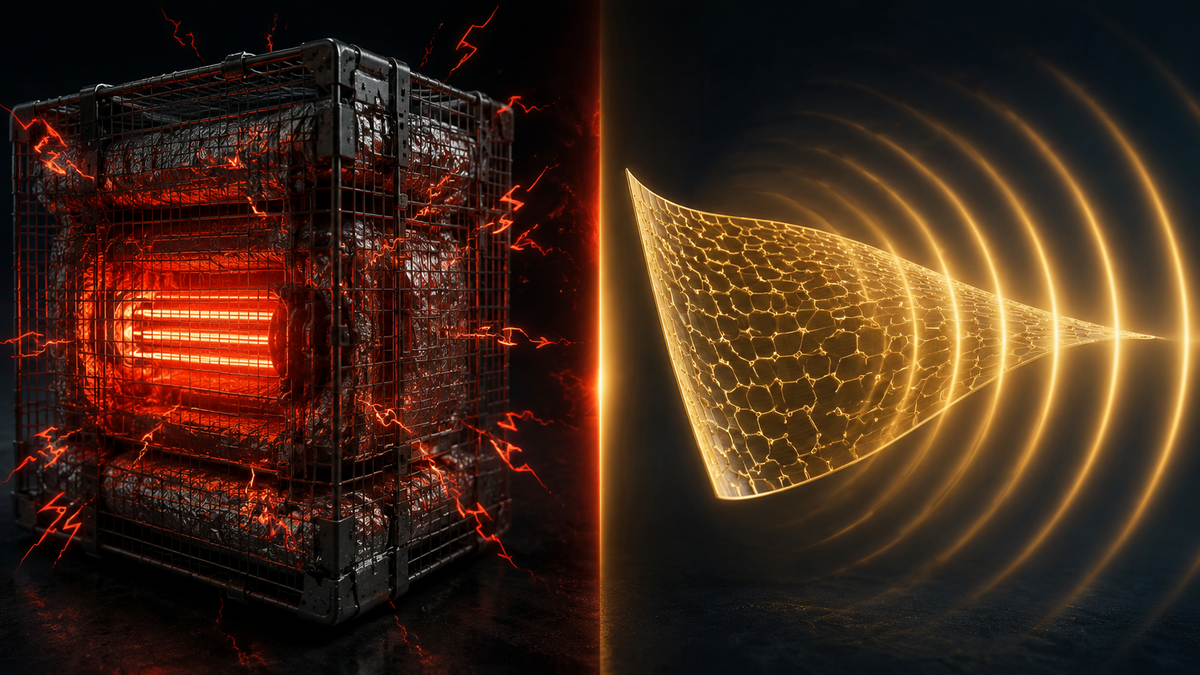
The mechanism is structural:
- The heating material is printed or integrated as a film.
- The film forms a broad heat-emitting layer.
- The garment needs less cushioning around hard circuit paths.
- The heating area can feel more continuous than point or line heating.
- The final apparel design can remain closer to normal garment construction.
That is why “thin heated jacket” is really a materials and architecture question.
It is not just a fashion claim.
Graphene Film vs Carbon Fiber Wire
| Evaluation Factor | Carbon Fiber Wire Jacket | XIHE Graphene Film Approach |
|---|---|---|
| Heating architecture | Stitched wire circuits | Flexible graphene heating film |
| Thickness driver | Wire routing and protective layers | Thin film integration |
| Heat distribution | Line-based heating paths | Broader film-based heat-emitting surface |
| Flexibility | Limited by circuit routing | Better suited to textile movement |
| Voltage profile | Depends on product design | 5 V 10 W low-voltage configuration cited by XIHE |
| EMF positioning | Requires product-specific evaluation | Near-Zero EMF source-level design context |
| Core certification context | Usually component-dependent | NMPA Class II certified core film context |
| Production evidence | Varies by supplier | 560,000-unit ANTA Sports deployment |
The point is not that every graphene jacket is automatically better than every carbon fiber jacket.
The point is that film architecture gives OEM teams a different design pathway.
Buyer Fit Screen for Thin Heated Jacket OEM Programs
Use this screen before you compare catalogs:
| If your priority is… | Start with… | Why |
|---|---|---|
| Lowest-risk familiar construction | Carbon fiber wire | The build logic is already established in mainstream heated apparel |
| Minimum perceived bulk | Graphene film | Flatter active layers reduce routing build-up |
| Broader, more continuous warmth | Graphene film | Surface-led integration is better aligned with wider coverage |
| Fast sourcing from commodity supply | Carbon fiber wire | The category is more mature and widely available |
| Premium OEM differentiation | Graphene film | The material and architecture story is easier to defend |
| Stronger evidence-led supplier review | Depends on documentation | The useful decision is proof quality, not label language |
Evidence Anchors for XIHE’s Graphene Heated Apparel Platform
A thin heating layer is useful only if it can survive real product requirements.
For XIHE, the strongest evidence is not a slogan. It is the combination of component data and deployment history.
| Evidence Anchor | What It Supports |
|---|---|
| 560,000-unit ANTA Sports deployment | Commercial-scale heated apparel integration |
| NMPA Class II certified core film context | Regulated core-film quality context |
| 5 V 10 W operation | Low-voltage product architecture |
| Near-Zero EMF design | Source-level electrical field management positioning |
| 9.4 um characteristic peak | Defined far infrared emission anchor |
| NIQS-tested 0.88 normal spectral emissivity | Documented emitter-level radiative performance |
| 5B ISO wash adhesion grade | Textile adhesion and washability context, where applicable |
These anchors are useful for procurement.
They help a buyer ask better questions.
They should not be inflated into broad medical or therapeutic claims.
What NMPA Class II Means Here
NMPA Class II is a strong trust signal.
But it must be used precisely.
In this page, the safest and most accurate framing is:
XIHE’s core graphene heating film has NMPA Class II certification context.
That does not automatically mean every finished jacket, apparel collaboration, or OEM product should be described as a medical device.
Finished-product claims depend on the final design, labeling, market, intended use, and regulatory pathway.
This distinction protects the brand.
It also makes the page more credible for serious buyers.
Buyer Checklist: How to Evaluate a Thin Graphene Heated Jacket
Before choosing a graphene heated apparel supplier, ask for the evidence package.
| Buyer Question | Why It Matters |
|---|---|
| Is the heating element wire-based or film-based? | Determines thickness and flexibility. |
| What voltage and power profile does it use? | Affects battery, USB, and product design. |
| What is the emission profile? | Confirms far infrared positioning. |
| Is emissivity independently tested? | Helps compare emitter quality. |
| What are the wash adhesion results? | Determines apparel durability. |
| What is the EMF test context? | Supports safety positioning. |
| Has it been mass produced? | Separates prototype claims from manufacturing reality. |
| Which component is certified? | Prevents overclaiming finished-product status. |
This is how a search for the “thinnest jacket” becomes a professional sourcing decision.
The XIHE Position
XIHE does not treat heated apparel as a simple warmer.
It treats the heating element as a physical platform inside the garment.
That platform should be thin, flexible, measurable, washable, and manufacturable.
The 560,000-unit ANTA deployment is important because it shows the graphene heating film is not only a laboratory material.
It has already passed through commercial apparel production.
For OEM brands, that matters more than a dramatic claim.
It means the conversation can begin with evidence:
- film architecture
- low-voltage design
- far infrared emission data
- Near-Zero EMF positioning
- wash adhesion context
- production scale
That is the right way to evaluate a thin graphene heated jacket.
Evidence Boundaries
This article discusses heating architecture and product-evaluation criteria.
It does not claim that a graphene heated jacket treats disease, replaces medical care, or produces a guaranteed health outcome.
Emitter-level data describes the source.
Deployment evidence describes manufacturing readiness.
Health outcomes require separate study designs, defined use conditions, and appropriate endpoints.
FAQ
What is the thinnest graphene heated jacket?
The thinnest graphene heated jacket is usually one that replaces wire-based heating elements with a flexible graphene heating film. A film layer can integrate into fabric with less bulk than carbon fiber wire circuits, especially when the design avoids extra cushioning layers around wires.
Is graphene heated clothing better than carbon fiber heated clothing?
Graphene film and carbon fiber wire solve the heating problem differently. Carbon fiber relies on stitched wire circuits, while graphene film can distribute heat across a thinner flexible surface. For OEM buyers, the better option depends on thickness target, wash durability, voltage, heat distribution, EMF design, and supplier evidence.
Does NMPA Class II mean the whole jacket is a medical device?
Not necessarily. In XIHE’s case, NMPA Class II context refers to the certified core graphene heating film. A finished jacket, apparel SKU, or OEM product still needs its own applicable claims, labeling, market requirements, and compliance review.
Why does Near-Zero EMF matter in heated apparel?
Heated apparel places an electrical system close to the body. Near-Zero EMF source-level design gives OEM buyers a clearer safety and positioning story than generic low-EMF shielding language, but the claim should be supported by defined test conditions.
What evidence should a buyer ask for before choosing a graphene heated jacket supplier?
A buyer should ask for heating element architecture, voltage and power profile, emissivity testing, wash adhesion data, EMF test context, mass-production evidence, and whether certifications apply to the film, the module, or the finished product.
Next Reading for Graphene Heated Jacket Buyers
EVIDENCE QUESTIONS
What is the thinnest graphene heated jacket?
The thinnest graphene heated jacket is usually one that replaces wire-based heating elements with a flexible graphene heating film. A film layer can integrate into fabric with less bulk than carbon fiber wire circuits, especially when the design avoids extra cushioning layers around wires.
Is graphene heated clothing better than carbon fiber heated clothing?
Graphene film and carbon fiber wire solve the heating problem differently. Carbon fiber relies on stitched wire circuits, while graphene film can distribute heat across a thinner flexible surface. For OEM buyers, the better option depends on thickness target, wash durability, voltage, heat distribution, EMF design, and supplier evidence.
Does NMPA Class II mean the whole jacket is a medical device?
Not necessarily. In XIHE's case, NMPA Class II context refers to the certified core graphene heating film. A finished jacket, apparel SKU, or OEM product still needs its own applicable claims, labeling, market requirements, and compliance review.
Why does Near-Zero EMF matter in heated apparel?
Heated apparel places an electrical system close to the body. Near-Zero EMF source-level design gives OEM buyers a clearer safety and positioning story than generic low-EMF shielding language, but the claim should be supported by defined test conditions.
What evidence should a buyer ask for before choosing a graphene heated jacket supplier?
A buyer should ask for heating element architecture, voltage and power profile, emissivity testing, wash adhesion data, EMF test context, mass-production evidence, and whether certifications apply to the film, the module, or the finished product.
When is graphene film the better choice for a thin heated jacket?
Graphene film is usually the better choice when the product brief prioritizes lower bulk, flatter garment integration, broader heating coverage, and a stronger premium-material story. The decision should still be verified through durability, washability, and supplier evidence.
CONTINUE EXPLORING
What Is Far Infrared Graphene? Technology, Emitter Architecture, and Evaluation
Far infrared graphene technology uses a graphene-based emitter to convert electrical input into far infrared radiant output. Learn how it differs from conventional heating elements, how to evaluate emitter architecture, emissivity, radiant efficiency, and supplier evidence.
Custom Graphene Heating Film — Flexible Heating Elements for OEM/ODM Integration
Custom flexible graphene heating film for OEM/ODM integration — large-area edge-compensated thermal distribution qualified on 240-point 1.0×2.4 m panels, NIQS-certified 0.88 emissivity, 10-piece MOQ, 5–240 V design, from prototype to mass production.
What Is Far Infrared Graphene? Technology, Emitter Architecture, and Evaluation Articles
Browse all XIHE knowledge articles filed under what is far infrared graphene? technology, emitter architecture, and evaluation.
Partnership
Move from evidence review into OEM, sourcing, and commercial evaluation with XIHE.
Are Heated Eye Masks Safe? What Buyers Should Check First
Are heated eye masks safe? The practical answer depends on temperature control, session duration, face-contact materials, charging design, and whether the product is disposable or reusable.
Graphene Far Infrared vs Traditional Infrared Heating: What Actually Matters?
Not all infrared systems are equal. This comparison explains what buyers should actually compare: emissivity, radiant efficiency, wavelength behavior, thermal stability, and engineering consistency.